Advertisements
Chapters
1: Solid State
2: Solutions
3: Electrochemistry
4: Chemical Kinetics
5: Surface Chemistry
Inorganic Chemistry
6: General Principles and Processes of Isolation of Elements
7: p-Block Elements
8: d-and ƒ-Block Elements
9: Coordination Compounds
Organic Chemistry
10: Haloalkanes and Haloarenes
Chapter 11: Alcohols, Phenols and Ethers
Chapter 12: Aldehydes, Ketones and Carboxylic Acids
Chapter 13: Organic Compounds containing Nitrogen
Chapter 14: Biomolecules
▶ 15: Polymers
Chapter 16: Chemistry in Everyday Life
![Nootan solutions for केमिस्ट्रि [इंग्रजी] इयत्ता १२ आयएससी chapter 15 - Polymers - Shaalaa.com](/images/chemistry-english-class-12-isc_6:a6407550bf9a46188b122e0d354548f8.png "Nootan solutions for केमिस्ट्रि [इंग्रजी] इयत्ता १२ आयएससी chapter 15 - Polymers")
Advertisements
Solutions for Chapter 15: Polymers
Below listed, you can find solutions for Chapter 15 of CISCE Nootan for केमिस्ट्रि [इंग्रजी] इयत्ता १२ आयएससी.
Nootan solutions for केमिस्ट्रि [इंग्रजी] इयत्ता १२ आयएससी 15 Polymers REVIEW exercises [Pages 1003 - 1013]
What do you understand by the terms-polymer?
What do you understand by the term polymerisation?
Explain the difference between the chain and the step growth polymerisation.
How is nylon-66 synthesised?
What is thermosetting?
What are thermoplastic polymers?
Write one example of a thermosetting polymer.
Give one example of thermoplastics.
Define the term thermosetting plastics.
Define the term step growth polymerisation.
Define Polymer.
Define the number average molecular masses of a polymer.
Define the weight average molecular masses of a polymer.
Name the property which is employed to determine the number average molecular mass.
Name the property which is employed to determine the weight average molecular mass.
What is the effect of structure on the properties of a polymer?
Define the following term:
Thermoplastics
Define the term thermosetting plastics.
Arrange the following polymers in the increasing order of their intermolecular forces.
Nylon-66, Buna-S, polythene
Classify Nylon-66, Buna-S, polythene as addition and condensation polymers.
Differentiate between elastomers and fibres on the basis of intermolecular forces.
Give one structural formula of elastomers.
Give one structural formula of fibres.
Comment on the main structural difference between thermoplastics and thermosetting polymers. What effect does this difference have on their properties?
Mention which of the following are addition polymers:
- Terylene
- Nylon-66
- Neoprene
- Teflon
Explain the following processe with a suitable example in the given case:
Chain-growth polymerisation
Explain the following process with a suitable example in the given case:
Step-growth polymerisation
Give one example for the following:
Thermoplastic polymer
Write one example of a Natural polymer.
Give one example for the following:
Condensation polymer
Give one example for the following:
Chain growth polymer
Write the structure and name of monomer of natural rubber.
Write the structure of the monomer used in the following polymer:
Buna-S
What is the difference between elastomers and fibres? Illustrate with an example of each.
How are polymers classified into different categories on the basis of intermolecular forces? Give an example of a polymer of each of these categories.
How do the thermoplastic polymers differ from the thermosetting polymers in their mode of formation? Give an example of each.
In terms of its mode of formation, how is chain growth polymerisation different from step growth polymerisation? Give an example of each.
Differentiate between addition and condensation polymers based on the mode of polymerisation. Give an example of each type.
What is meant by copolymerisation?
Give an example of copolymerisation of a polymer.
Distinguish between thermoplastic and thermosetting polymer.
Distinguish between the terms homopolymer and copolymer and give an example of each.
How are polymers classified on the basis of forces operating between their molecules? To which of these classes does nylon-66 belong?
What is natural polymer? Give two examples of natural polymers.
What is synthetic polymer? Give two examples of synthetic polymers.
What are polyolefins?
What are polydienes?
What is the difference between polyacrylates and polyesters?
What is the difference between nylon-6 and nylon-66?
What is bakelite?
How is buna-S obtained?
What is a polyamide?
Write the reaction for the preparation of Nylon-6.
What are polyolefins?
What is a polyamide?
Briefly describe the following term giving one example:
Polyesters
Arrange the following polymers in the increasing order of their intermolecular forces.
Nylon-6, Neoprene, PVC
Classify Nylon-6, Neoprene, and PVC as addition and condensation polymers.
Write chemical reaction for preparation of the following.
Buna-S
Write the reaction for the preparation of Nylon-6.
What are elastomers?
Write chemical reaction for preparation of the following.
Buna-S
Explain the term copolymers with examples.
How is terylene prepared?
Explain the difference between the chain and the step growth polymerisation.
How is nylon-66 synthesised?
Write an equation for the synthesis of the following polymer:
Glyptal
Write the reactions involved in the preparation of Teflon.
Write chemical reaction for preparation of the following.
Buna-S
How is terylene prepared?
Name the polymer used for making unbreakable crockery. How is it prepared?
Write the name and structure of the following polymer:
PVC
Write the name and structure of the following polymer:
PMMA
Write the name and structure of the following polymer:
PCTFE
Write the reaction for the preparation of Nylon-6.
Write the name of the monomer of the following polymer:
Bakelite
State whether bakelite is a thermoplastic or a thermosetting plastic. Give reasons for your answer.
Write the name of the monomer used for getting the following polymer:
Teflon
Write the names and structure of the monomers of the following polymers:
Nylon-6, 6
Give one use of Teflon.
Give one use of Nylon-66 polymer.
State the significance of numbers in the polymer nylon-6.
What is the significance of number of 6,6 in the polymer nylon-6,6?
Write the names and structure of the monomers of the following polymers:
Nylon-6, 6
Write the structure and name of monomer of natural rubber.
Write the names of the monomers used for getting the following polymer:
Terylene
Write the name of the monomer used for getting the following polymer:
Teflon
Write the monomers for the following:
Cellulose
Write the names of monomers used for getting the following polymer:
Neoprene
Write the monomers for the following:
Polythene
What are elastomers?
Write chemical reaction for preparation of the following.
Buna-S
How is terylene prepared?
Write chemical reaction for preparation of the following.
Neoprene
Write an equation for the synthesis of the following polymer:
Glyptal
Write the mode of free radical polymerisation of an alkene. Clearly indicate the role of an initiator in it.
Write the monomer used for the preparation of PVC.
Write the structures of monomers used for getting PMMA.
How is the following prepared?
Dacron
Write the reaction involved in the formation of bakelite.
How does vulcanization change the properties of natural rubber and how is it carried out?
Write the reaction involved in the formation of bakelite.
What is the major use of bakelite?
Why is Bakelite a thermosetting polymer?
Write the monomer used for the preparation of PVC.
Write the structure and name of the monomer of Nylon-6.
Nootan solutions for केमिस्ट्रि [इंग्रजी] इयत्ता १२ आयएससी 15 Polymers VERY SHORT ANSWER TYPE QUESTIONS [Pages 1018 - 1019]
Name the unit which undergoes repeated combination to form a polymer.
Name the process responsible for the formation of a polymer.
Name the polymers that are obtained by the repeated combination of two or more different types of monomer units.
Sort out the natural and synthetic polymers among the following:
Cellulose, polythene, rubber, starch, styron.
What is the building unit of starch?
Write the structure and name of monomer of natural rubber.
Give two examples of inorganic polymers.
Name the monomer of a protein.
Among linear and branched chain polymers, which does possess a higher density?
What does make a network polymer very hard and rigid?
Among addition and condensation polymers, which does have the same empirical formula as of its monomer?
Sort out the chain growth and step growth polymers among the following:
Polyethylene, Polyvinylchloride, Nylon-66, Terylene.
What type of polymers do possess the weakest intermolecular forces between polymeric chains?
What type of cross-links are developed when rubber is subjected to vulcanization?
Name the polymers which consist of very strong intermolecular forces between the polymeric chains.
What type of intermolecular forces are present in fibres?
Why do thermoplastics soften on heating?
Name two thermosetting polymers.
Which polymer is used as a packing material for textiles and food?
Name the monomer of styron.
Write the names of monomers used for getting the following polymer:
Neoprene
Which polymer can be used as a substitute of glass?
Write the repeat unit of acrilan.
To which class of polymers does terylene belong?
Name the monomers of glyptal.
Write the repeat unit of nylon-6.
Write the name of the monomer of the following polymer:
Bakelite
Name the polymer used for making unbreakable crockery. How is it prepared?
Name the monomers of melamine polymer.
Nootan solutions for केमिस्ट्रि [इंग्रजी] इयत्ता १२ आयएससी 15 Polymers SHORT ANSWER TYPE QUESTIONS [Page 1019]
What are polymers?
Give some examples of polymers.
Define the following term:
Polymerisation
Give an example of polymerisation.
What are homopolymers?
What are copolymers?
Give two examples of homopolymers.
Give two examples of copolymers.
Write the formula of natural rubber.
Write the structure and name of monomer of natural rubber.
Explain the classification of polymers on the basis of structures.
Why do branched chain polymers have lower density than that of linear polymers?
Why are cross-linked polymers very hard and rigid?
Give some examples of cross-linked polymers.
Give two points of difference between an addition and a condensation polymer.
What is addition polymerisation?
Give two examples of addition polymerisation.
What is condensation polymerisation? Illustrate with an example.
What is chain growth polymerisation and how does it take place?
Explain the following processe with a suitable example in the given case:
Chain-growth polymerisation
Explain the following process with a suitable example in the given case:
Step-growth polymerisation
What are chain growth polymers?
What are step growth polymers?
Give one example of chain growth polymer.
Give one example of step growth polymer.
What are elastomers?
What are the characteristics of elastomers?
What is vulcanization?
How does vulcanization change the properties of natural rubber and how is it carried out?
What are fibres?
Why do fibres possess a high tensile strength?
Give two examples of fibres.
What are thermoplastic polymers?
What are the important characteristics of thermoplastics?
What are plasticizers?
Give two examples of plasticizers.
What is thermosetting?
Write the characteristics of thermosetting polymers.
Give two examples of thermosetting polymers.
How is polythene synthesised?
What is the structural difference between low density and high density polythenes?
What do you understand by low density polythenes?
What do you understand by high density polythene?
Describe the important characteristics of low density polythene.
Describe the important characteristics of high density polythene.
Describe the important uses of low density polythene.
Describe the important uses of high density polythene.
Write the names and the structures of the monomers of polypropylene.
Write the name and the structure of the monomer of polystyrene.
Give the important uses of the polypropylene polymer.
Give the important uses of the polystyrene polymer.
Write chemical reaction for preparation of the following.
Neoprene
Why is neoprene preferred to natural rubber?
What are polyacrylates?
Give two examples of polyacrylates.
Give the name and structure of the monomer of PMMA.
What are the main characteristics of the PMMA polymer?
What is acrilan?
How is acrilan synthesised?
Write the important properties of acrilan polymer.
Write the important uses of acrilan polymer.
What is Teflon?
Write the reactions involved in the preparation of Teflon.
Why is Teflon used for making non-stick kitchen utensils?
Write the monomer used for the preparation of PVC.
Write uses of PVC.
Give one difference in the properties of PCTFE and PTFE.
What is the cause of the difference in the properties of PCTFE and PTFE?
How is terylene prepared?
Mention some of the important properties of the terylene.
Write any ‘two’ uses of terylene.
What is alkyd resin?
Why is alkyd resin used in the manufacture of paints and lacquers?
What is the significance of number of 6,6 in the polymer nylon-6,6?
How is nylon-66 synthesised?
Mention the important properties of nylon-66 polymer.
Mention the important uses of the nylon-66 polymer.
Write the reaction for the preparation of Nylon-6.
Give some important uses of the nylon-6 polymer.
Write the reaction involved in the formation of bakelite.
Write the name of a thermosetting plastic and mention its important uses.
Name the polymer used for making unbreakable crockery. How is it prepared?
Nootan solutions for केमिस्ट्रि [इंग्रजी] इयत्ता १२ आयएससी 15 Polymers LONG ANSWER TYPE QUESTIONS [Page 1020]
Define Polymer.
Define the following term:
Polymerisation
Define repeat unit.
What are homopolymers?
Explain the term copolymers with examples.
How are polymers classified on the basis of the source of availability?
Describe the main characteristics of the following:
Linear polymers
Describe the main characteristics of the following:
Branched chain polymers
Describe the main characteristics of the following:
Network polymers
How are polymers classified on the basis of synthesis? Give two examples of each type.
What is chain growth polymerisation and how does it take place?
Explain the following process with a suitable example in the given case:
Step-growth polymerisation
What are elastomers?
What are the characteristics of elastomers?
What is vulcanization?
How are polymers classified into different categories on the basis of intermolecular forces? Give an example of a polymer of each of these categories.
What are thermosetting polymers?
How are thermosetting polymers prepared?
Write the characteristics of thermosetting polymers.
Give two examples of thermosetting polymers.
What do you understand by the number average molecular mass of a polymer?
What do you understand by the weight average molecular masses of a polymer?
What is poly dispersity index?
What are polyolefins?
Describe the preparation of polythene.
Describe the types of polythene.
Describe the important characteristics of polythene.
Describe the important uses of polythene.
What are polydienes?
Write equations for the preparation of any two polymers of the polydienes class and mention their uses.
What are polyacrylates?
Give the name and structure of the monomer of PMMA.
Give the monomer of the following polymer:
Polyethylacrylate
Give the monomer of the following polymer:
Polyacrylonitrile
Give the important uses of the following polymer:
PMMA
Give the important uses of the following polymer:
Polyethylacrylate
Give the important uses of the following polymer:
Polyacrylonitrile
Name the monomer of the following:
PTFE
Name the monomer of the following:
PCTFE
Write the monomer used for the preparation of PVC.
Name the monomers of the following:
PP
Give the important characteristics of PTFE.
Give the important characteristics of PCTFE.
Give the important characteristics of PVC.
Give the important characteristics of PP.
Give the important uses of PTFE.
Give the important uses of PCTFE.
Write uses of PVC.
Give the important uses of the polypropylene polymer.
What are polyesters?
How is terylene prepared?
Mention some of the important properties of the terylene.
Write any ‘two’ uses of terylene.
To which class of polymers do nylons belong and how are they named?
Write the preparation of nylon 6, 6.
Mention the important properties of nylon-66 polymer.
Mention the important uses of the nylon-66 polymer.
What is a polyamide?
Write the reaction for the preparation of Nylon-6.
Give some important uses of the nylon-6 polymer.
To which class of polymers does bakelite belong?
What are the monomers of bakelite, and how is bakelite prepared from them?
Mention important properties of bakelite.
Mention important uses of bakelite.
What is glyptal?
Write an equation for the synthesis of the following polymer:
Glyptal
Mention important properties of glyptal.
Mention important uses of glyptal.
Write the name of the monomer used for getting the following polymer:
Teflon
Name the monomer of styron.
Name the monomers of melamine polymer.
Write down properties of teflon.
Mention the properties of styron.
Mention the properties of the melamine polymer.
Mention the uses of teflon.
Mention the uses of styron.
Mention the uses of melamine polymer.
What are formaldehyde resins?
Formaldehyde resins belong to which class of polymer?
How is melamine-formaldehyde resin synthesised?
Mention the uses of melamine polymer.
Discuss the structure of natural rubber.
Discuss the properties of natural rubber.
How is natural rubber vulcanized?
What is the need of vulcanization in natural rubber?
What is the effect of vulcanization of natural rubber?
Nootan solutions for केमिस्ट्रि [इंग्रजी] इयत्ता १२ आयएससी 15 Polymers OBJECTIVE (MULTIPLE CHOICE) TYPE QUESTIONS [Pages 1020 - 1021]
Choose the correct option in the following questions.
Which can be used as a monomer in a polymerisation reaction?
C2H6
C2H4
CH3Cl
all of these
Thermoplastic are:
Linear polymer.
Soften or melt on heating.
Molten polymer can be moulded in desired shape.
Linear polymers, soften or melts on heating, and molten polymer can be moulded in desired shape.
Which of the following belong to the class of natural polymers?
Proteins
Cellulose
Rubber
Proteins, cellulose and rubber
Natural rubber is a polymer derived from ______.
propylene
ethylene
butadiene
isoprene
Buna-S is a copolymer of ______.
styrene and buta-1, 3-diene.
styrene and ethylene.
buta-1, 3-diene and ethylene.
none of the above.
Nylon-6 is an example of ______.
polystyrene
polyisoprene
polypropylene
polyamide
Bakelite is a copolymer of ______.
HCHO and melamine.
HCHO and phenol.
phenol and ethylene.
none of these.
If N1, N2, N3, .... are the number of molecules with molecular masses M1, M2, M3, .... respectively, the weight average molecular mass is given by ______.
`(sum N_i M_i^2)/(sum N_i M_i)`
`(sum N_i M_i)/(sum N_i)`
`(sum N_i M_i^2)/(sum M_i)`
`(sum N_i M_i)/(sum M_i)`
Which one among the following is a thermosetting plastic?
PVC
PVA
Bakelite
None of these
The catalyst used in the manufacture of polythene by Ziegler method is ______.
titanium tetrachloride and triphenyl aluminium.
titanium tetrachloride and triethyl aluminium.
titanium dioxide.
titanium isoperoxide.
The fibre obtained by the condensation of hexamethylenediamine and adipic acid is ______.
dacron
nylon-66
rayon
teflon
Which of the following fibres are made of polyamides?
Dacron
Orlon
Nylon
Rayon
Synthetic rubber is ______.
polyester
polyamide
polysaccharide
poly (halodiene)
Peptide bond is a key feature in ______.
polysaccharides
proteins
nucleotides
vitamins
Natural rubber is a polymer of ______.
trans isoprene
cis isoprene
cis and trans isoprene
none of the above.
PMMA is the polymer of ______.
methyl methacrylate
methyl acrylate
methacrylate
ethylacrylate
Which of the following is not an example of addition polymer?
Polythene
Polystyrene
Neoprene
Terylene
Which of the following is an inert polymer used in coating, particularly in non-sticking frying pans?
Teflon
Perspex
Bakelite
Orlon
Formation of polyethylene from calcium carbide takes place as follows:
\[\ce{CaC2 + 2H2O -> Ca(OH)2 + C2H2}\]
\[\ce{C2H2 + H2 -> C2H4}\]

The amount of polyethylene obtained from 64.1 kg of CaC2 is:
7 kg
14 kg
21 kg
28 kg
Orlon is a polymer of ______.
styrene
tetrafluoroethylene
vinyl chloride
acrylonitrile
The repeat unit in polystyrene is:
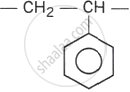
\[\begin{array}{cc}
\ce{- CH2 - CH -}\\
\phantom{...........}|\\
\phantom{...........}\ce{Cl}\\
\end{array}\]\[\begin{array}{cc}
\ce{- CH2 - CH -}\\
\phantom{...........}|\\
\phantom{............}\ce{CN}\\
\end{array}\]\[\begin{array}{cc}
\ce{- CH2 - CH -}\\
\phantom{...........}|\\
\phantom{............}\ce{Br}\\
\end{array}\]
The functionality of ethylene glycol is ______.
1
2
3
4
A three-dimensional network polymer is formed by monomers which are ______.
monofunctional
bifunctional
polyfunctional
none of these
Vulcanized rubber is a ______.
natural polymer
synthetic polymer
semisynthetic polymer
copolymer
Nucleic acids are the polymers of ______.
nucleotides
nucelosides
amino acids
isoprene
Solutions for 15: Polymers
Nootan solutions for केमिस्ट्रि [इंग्रजी] इयत्ता १२ आयएससी chapter 15 - Polymers
Shaalaa.com has the CISCE Mathematics केमिस्ट्रि [इंग्रजी] इयत्ता १२ आयएससी CISCE solutions in a manner that help students grasp basic concepts better and faster. The detailed, step-by-step solutions will help you understand the concepts better and clarify any confusion. Nootan solutions for Mathematics केमिस्ट्रि [इंग्रजी] इयत्ता १२ आयएससी CISCE 15 (Polymers) include all questions with answers and detailed explanations. This will clear students' doubts about questions and improve their application skills while preparing for board exams.
Further, we at Shaalaa.com provide such solutions so students can prepare for written exams. Nootan textbook solutions can be a core help for self-study and provide excellent self-help guidance for students.
Concepts covered in केमिस्ट्रि [इंग्रजी] इयत्ता १२ आयएससी chapter 15 Polymers are .
Using Nootan केमिस्ट्रि [इंग्रजी] इयत्ता १२ आयएससी solutions Polymers exercise by students is an easy way to prepare for the exams, as they involve solutions arranged chapter-wise and also page-wise. The questions involved in Nootan Solutions are essential questions that can be asked in the final exam. Maximum CISCE केमिस्ट्रि [इंग्रजी] इयत्ता १२ आयएससी students prefer Nootan Textbook Solutions to score more in exams.
Get the free view of Chapter 15, Polymers केमिस्ट्रि [इंग्रजी] इयत्ता १२ आयएससी additional questions for Mathematics केमिस्ट्रि [इंग्रजी] इयत्ता १२ आयएससी CISCE, and you can use Shaalaa.com to keep it handy for your exam preparation.
