Advertisements
Online Mock Tests
Chapters
1: The First War of Independence, 1857
2: Growth of Nationalism
▶ 3: First Phase of the Indian National Movement
4: Second Phase of the Indian National Movement
5: The Muslim League
2. MASS PHASE OF THE NATIONAL MOVEMENT (1915-1947)
6: Mahatma Gandhi and the National Movement
7: The Quit India Movement
8: Forward Bloc and The INA
9: Independence and Partition of India
3. THE CONTEMPORARY WORLD
10: The First World War
11: Rise of Dictatorships
12: The Second World War
13: United Nations
14: Major Agencies of the United Nations
15: Non-Aligned Movement
SECTION B - CIVICS : 1. THE UNION LEGISLATURE
1: The Union Parliament-I
2: The Union Parliament-II
2. THE UNION EXECUTIVE
3: The President and The Vice-President
4: Prime Minister and Council of Ministers
3. THE JUDICIARY
5: The Supreme Court
6: The High Courts and Subordinate Courts
![Morning Star solutions for टोटल हिस्ट्री अँड सिविक्स [इंग्रजी] इयत्ता १० आयसीएसई chapter 3 - First Phase of the Indian National Movement - Shaalaa.com](/images/total-history-and-civics-english-class-10-icse_6:5245755610f545c08dc24e700b430f63.jpg "Morning Star solutions for टोटल हिस्ट्री अँड सिविक्स [इंग्रजी] इयत्ता १० आयसीएसई chapter 3 - First Phase of the Indian National Movement")
Advertisements
Solutions for Chapter 3: First Phase of the Indian National Movement
Below listed, you can find solutions for Chapter 3 of CISCE Morning Star for टोटल हिस्ट्री अँड सिविक्स [इंग्रजी] इयत्ता १० आयसीएसई.
Morning Star solutions for टोटल हिस्ट्री अँड सिविक्स [इंग्रजी] इयत्ता १० आयसीएसई 3 First Phase of the Indian National Movement EXERClSES [Pages 46 - 49]
Multiple-Choice Questions. Select the correct option.
Dadabhai Naoroji presented which famous theory in his paper - ‘Poverty and Un-British Rule in India?
Deficit Theory
Drain Theory
Deprivation Theory
Detriment Theory
Methods used by Early Nationalists were ______.
Assertive in their approach.
Constitutional within the framework of law.
Non-violent but uncooperative to authority.
Assertive in approach but within the framework of law.
What were the 3P’s of the Early Nationalists?
Petition, Protests and Passion
Purpose, Persistence and Prayers
Petition, Prayers and Protests
Protests, Petition and Process
Which of the following was the aim of the Early Nationalists?
Eradication of British rule in India.
Promotion of equality among the workers for the cause of India.
Formulation of popular demands to be presented before the government.
Organisation of a violent struggle for the political emancipation of India.
Which of the following was a demand of the Early Nationalists?
Reduction in taxes and increase in government expenditure.
A larger share of Indians in the governance of the country.
Complete fusion of legislature and executive.
Employment of Indians at all posts in the administrative services.
Which of the following administrative demands were made by the Early Nationalists?
Increase in the powers of local bodies.
Increase in official control over local bodies.
Increase in the British officers in the civil services.
Transfer of police service to local bodies.
Which of the following reforms was a result of the efforts made by Early Nationalists?
Withdrawal of the Partition of Bengal.
Simultaneous ICS exams in India and England.
Appointment of Lord Curzon as Viceroy.
Irish Home Rule Agitation.
Which of the following was achieved by Gopal Krishna Gokhale, as a Member of the Imperial Legislative Council?
Reduction in land revenue.
Abolition of salt tax.
Primary education made compulsory.
Reduction in toll tax.
The Early Nationalists initially believed that the British wanted to be just to India but were unaware of the real state of affairs. In this context, which of the following statements are true?
- They believed that the British rule had many benefits.
- They believed that the main obstacle in India’s progress was not the British Colonial rule but India’s own social and economic backwardness.
- They provided elaborate statistical data to prove that the British rule was responsible for India’s poverty.
(i) and (ii)
(ii) and (iii)
(i) and (iii)
(i), (ii) and (iii)
Dadabhai Naoroji : London India Society : : Gopal Krishna Gokhale : ______.
Servants of India Society
East India Association
Indian Association
Indian National Conference
Select the option that shows the correct relationship between Statements (I) and (II).
(I) The Early Nationalists believed in moderate politics.
(II) They asked for constitutional and other reforms within the framework of British rule.
(II) contradicts (1)
(I) is the reason for (II)
(I) is true, but (II) is false.
(I) and (II) are independent of each other.
Select the option that shows the correct relationship between Statements (I) and (II).
(I) The Early Nationalists created national awakening among people that they belonged to one common country-India.
(II) The Early Nationalists drew the masses into the mainstream of the national movement.
(II) contradicts (I).
(II) is the reason for (I).
(I) is true, but (II) is false.
(I) and (II) are independent of each other.
Select the option that shows the correct relationship between Statements (I) and (II).
(I) A few government officials attended the first session of the Congress and took part in its deliberations.
(II) British officials later on criticised the Congress and branded its leaders as ‘disloyal babus’ and ‘violent villains’.
(II) contradicts (I).
(II) is the reason for (I).
(I) is true, but (II) is false.
(I) and (II) are independent of each other.
Select the option that shows the correct relationship between Statements (I) and (II).
(I) The British followed a policy of granting minor concessions to separatists to quell the growth of nationalism.
(II) The British realised that the growing unity of the Indians posed a major threat to their rule.
II) contradicts (I).
(II) is the reason for (I).
(I) is true, but (II) is false.
(I) and (II) are independent of each other.
Shon Answer Questions.
Which period of the National Movement is known as the period of the ‘Early Nationalists’?
Name any two leaders of the Congress who are known as ‘Early Nationalists’.
Mention two reasons for the Early Nationalist’s faith in the British sense of justice.
What was the belief of the Early Nationalists regarding the British rule in India?
What, according to the Early Nationalists, was an obstacle in India’s progress?
What kind of self-government did the Early Nationalists demand?
State any two issues opposed by the Early Nationalists in the field of civil liberties.
Mention any two demands of the Early Nationalists that aimed at improving the lot of the peasants.
Mention any two constitutional demands made by the Early Nationalists.
Name any two economic issues raised by the Early Nationalists.
What did the Early Nationalists demand for the industrial growth of India?
Mention any two achievements of the Early Nationalists.
Who is known as India’s unofficial ambassador and why?
Who is the author of ‘Poverty and Un-British Rule in India’?
Name the author of A Nation in the Making.
Name the two Acts that Surendranath Banerjee agitated against.
List briefly any two causes that Gopal Krishna Gokhale supported.
Structured Questions.
The period from 1885 to 1905 was dominated by the Early Nationalists. In this context, answer the following questions:
- To which section of society did they belong? What were their demands?
- What methods did they adopt?
- How did the Early Nationalists help in the growth of nationalism in India?
The Early Nationalists were practical and wanted to win freedom by a gradual process. In this context, answer the following:
- How did they expose the true nature of British rule in India?
- What was the attitude of the Early Nationalists towards the British? Why did they develop such an attitude?
- What were the reasons for the partial failure of their methods?
Surendranath Banerjee was popularly known as the father of Indian Nationalism. In this context, answer the following questions:
- Trace his contribution towards the formation of the Indian National Congress.
- What was India’s political goal, according to him? What were the methods he advocated to attain it?
- What was his contribution to India’s freedom struggle?
Read the excerpt given below and answer the questions that follow:
|
The romance is that there is security of life and property in India; the reality is that there is no such thing. There is security of life and property in one sense or way - i.e., the people are secure from any violence from each other or from Native despots.... But from England’s own grasp there is no security of property at all and, as a consequence, no security for life. India’s property is not secure. What is secure, and well secure, is that England is perfectly safe and secure, and does so with perfect security, to carry away from India, and to eat up in India, her property at the present rate of $30,0000,000 or 40,000,000 a year, .... I therefore venture to submit that India does not enjoy security of her property and life.... Тo millions in India life is simply ‘half-feeding’, or starvation, or famine and disease. – Dadabhai Naoroji |
- Who was Dadabhai Naoroji? According to Dadabhai Naoroji, in what sense security of life and property prevails in India?
- How is England ‘perfectly safe and secure’, as described in the excerpt by Naoroji?
- Dadabhai Naoroji propounded a theory to describe the exploitative nature of British rule in India. Name it. Explain briefly the last line of the excerpt given above.
See the picture on the side and answer the questions that follow:
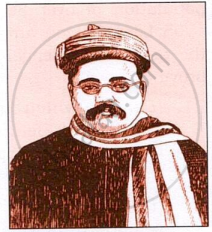
- Identify the person in the given picture. State three policies of the imperial regime which were opposed by this person.
- What role did he play as a member of the Imperial Legislative Council?
- How did he try to arouse national awakening?
Higher Order Thinking Skills (HOTS)
Imagine that you got a chance to interview one of the Early Nationalist leaders. On the basis of interview, express your views on the Early Nationalist leader’s beliefs as well as the methods used by him.
Suppose you want to present the demands of the people of your area to the MLA of your area. State which methods followed by the Early Nationalists you would choose and why?
Solutions for 3: First Phase of the Indian National Movement
Morning Star solutions for टोटल हिस्ट्री अँड सिविक्स [इंग्रजी] इयत्ता १० आयसीएसई chapter 3 - First Phase of the Indian National Movement
Shaalaa.com has the CISCE Mathematics टोटल हिस्ट्री अँड सिविक्स [इंग्रजी] इयत्ता १० आयसीएसई CISCE solutions in a manner that help students grasp basic concepts better and faster. The detailed, step-by-step solutions will help you understand the concepts better and clarify any confusion. Morning Star solutions for Mathematics टोटल हिस्ट्री अँड सिविक्स [इंग्रजी] इयत्ता १० आयसीएसई CISCE 3 (First Phase of the Indian National Movement) include all questions with answers and detailed explanations. This will clear students' doubts about questions and improve their application skills while preparing for board exams.
Further, we at Shaalaa.com provide such solutions so students can prepare for written exams. Morning Star textbook solutions can be a core help for self-study and provide excellent self-help guidance for students.
Concepts covered in टोटल हिस्ट्री अँड सिविक्स [इंग्रजी] इयत्ता १० आयसीएसई chapter 3 First Phase of the Indian National Movement are Methods of the Early Nationalists, Prominent Early Nationalist Leaders, The Early Nationalists, Demands of the Early Nationalists, Beliefs of the Early Nationalists, Achievements of the Early Nationalists, Criticism of the Early Nationalists, Official Attitude Towards the Congress, Methods of the Early Nationalists, Prominent Early Nationalist Leaders, The Early Nationalists, Demands of the Early Nationalists, Beliefs of the Early Nationalists, Achievements of the Early Nationalists, Criticism of the Early Nationalists, Official Attitude Towards the Congress, Methods of the Early Nationalists, Prominent Early Nationalist Leaders, The Early Nationalists, Demands of the Early Nationalists, Beliefs of the Early Nationalists, Achievements of the Early Nationalists, Criticism of the Early Nationalists, Official Attitude Towards the Congress.
Using Morning Star टोटल हिस्ट्री अँड सिविक्स [इंग्रजी] इयत्ता १० आयसीएसई solutions First Phase of the Indian National Movement exercise by students is an easy way to prepare for the exams, as they involve solutions arranged chapter-wise and also page-wise. The questions involved in Morning Star Solutions are essential questions that can be asked in the final exam. Maximum CISCE टोटल हिस्ट्री अँड सिविक्स [इंग्रजी] इयत्ता १० आयसीएसई students prefer Morning Star Textbook Solutions to score more in exams.
Get the free view of Chapter 3, First Phase of the Indian National Movement टोटल हिस्ट्री अँड सिविक्स [इंग्रजी] इयत्ता १० आयसीएसई additional questions for Mathematics टोटल हिस्ट्री अँड सिविक्स [इंग्रजी] इयत्ता १० आयसीएसई CISCE, and you can use Shaalaa.com to keep it handy for your exam preparation.
