Advertisements
Online Mock Tests
Chapters
▶ 1: The First War of Independence, 1857
2: Growth of Nationalism
3: First Phase of the Indian National Movement
4: Second Phase of the Indian National Movement
5: The Muslim League
2. MASS PHASE OF THE NATIONAL MOVEMENT (1915-1947)
6: Mahatma Gandhi and the National Movement
7: The Quit India Movement
8: Forward Bloc and The INA
9: Independence and Partition of India
3. THE CONTEMPORARY WORLD
10: The First World War
11: Rise of Dictatorships
12: The Second World War
13: United Nations
14: Major Agencies of the United Nations
15: Non-Aligned Movement
SECTION B - CIVICS : 1. THE UNION LEGISLATURE
1: The Union Parliament-I
2: The Union Parliament-II
2. THE UNION EXECUTIVE
3: The President and The Vice-President
4: Prime Minister and Council of Ministers
3. THE JUDICIARY
5: The Supreme Court
6: The High Courts and Subordinate Courts
![Morning Star solutions for टोटल हिस्ट्री अँड सिविक्स [इंग्रजी] इयत्ता १० आयसीएसई chapter 1 - The First War of Independence, 1857 - Shaalaa.com](/images/total-history-and-civics-english-class-10-icse_6:5245755610f545c08dc24e700b430f63.jpg "Morning Star solutions for टोटल हिस्ट्री अँड सिविक्स [इंग्रजी] इयत्ता १० आयसीएसई chapter 1 - The First War of Independence, 1857")
Advertisements
Solutions for Chapter 1: The First War of Independence, 1857
Below listed, you can find solutions for Chapter 1 of CISCE Morning Star for टोटल हिस्ट्री अँड सिविक्स [इंग्रजी] इयत्ता १० आयसीएसई.
Morning Star solutions for टोटल हिस्ट्री अँड सिविक्स [इंग्रजी] इयत्ता १० आयसीएसई 1 The First War of Independence, 1857 EXERCISES [Pages 21 - 25]
Multiple-Choice Questions. Select the correct option.
The East India Company’s territorial power began to increased rapidly in India after which of the following Battles?
The Battle of Buxar
The Battle of Plassey
The First Anglo-Mysore War
The Third Anglo-Maratha War
Who introduced the Subsidiary Alliance in India?
Lord Hastings
Lord Amherst
Lord Wellesley
Lord Cornwallis
Subsidiary Alliance : Awadh : : Doctrine of Lapse : ______
Hyderabad
Mysore
Tanjore
Jhansi
Which was the first kingdom to sign the Subsidiary Alliance?
Mysore
Awadh
Maratha
Jhansi
Seventy-five thousand of the Company’s sepoys belonged to which of the following states?
Jaipur
Awadh
Mysore
Sambalpur
Where was the family seat of Nana Saheb located?
Nagpur
Lucknow
Poona (Pune)
Kanpur
Which of the following reforms was resented by the Indians?
The Abolition of Sati
The Widow Remarriage Act
Opening of Girl’s school
Both the Abolition of Sati and the Widow Remarriage Act.
The Uprising of 1857 began from ______.
Meerut
Plassey
Buxar
Delhi
After the initial success of the Uprising of 1857, the objective of the leaders of the Uprising included ______.
restoring the former glory to the Mughal empire.
forming a Federation of Indian States.
eliminating foreign rule and the return of the old order.
All of the above.
An effect of the Uprising of 1857 was that ______.
the spirit of rebellion in India was crushed
the British became totally demoralised
the British abandoned their repressive policies
unity was forged between the Hindus and Muslims
Under the Government of India Act 1858, who gave up the direct administration of India?
The East India Company
The British Crown
Lord Mountbatten
The Mughal Emperor
Arrange the following events in chronological order:
- Battle of Plassey
- Queen Victoria’s Proclamation
- Lord Dalhousie annexed Awadh
- Introduction of the Enfield Rifle
(A), (B), (C), (D)
(C), (A), (B), (D)
(A), (C), (D), (B)
(A), (D), (C), (B)
Which was not a drain of wealth from India?
Salaries of Englishmen
Salaries of Sepoys
Establishment of British Officers
Savings of Englishmen
Choose the options that were not a part of Queen Victoria’s Proclamation.
P: All subjects of the Queen would be treated as equals.
Q: A general pardon to all those who were a part of the 1857 uprising.
R: Policy of non-intervention in social and religious matters.
S: Continue political expansion with the Doctrine of Lapse and Subsidiary Alliance.
P and Q
Q and R
R and S
Q and S
Select the option that shows the correct relationship between Statements (I) and (II).
(I) Although these revolts were local, scattered and isolated, they established a local tradition of struggle against the foreign rule.
(II) From the mid-18th century till 1857, one part of the country or the other rose in revolt against the British policies, which harmed the interests of the Indians belonging to all the segments of Indian society.
(II) contradicts (1)
(II) is the reason for (I)
(I) is true but (II) is false
(I) and (II) are independent of each other.
Select the option that shows the correct relationship between Statements (I) and (II).
(I) The British policy of territorial expansion and gradual annexation of the native Indian States was one of the major grievances of the Indian rulers.
(II) Some States were brought under British control without actually being annexed.
(II) contradicts (I)
(II) is the reason for (I)
(I) is true, but (II) is false
(I) and (II) are independent of each other.
Select the option that shows the correct relationship between Statements (I) and (II).
(I) Lord Dalhousie justified the annexation of Awadh as “for the good of the governed.”
(II) The people of Awadh had to pay higher land revenue and additional taxes on food, houses and ferries.
(II) contradicts (I)
(II) is the reason for (I)
(I) is true, but (II) is false
(I) and (II) are independent of each other.
Select the option that shows the correct relationship between Statements (I) and (II).
(I) The British introduced modern innovations like railways and telegraph in India in the mid-19th century.
(II) The British introduced these innovations to modernise India.
(II) contradicts (I).
(II) is the reason for (I).
(I) is true, but (II) is false.
(I) and (II) are independent of each other.
Select the option that shows the correct relationship between Statements (I) and (II).
(I) The Indian soldiers, who helped the East India Company to establish the British Empire in India, were poorly paid, ill-fed and badly housed.
(II) A large proportion of the British Army consisted of Indian soldiers.
(II) contradicts (I)
(II) is the reason for (I)
(I) is true, but (II) is false
(I) and (II) are independent of each other.
Select the option that shows the correct relationship between Statements (I) and (II).
(I) The Uprising of 1857 paved the way for the rise of the national movement.
(II) Although the Uprising failed to achieve its objectives, it inspired the Indians to resist British rule.
(II) contradicts (I).
(II) is the reason for (I).
(I) is true, but (II) is false.
(I) and (II) are independent of each other.
Short Answer Questions.
Read the excerpt given below and answer the questions that follow:
| Originally formed in 1600 to trade with India, the East India Company purchased land from Indian rulers to build its factories (settlements) and recruited local armies to protect them. These evolved into the Bengal, Bombay, and Madras armies. With the collapse of the Mughal Empire and victory over French forces while simultaneously getting involved in local politics, the East India Company emerged as a major political power in India. |
- After which battle did the Company begin rapid territorial expansion in India?
- What was the result of the Great Uprising of 1857 on the Company’s rule?
What was the nature of revolts against the British before the First War of Independence?
Why was the ‘war of 1857’ hailed as the first war of National Independence?
State any two political causes responsible for the First War of Independence.
Name two ways in which the British expanded their territorial power in India.
What was the subsidiary alliance?
Name two Indian States brought under the British control using the Subsidiary Alliance.
Explain the term doctrine of lapse.
Name the two states annexed by the British using the Doctrine of Lapse.
Which policy was used by Lord Dalhousie against Rani Laxmi Bai?
Why did Rani Laxmi Bai become a bitter enemy of the British?
State two announcements which adversely affected the Mughal dynasty in India.
Mention any two consequences of the annexation of Awadh.
State any two consequences of the disbanding of the armies of the annexed States by the British.
Give the meaning of Absentee Sovereignty.
Why was absentee sovereignty resented by the Indians?
What were the apprehensions of Indians about the introduction of the railways?
Mention any two social reforms advocated by the British which affected the religious traditions of the Indian people.
Mention any two measures which point to the policy of social discrimination followed by the British in India.
Give any two grievances of the peasantry against the British.
What did the British do to reduce the landed aristocracy to poverty?
What was the provision of the General Service Enlistment Act which was resented by the Indian soldiers? Why was it resented?
Mention any two measures which point to the policy of social discrimination followed by the British in India.
State two effects of the British defeat in the First Afghan War on the Indian soldiers.
State two effects of the British defeat in the Punjab Wars on the Indian soldiers.
What was the immediate cause of the First War of Independence?
Who was Mangal Pandey?
What did Mangal Pandey do?
State two consequences of the First War of Indian Independence on the East India Company.
How did the Queen’s Proclamation affect India’s foreign policy?
Mention any two drawbacks of the First War of Independence.
Structured Questions
Read the excerpt given below and answer the questions that follow:
|
“The sepoys are now enjoined to display communal harmony and exhorted to pray to their respective gods.... They are now called sipah-i-Hindostan (the Armу of India), and there are appeals now to fellow countrymen “ahl-i watan”, dear compatriots “aziz ham-watan” with specific exhortations for a united rallying of Hindus and Muslims.” − The Dehli Urdu Akhbar (the first Urdu weekly newspaper), June 1857 |
- What was the policy that the British followed to dispel ‘the communal harmony’? Briefly explain how the British unwittingly led to the ‘united rallying of Hindus and Muslims’ by introducing the Enfield Rifle.
- How was the British army reorganised to avoid another uprising of this kind?
- How did the end of the East India Company’s rule bring in grave economic perils in India?
Economic exploitation of the country produced discontent, resentment, and resistance among the people that culminated in the Great Uprising of 1857.
- The ruin of trade and handicrafts.
- Impoverishment of the cultivators.
- Subordination of the Indian economy to British interests (making India an agricultural colony of British capitalism).
Study the picture and answer the following questions:

- Who are the persons in the picture? How were they treated by their British counterparts?
- State any three grievances they had against the British.
- What changes were brought in their status after the Uprising of 1857?
Read the excerpt given below and answer the questions that follow:
|
These rebels of Delhi must be made an example to all their countrymen for ages to come of the consequences of such crimes, at the same time that every possible precaution is taken to do away with all temptation or provocation to future offences of a similar character. − The Guardian, Manchester, June 30, 1857 |
- Who are referred to as ‘rebels of Delhi’ in the excerpt above? When did they rebel and where?
- What was the temptation or provocation being talked about in the excerpt?
- What were the consequences of their alleged ‘crimes’?
Study the picture and answer the following questions:
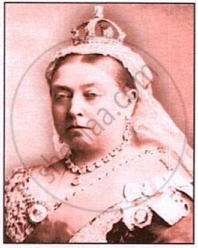
- Identify the person in the picture. Name the proclamation made by her in 1858.
- Where and by whom was this proclamation made public?
- What assurance did this proclamation give to the Princely States in India?
Higher Order Thinking Skills (HOTS)
Imagine you were present when the rulers of Indian states met at a common place before the Uprising of 1857. Each ruler voiced his grievance against the British. Make a list of the grievances of each of the rulers.
Imagine you were a Subedar in the army, hailing from a landed family from Awadh. State the grievances your father had against the British.
There were uprisings against the British in every corner of the country in the nineteenth century. Make a list of the uprisings in different States and the manner in which the imperialists dealt with them.
Suppose the Uprising of 1857 had not taken place when it did. What would have happened then? Do you think India would still have gained Independence later? Why or why not?
India gained independence from British rule 90 years after the First War of Independence. Why do you think it took so long for us to become an independent nation?
Solutions for 1: The First War of Independence, 1857
Morning Star solutions for टोटल हिस्ट्री अँड सिविक्स [इंग्रजी] इयत्ता १० आयसीएसई chapter 1 - The First War of Independence, 1857
Shaalaa.com has the CISCE Mathematics टोटल हिस्ट्री अँड सिविक्स [इंग्रजी] इयत्ता १० आयसीएसई CISCE solutions in a manner that help students grasp basic concepts better and faster. The detailed, step-by-step solutions will help you understand the concepts better and clarify any confusion. Morning Star solutions for Mathematics टोटल हिस्ट्री अँड सिविक्स [इंग्रजी] इयत्ता १० आयसीएसई CISCE 1 (The First War of Independence, 1857) include all questions with answers and detailed explanations. This will clear students' doubts about questions and improve their application skills while preparing for board exams.
Further, we at Shaalaa.com provide such solutions so students can prepare for written exams. Morning Star textbook solutions can be a core help for self-study and provide excellent self-help guidance for students.
Concepts covered in टोटल हिस्ट्री अँड सिविक्स [इंग्रजी] इयत्ता १० आयसीएसई chapter 1 The First War of Independence, 1857 are Causes of First War of Independence, Immediate Cause, Beginning of the Uprising, Main Events of 1857, Consequences of the First War of Independence, Drawbacks of the First War of Independence, Nature of the War, Early Resistance to British Rule in India, Political Causes, Socio-Religious Causes, Economic Causes, Military Causes, Causes of First War of Independence, Immediate Cause, Beginning of the Uprising, Main Events of 1857, Consequences of the First War of Independence, Drawbacks of the First War of Independence, Nature of the War, Early Resistance to British Rule in India, Political Causes, Socio-Religious Causes, Economic Causes, Military Causes, Causes of First War of Independence, Immediate Cause, Beginning of the Uprising, Main Events of 1857, Consequences of the First War of Independence, Drawbacks of the First War of Independence, Nature of the War, Early Resistance to British Rule in India, Political Causes, Socio-Religious Causes, Economic Causes, Military Causes, Causes of First War of Independence, Immediate Cause, Beginning of the Uprising, Main Events of 1857, Consequences of the First War of Independence, Drawbacks of the First War of Independence, Nature of the War, Early Resistance to British Rule in India, Political Causes, Socio-Religious Causes, Economic Causes, Military Causes.
Using Morning Star टोटल हिस्ट्री अँड सिविक्स [इंग्रजी] इयत्ता १० आयसीएसई solutions The First War of Independence, 1857 exercise by students is an easy way to prepare for the exams, as they involve solutions arranged chapter-wise and also page-wise. The questions involved in Morning Star Solutions are essential questions that can be asked in the final exam. Maximum CISCE टोटल हिस्ट्री अँड सिविक्स [इंग्रजी] इयत्ता १० आयसीएसई students prefer Morning Star Textbook Solutions to score more in exams.
Get the free view of Chapter 1, The First War of Independence, 1857 टोटल हिस्ट्री अँड सिविक्स [इंग्रजी] इयत्ता १० आयसीएसई additional questions for Mathematics टोटल हिस्ट्री अँड सिविक्स [इंग्रजी] इयत्ता १० आयसीएसई CISCE, and you can use Shaalaa.com to keep it handy for your exam preparation.
