Advertisements
Advertisements
Distinguish between:
Alkane - Alkene
Concept: undefined >> undefined
Write a short note.
Specific heat capacity
Concept: undefined >> undefined
Advertisements
Write a short note.
Catenation power
Concept: undefined >> undefined
Write a short note.
Functional groups in carbon compounds
Concept: undefined >> undefined
Decide the unit for specific heat capacity.
Concept: undefined >> undefined
Explain how heat capacity of a solid can be determined by the method of mixture.
Concept: undefined >> undefined
Read this activity and answer the following questions.
- Take three spheres of iron, copper and lead. the lead of equal mass.
- Put all the three spheres in boiling water in the beaker for some time.
- Take the three spheres out of the water.
- All the spheres will be at a temperature 100 °C.
- Put them immediately on the thick slab of wax.
- Note, the depth that each of the sphere goes into the wax.
Questions:
- Which property is determined from this activity?
- Give name to that property.
- Explain the term principal of heat exchange with the help of this activity.
Concept: undefined >> undefined
The cold object the hot object enclosed in one box of heat-resistant material.
- What changes will occur in the two objects when temperature flows from those objects?
- Which principle can show that the energy exchange takes place between two objects only when kept in isolated system?
Concept: undefined >> undefined
An object is placed vertically at a distance of 20 cm from a convex lens. If the height of the object is 5 cm and the focal length of the lens is 10 cm, what will be the position, size and nature of the image? How much bigger as compared to the object?
Concept: undefined >> undefined
Complete the given chart with writing the correct functional group of carbon compounds.
(Ester, Aldehyde, Ketone, Carboxylic acid, Alcohol, Ether)
| -O-H | |
| \[\begin{array}{cc} \ce{O}\phantom{..}\\ ||\phantom{..}\\ \ce{-C-H} \end{array}\] |
|
| \[\begin{array}{cc} \ce{O}\\ ||\\ \ce{-C-} \end{array}\] |
|
| \[\begin{array}{cc} \ce{O}\phantom{.....}\\ ||\phantom{.....}\\ \ce{-C-O-H} \end{array}\] |
|
| -O- | |
| \[\begin{array}{cc} \ce{O}\phantom{..}\\ ||\phantom{..}\\ \ce{-C-O} \end{array}\] |
|
|
\[\begin{array}{cc} |
Concept: undefined >> undefined
Observe the figure and write the answers to the questions asked.
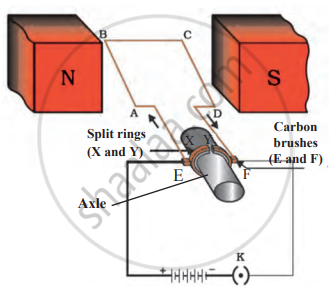
- The construction shown in the figure is of which device?
- Explain the principle on which this device works.
- Write any three uses of this device.
Concept: undefined >> undefined
Read the passage and answer the questions based on it.
If heat is exchanged between a hot and cold object, the temperature of the cold object goes on increasing due to gain of energy and the temperature of the hot object goes on decreasing due to loss of energy. The change in temperature continues till the temperatures of both objects attain the same value. In this process, the cold object gains heat energy and the hot object loses heat energy. If the system of both the objects is isolated from the environment by keeping it inside a heat-resistant box then no energy can flow from inside the box or come into the box. In this situation, we get the following principle.
Heat energy lost by the hot object = Heat energy gained by the cold object. This is called the ‘Principle of heat exchange’.
- Where does heat transfer take place?
- In such a situation which principle of heat do you perceive?
- How can this principle be explained in short?
- Which property of the substance is measured using this principle?
Concept: undefined >> undefined
State whether true or false. If false, correct the statement.
A generator converts mechanical energy into electrical energy.
Concept: undefined >> undefined
Complete the following table for convex lens:
| Sr. No. | Position of the object | Position of the image | Nature of the image |
| 1. | Beyond 2F1 | __________________ | ________________________ |
| 2. | __________________ | At infinity | ________________________ |
| 3. | __________________ | __________________ | Real, inverted and enlarged |
Concept: undefined >> undefined
In a double displacement reaction ______.
Concept: undefined >> undefined
Observe the following diagram and answer the questions.

- Construction of which equipment does the above diagram show?
- On which principle does this equipment work?
- According to which law the coil ABCD rotates?
- Write the law in your own words.
- Where is this equipment used?
Concept: undefined >> undefined
To study energy exchange between hot and cold objects, the system of both objects is isolated from the environment by keeping them inside ______.
Concept: undefined >> undefined
Match the columns:
| Column ‘A’ | Column ‘B’ |
| The SI unit of specific heat capacity | (a) Jkg−1°C−1 |
| (b) kg/m3 | |
| (c) calorie |
Concept: undefined >> undefined
Add potassium chromate (K2CrO4) into the solution of barium sulphate (BaSO4).
- What was the colour of the precipitate formed? Also, write the name of the precipitate.
- Write down the balanced equation for this reaction.
- Will you call this reaction a displacement reaction or a double displacement reaction? Why?
Concept: undefined >> undefined
The specific heat capacity of ______ is maximum.
Concept: undefined >> undefined
