Advertisements
Advertisements
Obtain the expression for the cyclotron frequency.
Concept: undefined >> undefined
A deuteron and a proton are accelerated by the cyclotron. Can both be accelerated with the same oscillator frequency? Give reason to justify your answer.
Concept: undefined >> undefined
Advertisements
Explain the principle and working of a cyclotron with the help of a schematic diagram. Write the expression for cyclotron frequency.
Concept: undefined >> undefined
Total internal reflection can take place only if ______.
Concept: undefined >> undefined
Solve the previous problem if the paperweight is inverted at its place so that the spherical surface touches the paper.
Concept: undefined >> undefined
In an electric circuit containing a battery, the charge (assumed positive) inside the battery ____________ .
Concept: undefined >> undefined
Verify that the units weber and volt second are the same.
Concept: undefined >> undefined
Which of the following particles will describe the smallest circle when projected with the same velocity perpendicular to a magnetic field?
Concept: undefined >> undefined
An electron is projected horizontally with a kinetic energy of 10 keV. A magnetic field of strength 1.0 × 10⁻⁷ T exists in the vertically upward direction.
(a) Will the electron deflect towards the right or left of its motion?
(b) Calculate the sideways deflection of the electron while travelling through 1 m. Make appropriate approximations.
Concept: undefined >> undefined
Consider a 10-cm long portion of a straight wire carrying a current of 10 A placed in a magnetic field of 0.1 T making an angle of 53° with the wire. What magnetic force does the wire experience?
Concept: undefined >> undefined
Figure shows a rod PQ of length 20.0 cm and mass 200 g suspended through a fixed point O by two threads of lengths 20.0 cm each. A magnetic field of strength 0.500 T exists in the vicinity of the wire PQ, as shown in the figure. The wires connecting PQ with the battery are loose and exert no force on PQ. (a) Find the tension in the threads when the switch S is open. (b) A current of 2.0 A is established when the switch S is closed. Find the tension in the threads now.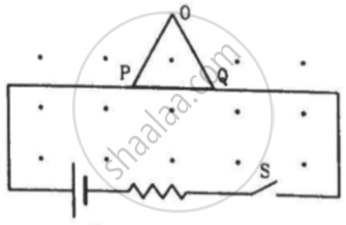
Concept: undefined >> undefined
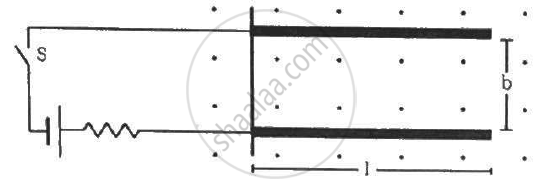
Two metal strips, each of length l, are clamped parallel to each other on a horizontal floor with a separation b between them. A wire of mass m lies on them perpendicularly, as shown in the figure. A vertically-upward magnetic field of strength B exists in the space. The metal strips are smooth but the coefficient of friction between the wire and the floor is µ. A current i is established when the switch S is closed at the instant t = 0. Discuss the motion of the wire after the switch is closed. How far away from the strips will the wire reach?
Concept: undefined >> undefined
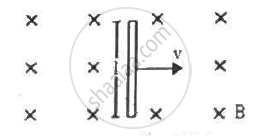
A conducting wire of length l, lying normal to a magnetic field B, moves with a velocity v,as shown in the figure. (a) Find the average magnetic force on a free electron of the wire. (b) Due to this magnetic force, electrons concentrate at one end, resulting in an electric field inside the wire. The redistribution stops when the electric force on the free electrons balances the magnetic force. Find the electric field developed inside the wire when the redistribution stops. (c) What potential difference is developed between the ends of the wire?
Concept: undefined >> undefined
(a) An electron moves along a circle of radius 1 m in a perpendicular magnetic field of strength 0.50 T. What would be its speed? Is it reasonable? (b) If a proton moves along a circle of the same radius in the same magnetic field, what would be its speed?
Concept: undefined >> undefined
\[\ce{Fe+}\] ions are accelerated through a potential difference of 500 V and are injected normally into a homogeneous magnetic field B of strength 20.0 mT. Find the radius of the circular paths followed by the isotopes with mass numbers 57 and 58. Take the mass of an ion = A (1.6 × 10⁻²⁷) kg, where A is the mass number.
Concept: undefined >> undefined
Can a plane mirror ever form a real image?
Concept: undefined >> undefined
A point source of light is placed in front of a plane mirror.
Concept: undefined >> undefined
following Figure shows two rays A and B being reflected by a mirror and going as A' and B'. The mirror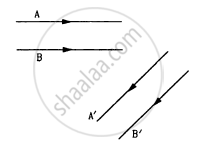
Concept: undefined >> undefined
The rays of different colours fail to converge at a point after going through a converging lens. This defect is called
Concept: undefined >> undefined
Mark the correct options.
Concept: undefined >> undefined
