Advertisements
Advertisements
प्रश्न
An electron is projected horizontally with a kinetic energy of 10 keV. A magnetic field of strength 1.0 × 10⁻⁷ T exists in the vertically upward direction.
(a) Will the electron deflect towards the right or left of its motion?
(b) Calculate the sideways deflection of the electron while travelling through 1 m. Make appropriate approximations.
Advertisements
उत्तर
Given:
The kinetic energy of the electron projected in the horizontal direction, K.E = 10 keV = 1.6 × 10⁻¹⁵ J
Magnetic field, B = 1 × 10⁻⁷ T
The direction of magnetic field is vertically upward.
(a) The direction can be found by the right-hand screw rule. So, the electron will be deflected towards left.
(b) Kinetic energy,
`K.E = 1/2mv^2`
`v = sqrt((K.Exx 2)/m)`
Magnetic force,
`vecF = q vecv xx vecB` ......(i)
and F = ma
Therefore, equation (i) will be
`a=(qvecvxx vecB)/m`
Applying equation of motion
`s = ut + 1/2 at^2`
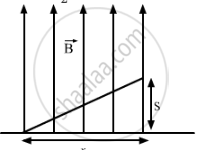
t= Time taken to cross the magnetic field
As there is no force acting on the electron in the horizontal direction, the velocity of the electron remain constant in this direction.
So, the time taken to cross a distance of 1m in the horizontal direction in the magnetic field,
`t = (d)/(v_"horizontal")`
=` (1)/sqrt((2xxkxxE)/m`
= `(qvB)/(4xxK.E)`
`= 1/4 (1.6xx10^-(19) xx1xx10^-7xx sqrt(2 xx K. E)/m)/(10xx 10^-16)`
`= 0.148 xx 10^-3 m`
`= 0.01482 cm`
s = 0.0148 = 1.5 × 10⁻² cm
APPEARS IN
संबंधित प्रश्न
Which one of the following particles cannot be accelerated by a cyclotron?
(A) Electrons
(B) Protons
(C) Deuterons
(D) α- particles
State the principle of a cyclotron.
State the underlying principle of a cyclotron. Write briefly how this machine is used to accelerate charged particles to high energies
Deduce an expression for the frequency of revolution of a charged particle in a magnetic field and show that it is independent of velocity or energy of the particle.
Obtain the expression for the cyclotron frequency.
Consider a 10-cm long portion of a straight wire carrying a current of 10 A placed in a magnetic field of 0.1 T making an angle of 53° with the wire. What magnetic force does the wire experience?
(a) An electron moves along a circle of radius 1 m in a perpendicular magnetic field of strength 0.50 T. What would be its speed? Is it reasonable? (b) If a proton moves along a circle of the same radius in the same magnetic field, what would be its speed?
\[\ce{Fe+}\] ions are accelerated through a potential difference of 500 V and are injected normally into a homogeneous magnetic field B of strength 20.0 mT. Find the radius of the circular paths followed by the isotopes with mass numbers 57 and 58. Take the mass of an ion = A (1.6 × 10⁻²⁷) kg, where A is the mass number.
Answer the following question.
State the underlying principle of a cyclotron. Explain its working with the help of a schematic diagram. Obtain the expression for cyclotron frequency.
A cyclotron's oscillator frequency is 10 MHz. What should be the operating magnetic field for accelerating protons? If the radius of its 'dees' is 60 cm, calculate the kinetic energy (in MeV) of the proton beam produced by the accelerator.
Assertion: The frequency of circular motion of a charged particle in cyclotron is independent of the mass of the particle.
Reason: Greater the mass of the particle less will be the frequency of the particle.
A charged particle is moving in a cyclotron, what effect on the radius of path of this charged particle will occur when the frequency of the ratio frequency field is doubled?
An aircraft executes a horizontal loop of radius 1.00 km with a steady speed of 900 km/h. Its centripetal acceleration is ______.
The life time of muon in the rest frame is 2 × 10⁻⁶ sec. A beam of muons emerges from a cyclotron with velocity where c is the velocity of light The mean life of muons observed in the laboratory frame will be ______.
The cyclotron was designed by ______
In a cyclotron, a charged particle ______.
