मराठी
कर्नाटक बोर्ड पी.यू.सी.पीयूसी विज्ञान इयत्ता ११

Two Metal Strips, Each of Length L, Are Clamped Parallel to Each Other on a Horizontal Floor with a Separation B Between Them. a Wire of Mass M Lies on - Physics

Advertisements
Advertisements

प्रश्न

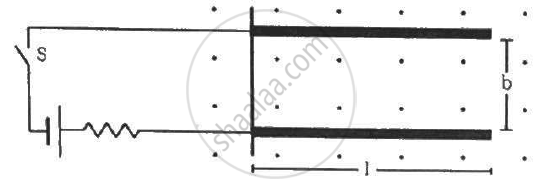
Two metal strips, each of length l, are clamped parallel to each other on a horizontal floor with a separation b between them. A wire of mass m lies on them perpendicularly, as shown in the figure. A vertically-upward magnetic field of strength B exists in the space. The metal strips are smooth but the coefficient of friction between the wire and the floor is µ. A current i is established when the switch S is closed at the instant t = 0. Discuss the motion of the wire after the switch is closed. How far away from the strips will the wire reach?
बेरीज
Advertisements

उत्तर

Given:-

Length of the two metal strips = l

Separation between the strips = b

Mass of the wire = m

Strength magnetic field = B

Coefficient of friction between the wire and the floor = µ

Let the distance covered by the wire be x.

Due to the presence of the magnetic field, a net magnetic force will act on the wire towards the right.

Let the wire has moved through a distance x after travelling the length of the strips.

As the contact between the wire and strip is smooth so coefficient of friction between them is zero. Under the influence of magnetic force,firstly the wire will travel a distance equal to the length of the strips. After this, it travels a distance x and also now,a frictional force will act on the wire in a direction opposite to its direction of motion.

So we can equate the work done by the magnetic force and the frictional force.

Thus, F × l = µmg × x,

where g is the acceleration due to gravity

⇒ ibBl = µmgx

⇒  `x = (iblB)/(mumg)`

shaalaa.com
  या प्रश्नात किंवा उत्तरात काही त्रुटी आहे का?
पाठ 12: Magnetic Field - Exercises [पृष्ठ २३२]

APPEARS IN

एचसी वर्मा Concepts of Physics Vol. 2 [English] Class 11 and 12
पाठ 12 Magnetic Field
Exercises | Q 22 | पृष्ठ २३२

संबंधित प्रश्‍न

Draw a neat labelled diagram for the construction of 'cyclotron'


Which one of the following particles cannot be accelerated by a cyclotron?

(A) Electrons

(B) Protons

(C) Deuterons

(D) α- particles


State the underlying principle of a cyclotron. Write briefly how this machine is used to accelerate charged particles to high energies


Deduce an expression for the frequency of revolution of a charged particle in a magnetic field and show that it is independent of velocity or energy of the particle.


A deuteron and a proton are accelerated by the cyclotron. Can both be accelerated with the same oscillator frequency? Give reason to justify your answer.


An α-particle and a proton are released from the centre of the cyclotron and made to accelerate.

(i) Can both be accelerated at the same cyclotron frequency?

Give reason to justify your answer.

(ii) When they are accelerated in turn, which of the two will have higher velocity at the exit slit of the does?


A cyclotron is used to accelerate protons to a kinetic energy of 5 MeV. If the strength of magnetic field in the cyclotron is 2T, find the radius and the frequency needed for the applied alternating voltage of the cyclotron. (Given : Velocity of proton= `3xx10^7 m//s`)


Verify that the units weber and volt second are the same.


Which of the following particles will describe the smallest circle when projected with the same velocity perpendicular to a magnetic field?


An electron is projected horizontally with a kinetic energy of 10 keV. A magnetic field of strength 1.0 × 10⁻⁷ T exists in the vertically upward direction.
(a) Will the electron deflect towards the right or left of its motion?
(b) Calculate the sideways deflection of the electron while travelling through 1 m. Make appropriate approximations.


Consider a 10-cm long portion of a straight wire carrying a current of 10 A placed in a magnetic field of 0.1 T making an angle of 53° with the wire. What magnetic force does the wire experience?


(a) An electron moves along a circle of radius 1 m in a perpendicular magnetic field of strength 0.50 T. What would be its speed? Is it reasonable? (b) If a proton moves along a circle of the same radius in the same magnetic field, what would be its speed?


\[\ce{Fe+}\] ions are accelerated through a potential difference of 500 V and are injected normally into a homogeneous magnetic field B of strength 20.0 mT. Find the radius of the circular paths followed by the isotopes with mass numbers 57 and 58. Take the mass of an ion = A (1.6 × 10⁻²⁷) kg, where A is the mass number.


Which of the following is not correct about cyclotron?


An aircraft executes a horizontal loop of radius 1.00 km with a steady speed of 900 km/h. Its centripetal acceleration is ______.


A particle of mass m is moving in a circular path of constant radius r such that, its centripetal acceleration ac is varying with time t as ac = k2rt2, where k is a constant. The power delivered to the particle by the forces acting on it is ______.


The cyclotron was designed by ______


Share
Notifications

Englishहिंदीमराठी


      Forgot password?
Use app×