मराठी
कर्नाटक बोर्ड पी.यू.सी.पीयूसी विज्ञान इयत्ता ११

A Metal Wire Pq of Mass 10 G Lies at Rest on Two Horizontal Metal Rails Separated by 4.90 Cm (Figure). a Vertically-downward Magnetic Field of Magnitude - Physics

Advertisements
Advertisements

प्रश्न

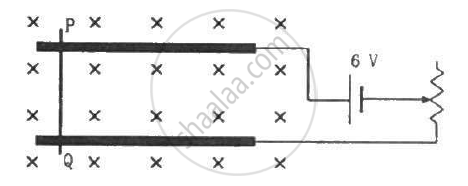
A metal wire PQ of mass 10 g lies at rest on two horizontal metal rails separated by 4.90 cm (figure). A vertically-downward magnetic field of magnitude 0.800 T exists in the space. The resistance of the circuit is slowly decreased and it is found that when the resistance goes below 20.0 Ω, the wire PQ starts sliding on the rails. Find the coefficient of friction.
बेरीज
Advertisements

उत्तर

Given:-

Mass of the metal wire, M = 10 g

Distance between the two horizontal metal rails, l = 4.90 cm

Vertically-downward magnetic field, B = 0.800 T

As per the question, when the resistance of the circuit is slowly decreased below 20.0 Ω, the wire PQ starts sliding on the rails. At that moment,

current in the wire, i = `V/R =6/20A  `Using Fleming's left-hand rule, the magnetic force will act towards the right. So, due to this magnetic force, the wire will try to slide on the rails.The frictional force will try to oppose this motion of the wire.

When the wire just starts sliding on the rails, the frictional force acting on the wire will just balance the magnetic force acting on the wire.This implies

µR = F, where

µ is the coffiecent of friction

R is the normal reaction force and

F is the magnetic force

`⇒mu xx M xx g = ilB`

`muxx10xx10^-3xx9.8 = 6/20xx 4.9 xx 10^-2xx0.8`

`mu = (6xx4.9xx10^-2xx0.8)/(20xx10xx10^-3xx9.8)`

µ = 0.12

shaalaa.com
Force on a Moving Charge in Uniform Magnetic and Electric Fields
  या प्रश्नात किंवा उत्तरात काही त्रुटी आहे का?
पाठ 12: Magnetic Field - Exercises [पृष्ठ २३२]

APPEARS IN

एचसी वर्मा Concepts of Physics Vol. 2 [English] Class 11 and 12
पाठ 12 Magnetic Field
Exercises | Q 23 | पृष्ठ २३२

संबंधित प्रश्‍न

A moving charged particle q travelling along the positive x-axis enters a uniform magnetic field B.
When will the force acting on q be maximum?


A long horizontal wire P carries a current of 50A. It is rigidly fixed. Another wire Q is placed directly above and parallel to P, as shown in Figure 1 below. The weight per unit length of the wire Q is 0.025 Nm-1 and it carries a current of 25A. Find the distance 'r' of the wire Q from the wire P so that the wire Q remains at rest


A straight wire of mass 200 g and length 1.5 m carries a current of 2 A. It is suspended in mid air by a uniform magnetic field B. What is the magnitude of the magnetic field?


Assume that the magnetic field is uniform in a cubical region and zero outside. Can you project a charged particle from outside into the field, so that the particle describes a complete circle in the field?


A charged particle is whirled in a horizontal circle on a frictionless table by attaching it to a string fixed at one point. If a magnetic field is switched on in the vertical direction, the tension in the string


A charged particle moves along a circle under the action of possible constant electric and magnetic fields. Which of the following is possible?
(a) E = 0, B = 0
(b) E = 0, B ≠ 0
(c) E ≠ 0, B = 0
(d) E ≠ 0, B ≠ 0


A particle is projected in a plane perpendicular to a uniform magnetic field. The area bounded by the path described by the particle is proportional to


Two particles X and Y having equal charge, after being accelerated through the same potential difference enter a region of uniform magnetic field and describe circular paths of radii R1 and R2 respectively. The ratio of the mass of X to that of Y is ______.


When a proton is released from rest in a room, it starts with an initial acceleration a0towards west. When it is projected towards north with a speed v0, it moves with an initial acceleration 3a0 towards west. Find the electric field and the maximum possible magnetic field in the room.


Prove that the force acting on a current-carrying wire, joining two fixed points a and b in a uniform magnetic field, is independent of the shape of the wire.


Consider a non-conducting ring of radius r and mass m that has a total charge qdistributed uniformly on it. The ring is rotated about its axis with an angular speed ω. (a) Find the equivalent electric current in the ring. (b) Find the magnetic moment µ of the ring. (c) Show that `pi = (q)/(2m)` l, where l is the angular momentum of the ring about its axis of rotation.


A particle of mass m and positive charge q, moving with a uniform velocity v, enters a magnetic field B, as shown in the figure. (a) Find the radius of the circular arc it describes in the magnetic field. (b) Find the angle subtended by the arc at the centre. (c) How long does the particle stay inside the magnetic field? (d) Solve the three parts of the above problem if the charge q on the particle is negative.


A narrow beam of singly-charged carbon ions, moving at a constant velocity of 6.0 × 10⁴m s−1, is sent perpendicularly in a rectangular region of uniform magnetic field B = 0.5 T (figure). It is found that two beams emerge from the field in the backward direction, the separations from the incident beam being 3.0 cm and 3.5 cm. Identify the isotopes present in the ion beam. Take the mass of an ion = A(1.6 × 10⁻²⁷) kg, where A is the mass number.


A proton is projected with a velocity of 3 × 10⁶ m s−1 perpendicular to a uniform magnetic field of 0.6 T. Find the acceleration of the proton.


A particle of mass m and charge q is released from the origin in a region in which the electric field and magnetic field are given by
`vecB = -B_0 vecj and vecE = E_0 vecK `
Find the speed of the particle as a function of its z-coordinate.


An electron is emitted with negligible speed from the negative plate of a parallel-plate capacitor charged to a potential difference V. The separation between the plates is dand a magnetic field B exists in the space, as shown in the figure. Show that the electron will fail to strike the upper plates if `d > ((2m_eV)/(eB_0^2))^(1/2)`


A long, straight wire carrying a current of 30 A is placed in an external, uniform magnetic field of 4.0 × 10⁻⁴ T parallel to the current. Find the magnitude of the resultant magnetic field at a point 2.0 cm away from the wire.


When does a moving charged particle nor experience any force while moving through a uniform magnetic field?


A charged particle moves through a magnetic field in a direction perpendicular to it. Then the ______.

Share
Notifications

Englishहिंदीमराठी


      Forgot password?
Use app×