मराठी
कर्नाटक बोर्ड पी.यू.सी.पीयूसी विज्ञान इयत्ता ११

Electrons Emitted with Negligible Speed from an Electron Gun Are Accelerated Through a Potential Difference V Along the X-axis. - Physics

Advertisements
Advertisements

प्रश्न

Electrons emitted with negligible speed from an electron gun are accelerated through a potential difference V along the x-axis. These electrons emerge from a narrow hole into a uniform magnetic field B directed along this axis. However, some of the electrons emerging from the hole make slightly divergent angles, as shown in the figure. Show that these paraxial electrons are refocussed on the x-axis at a distance `sqrt(8pi^2mV)/(eB^2).`
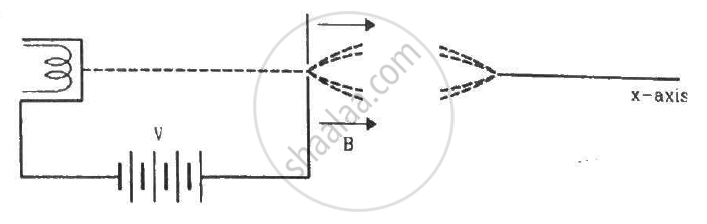
बेरीज
Advertisements

उत्तर

Given:-

Electrons are accelerated through a potential difference = V

Let the mass of an electron be m and the charge of an electron be e.

We know:-

Electric field, E = `V/r`

Force experienced by the electron, F = eE

Acceleration of the electron, a = `(eV)/(rm)`

Using the equation of motion

v2 − u2= 2 × a × s,

v2 = 2 × a × s  (As u = 0)

Here, s = r

v =`sqrt(2eVr)/(rm)`

= `sqrt(2eV)/m`

Time taken by electron to cover the curved path,

As the acceleration of the electron is along the  y axis only, it travels along the  x axis with uniform velocity.

Velocity of the electron moving along the field remains v.

Therefore, the distance at which the beam is refocused, d = v × T

`d = sqrt(2eV)/m`

`d = sqrt(8pi^2mV)/(eB^2)`

shaalaa.com
Force on a Moving Charge in Uniform Magnetic and Electric Fields
  या प्रश्नात किंवा उत्तरात काही त्रुटी आहे का?
पाठ 12: Magnetic Field - Exercises [पृष्ठ २३३]

APPEARS IN

एचसी वर्मा Concepts of Physics Vol. 2 [English] Class 11 and 12
पाठ 12 Magnetic Field
Exercises | Q 44 | पृष्ठ २३३

संबंधित प्रश्‍न

An electron moving horizontally with a velocity of 4 ✕ 104 m/s enters a region of uniform magnetic field of 10−5 T acting vertically upward as shown in the figure. Draw its trajectory and find out the time it takes to come out of the region of magnetic 

field.


A proton and a deuteron having equal momenta enter in a region of a uniform magnetic field at right angle to the direction of a the field. Depict their trajectories in the field.


Write the expression for the force,`vecF` acting on a charged particle of charge ‘q’, moving with a velocity `vecV` in the presence of both electric field `vecF`and magnetic field `vecB` . Obtain the condition under which the particle moves undeflected through the fields.


A charged particle is whirled in a horizontal circle on a frictionless table by attaching it to a string fixed at one point. If a magnetic field is switched on in the vertical direction, the tension in the string


A charged particle moves in a uniform magnetic field. The velocity of the particle at some instant makes an acute angle with the magnetic field. The path of the particle will be


A charged particle moves along a circle under the action of possible constant electric and magnetic fields. Which of the following is possible?
(a) E = 0, B = 0
(b) E = 0, B ≠ 0
(c) E ≠ 0, B = 0
(d) E ≠ 0, B ≠ 0


If a charged particle moves unaccelerated in a region containing electric and magnetic fields
(a) `vecE  "must be perpendicular" to vecB`
(b) `vecv "must be perpendicular" to vecE` 
(c) must be perpendicular to v_B


A 10 g bullet with a charge of 4.00 μC is fired at a speed of 270 m s−1 in a horizontal direction. A vertical magnetic field of 500 µT exists in the space. Find the deflection of the bullet due to the magnetic field as it travels through 100 m. Make appropriate approximations.


A semicircular wire of radius 5.0 cm carries a current of 5.0 A. A magnetic field B of magnitude 0.50 T exists along the perpendicular to the plane of the wire. Find the magnitude of the magnetic force acting on the wire.


An electron of kinetic energy 100 eV circulates in a path of radius 10 cm in a magnetic field. Find the magnetic field and the number of revolutions per second made by the electron.


Protons with kinetic energy K emerge from an accelerator as a narrow beam. The beam is bent by a perpendicular magnetic field, so that it just misses a plane target kept at a distance l in front of the accelerator. Find the magnetic field.


A circular coil of radius 2.0 cm has 500 turns and carries a current of 1.0 A. Its axis makes an angle of 30° with the uniform magnetic field of magnitude 0.40 T that exists in the space. Find the torque acting on the coil.


A narrow beam of singly charged potassium ions of kinetic energy 32 keV is injected into a region of width 1.00 cm with a magnetic field of strength 0.500 T, as shown in the figure. The ions are collected at a screen 95.5 cm away from the field region. If the beam contains isotopes of atomic weights 39 and 41, find the separation between the points where these isotopes strike the screen. Take the mass of a potassium ion = A (1.6 × 10⁻²⁷) kg, where A is the mass number.


Two particles, each with mass m are placed at a separation d in a uniform magnetic field B, as shown in the figure. They have opposite charges of equal magnitude q. At time t = 0, the particles are projected towards each other, each with a speed v. Suppose the Coulomb force between the charges is switched off. (a) Find the maximum value vmof the projection speed, so that the two particles do not collide. (b) What would be the minimum and maximum separation between the particles if v = vm/2? (c) At what instant will a collision occur between the particles if v = 2vm? (d) Suppose v = 2vm and the collision between the particles is completely inelastic. Describe the motion after the collision.


A charged particle moves through a magnetic field in a direction perpendicular to it. Then the ______.

The velocity of a body of mass 2 kg as a function of time t is given by v(t) = 2t`hat"i" + "t"^2hat"j"`. The force acting on it, at time t = 2 s is given by ______.


Share
Notifications

Englishहिंदीमराठी


      Forgot password?
Use app×