मराठी
कर्नाटक बोर्ड पी.यू.सी.पीयूसी विज्ञान इयत्ता ११

Following Figure Shows Two Rays a and B Being Reflected by a Mirror and Going as A' and B'. the Mirror - Physics

Advertisements
Advertisements

प्रश्न

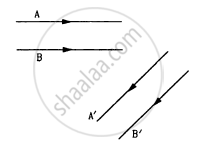
following Figure shows two rays A and B being reflected by a mirror and going as A' and B'. The mirror
पर्याय

  • is plane

  • is convex

  • is concave

  • may be any spherical mirror.

MCQ
Advertisements

उत्तर

is plane

    This is because the reflected rays are still parallel, which is only possible if the mirror is a plane mirror. A spherical mirror will either converge or diverge the reflected rays.

shaalaa.com
  या प्रश्नात किंवा उत्तरात काही त्रुटी आहे का?
पाठ 18: Geometrical Optics - MCQ [पृष्ठ ४११]

APPEARS IN

एचसी वर्मा Concepts of Physics Vol. 1 [English] Class 11 and 12
पाठ 18 Geometrical Optics
MCQ | Q 5 | पृष्ठ ४११

संबंधित प्रश्‍न

a) Give two reasons to explain why reflecting telescopes are preferred over refracting type.


Use the mirror equation to show that a convex mirror always produces a virtual image independent of the location of the object.


Using mirror formula, explain why does a convex mirror always produce a virtual image.


A point object O is placed at a distance of 15cm from a convex lens L of focal length 1 Ocm as shown in Figure 5 below. On the other side of the lens, a convex mirror M is placed such that its distance from the lens is equal to the focal length of the lens. The final image formed by this combination is observed to coincide with the object O. Find the focal length of the convex mirror


Use the mirror equation to show that an object placed between f and 2f of a concave mirror forms an image beyond 2f.


Use the mirror equation to show a convex mirror always produces a virtual image independent of the location of the object ?


Can a plane mirror ever form a real image?


The rays of different colours fail to converge at a point after going through a converging lens. This defect is called


Which of the following (referred to a spherical mirror) do (does) not depend on whether the rays are paraxial or not?
(a) Pole
(b) Focus
(c) Radius of curvature
(d) Principal axis


A cylindrical vessel of diameter 12 cm contains 800π cm3 of water. A cylindrical glass piece of diameter 8.0 cm and height 8.0 cm is placed in the vessel. If the bottom of the vessel under the glass piece is seen by the paraxial rays (see figure), locate its image. The index of refraction of glass is 1.50 and that of water is 1.33.


A light ray is incident normally on the face AB of a right-angled prism ABC (μ = 1.50) as shown in figure. What is the largest angle ϕ for which the light ray is totally reflected at the surface AC?


Write any one use for each of the following mirrors : 

(a) Convex

(b) Concave 


For paraxial rays, show that the focal length of a spherical mirror is one-half of its radius of curvature.


A point object is placed at a distance of 20 cm from a thin plano-convex lens of focal length 15 cm, if the plane surface is silvered. The image will form at:


Car B overtakes car A at a relative speed of 40 ms-1. How fast will the image of car B appear to move in the mirror of focal length 10 cm fitted in car A, when car B is 1.9 m away from car A?


When a clock is viewed in a mirror, the needles exhibit a time which appears to be 8:20. Then the actual time will be:


A convex lens of focal length 15 cm is placed coaxially in front of a convex mirror. The lens is 5 cm from the pole of the mirror. When an object is placed on the axis at a distance of 20 cm from the lens, it is found that the image coincides with the object. Calculate the radius of curvature of the mirror - (consider all-optical event): 


Share
Notifications

Englishहिंदीमराठी


      Forgot password?
Use app×