Advertisements
Advertisements
प्रश्न
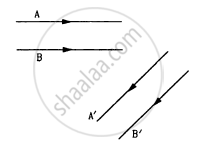
following Figure shows two rays A and B being reflected by a mirror and going as A' and B'. The mirror
विकल्प
is plane
is convex
is concave
may be any spherical mirror.
Advertisements
उत्तर
is plane
This is because the reflected rays are still parallel, which is only possible if the mirror is a plane mirror. A spherical mirror will either converge or diverge the reflected rays.
APPEARS IN
संबंधित प्रश्न
Calculate the distance of an object of height h from a concave mirror of radius of curvature 20 cm, so as to obtain a real image of magnification 2. Find the location of the image also.
Use the mirror equation to show that an object placed between f and 2f of a concave mirror produces a real image beyond 2f.
Use the mirror equation to deduce that an object placed between the pole and focus of a concave mirror produces a virtual and enlarged image.
An object is kept on the principal axis of a concave mirror of focal length 10 cm. at a distance of 15
cm from its pole. The image formed by the mirror is:
(a) Virtual and magnified
(b) Virtual and diminished
(c) Real and magnified
(d) Real and diminished
A point object O is placed at a distance of 15cm from a convex lens L of focal length 1 Ocm as shown in Figure 5 below. On the other side of the lens, a convex mirror M is placed such that its distance from the lens is equal to the focal length of the lens. The final image formed by this combination is observed to coincide with the object O. Find the focal length of the convex mirror

Use the mirror equation to show a convex mirror always produces a virtual image independent of the location of the object ?
Can a plane mirror ever form a real image?
A point source of light is placed in front of a plane mirror.
The rays of different colours fail to converge at a point after going through a converging lens. This defect is called
A light ray falling at an angle of 45° with the surface of a clean slab of ice of thickness 1.00 m is refracted into it at an angle of 30°. Calculate the time taken by the light rays to cross the slab. Speed of light in vacuum = 3 × 10⁸ m s−1.
A light ray is incident normally on the face AB of a right-angled prism ABC (μ = 1.50) as shown in figure. What is the largest angle ϕ for which the light ray is totally reflected at the surface AC?

Name the physical principle on which the working of optical fibers is based.
The figure below shows the positions of a point object O, two lenses, a plane mirror and the final image I which coincides with the object. The focal length of the convex lens is 20 cm. Calculate the focal length of the concave lens.

For paraxial rays, show that the focal length of a spherical mirror is one-half of its radius of curvature.
Car B overtakes car A at a relative speed of 40 ms-1. How fast will the image of car B appear to move in the mirror of focal length 10 cm fitted in car A, when car B is 1.9 m away from car A?
When a clock is viewed in a mirror, the needles exhibit a time which appears to be 8:20. Then the actual time will be:
