Advertisements
Advertisements
The anode of a thermionic diode is connected to the negative terminal of a battery and the cathode to its positive terminal.
Concept: undefined >> undefined
The constant A in the Richardson−Dushman equation for tungsten is 60 × 104 A m−2K−2. The work function of tungsten is 4.5 eV. A tungsten cathode with a surface area 2.0 × 10⁻⁵ m2 is heated by a 24 W electric heater. In steady state, the heat radiated by the heater and the cathode equals the energy input by the heater and the temperature becomes constant. Assuming that the cathode radiates like a blackbody, calculate the saturation current due to thermions. Take Stefan's Constant = 6 × 10⁻⁸ W m−2 K−1. Assume that the thermions take only a small fraction of the heat supplied.
Concept: undefined >> undefined
Advertisements
Explain the terms : Transmitter in communication system
Concept: undefined >> undefined
Why are coils of electric toasters and electric irons made of an alloy rather than a pure metal?
Concept: undefined >> undefined
Find the condition under which the charged particles moving with different speeds in the presence of electric and magnetic field vectors can be used to select charged particles of a particular speed.
Concept: undefined >> undefined
Asha's mother read an article in the newspaper about a disaster that took place at Chernobyl. She could not understand much from the articles and asked a few questions from Asha regarding the article. Asha tried to answer her mother's questions based on what she learnt in Class XII Physics.
(a) What was the installation at Chernobyl where the disaster took place? What according to you, was the cause of this disaster?
(b) Explain the process of release of energy in the installation at Chernobyl.
(c) What according to you, were the values displayed by Asha and her mother?
Concept: undefined >> undefined
The wavefronts of a light wave travelling in vacuum are given by x + y + z = c. The angle made by the direction of propagation of light with the X-axis is _________ .
Concept: undefined >> undefined
The wavefronts of light coming from a distant source of unknown shape are nearly _________ .
Concept: undefined >> undefined
Calculate the electric field in a copper wire of cross-sectional area 2.0 mm2 carrying a current of 1 A.
The resistivity of copper = 1.7 × 10⁻⁸ Ω m
Concept: undefined >> undefined
A wire has a length of 2.0 m and a resistance of 5.0 Ω. Find the electric field existing inside the wire if it carries a current of 10 A.
Concept: undefined >> undefined
Two proton beams going in the same direction repel each other whereas two wires carrying currents in the same direction attract each other. Explain.
Concept: undefined >> undefined
A moving charge produces
Concept: undefined >> undefined
Consider a long, straight wire of cross-sectional area A carrying a current i. Let there be n free electrons per unit volume. An observer places himself on a trolley moving in the direction opposite to the current with a speed \[v = \frac{i}{\text{nAe}}\] and separation from the wire by a distance r. The magnetic field seen by the observer is very nearly
Concept: undefined >> undefined
A metallic loop is placed in a nonuniform magnetic field. Will an emf be induced in the loop?
Concept: undefined >> undefined
An inductor is connected to a battery through a switch. Explain why the emf induced in the inductor is much larger when the switch is opened as compared to the emf induced when the switch is closed.
Concept: undefined >> undefined
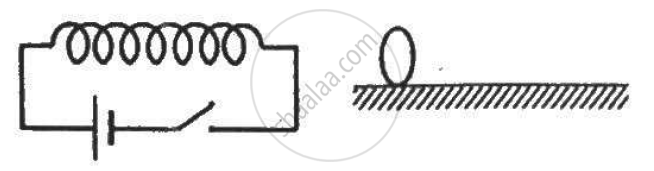
Figure shows a horizontal solenoid connected to a battery and a switch. A copper ring is placed on a frictionless track, the axis of the ring being along the axis of the solenoid. As the switch is closed, the ring will __________ .
Concept: undefined >> undefined
The magnetic field energy in an inductor changes from maximum to minimum value in 5.0 ms when connected to an AC source. The frequency of the source is
Concept: undefined >> undefined
An inductor, a resistance and a capacitor are joined in series with an AC source. As the frequency of the source is slightly increased from a very low value, the reactance
Concept: undefined >> undefined
An inductor coil of some resistance is connected to an AC source. Which of the following quantities have zero average value over a cycle?
(a) Current
(b) Induced emf in the inductor
(c) Joule heat
(d) Magnetic energy stored in the inductor
Concept: undefined >> undefined
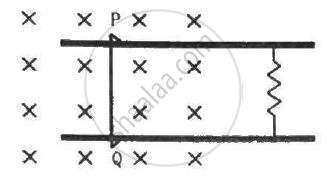
Consider the situation shown in figure. The wire PQ has mass m, resistance r and can slide on the smooth, horizontal parallel rails separated by a distance l. The resistance of the rails is negligible. A uniform magnetic field B exists in the rectangular region and a resistance R connects the rails outside the field region. At t = 0, the wire PQ is pushed towards right with a speed v0. Find (a) the current in the loop at an instant when the speed of the wire PQ is v, (b) the acceleration of the wire at this instant, (c) the velocity vas a functions of x and (d) the maximum distance the wire will move.
Concept: undefined >> undefined
