Advertisements
Advertisements
प्रश्न
An inductor is connected to a battery through a switch. Explain why the emf induced in the inductor is much larger when the switch is opened as compared to the emf induced when the switch is closed.
Advertisements
उत्तर
When we close the switch, the current takes some time to grow in the circuit. Due to this growth of current, the flux increases; hence, an emf is induced. On the other hand, when we open the switch, there is no path for the current to flow; hence, it suddenly drops to zero. This rate of decrease of current is much greater than the rate of growth of current when the switch is closed. So, when the switch is opened, the induced emf is more.
APPEARS IN
संबंधित प्रश्न
Draw a schematic sketch of an ac generator describing its basic elements. State briefly its working principle. Show a plot of variation of
(i) Magnetic flux and
(ii) Alternating emf versus time generated by a loop of wire rotating in a magnetic field.
A metallic loop is placed in a nonuniform magnetic field. Will an emf be induced in the loop?
Answer the following question.
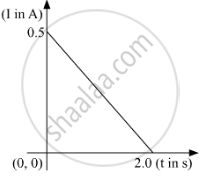
When a conducting loop of resistance 10 Ω and area 10 cm2 is removed from an external magnetic field acting normally, the variation of induced current-I in the loop with time t is as shown in the figure.
Find the
(a) total charge passed through the loop.
(b) change in magnetic flux through the loop
(c) magnitude of the field applied
The magnetic flux linked with a coil of N turns of area of cross-section A held with its plane parallel to the field B is ______.
Two inductors of inductance L each are connected in series with the opposite? magnetic fluxes. The resultant inductance is ______.
The unit of magnetic flux in SI is ______
A square of side L meters lies in the x-y plane in a region, where the magnetic field is given by `B = Bo(2hati + 3hatj + 4hatk)`T, where B0 is constant. The magnitude of flux passing through the square is ______.
A coil is placed in a time varying magnetic field. If the number of turns in the coil were to be halved and the radius of wire doubled, the electrical power dissipated due to the current induced in the coil would be: (Assume the coil to be short circuited.)
The Figure below shows an infinitely long metallic wire YY' which is carrying a current I'.
P is a point at a perpendicular distance r from it.
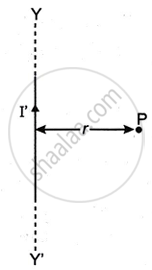
- What is the direction of magnetic flux density B of the magnetic field at the point P?
- What is the magnitude of magnetic flux density B of the magnetic field at the point P?
- Another metallic wire MN having length l and carrying a current I is now kept at point P. If the two wires are in vacuum and parallel to each other, how much force acts on the wire MN due to the current I' flowing in the wire YY'?
Which symbol represents magnetic flux?
When every turn of a coil of \[N\] turns contributes equally, what is its magnetic flux linkage?
What condition is specified for using \[\Phi=NBA\cos\theta\] as the magnetic flux linkage of a coil?
What is the SI unit of magnetic flux?
Which equivalent unit of magnetic flux uses tesla and square metres?
What is the nature of magnetic flux?
What is the dimensional formula of magnetic flux?
When is magnetic flux maximum relative to the plane of the surface?
What happens to magnetic flux when area \[A\] increases while magnetic field and orientation remain unchanged?
Which expression relates induced emf to the change in magnetic flux for a coil of \[N\] turns?
Why does the number of magnetic field lines entering a closed surface equal the number leaving it?
