Advertisements
Advertisements
प्रश्न
A square loop MNOP of side 20 cm is placed horizontally in a uniform magnetic field acting vertically downwards as shown in the figure. The loop is pulled with a constant velocity of 20 cm s−1 till it goes out of the field.
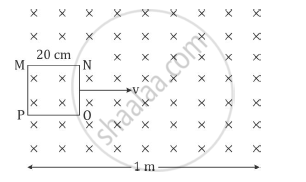
(i) Depict the direction of the induced current in the loop as it goes out of the field. For how long would the current in the loop persist?
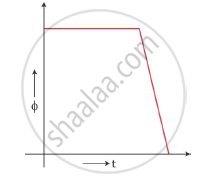
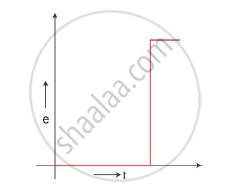
(ii) Plot a graph showing the variation of magnetic flux and induced emf as a function of time.
Advertisements
उत्तर
(i)The direction of induced current in the loop as it goes out is depicted in the figure below.
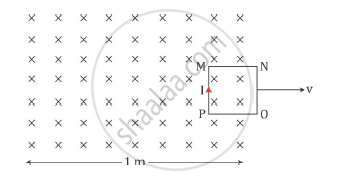
The current will persist till the entire loop comes out of the field. Hence, we have
`t=d/v=(20 cm)/(20 `
Hence, the current will persist for 1 second.
(ii)The magnetic flux in the coil when it is inside the field is constant. This maximum flux is given as Φ = Bla (a is the side of the square loop). This flux will start dropping once the loop comes out of the field and will be zero when it is completely out of the field.
The e.m.f. induced in the coil when it is inside the field is zero as the flux is not changing. When the loop just comes out of the field, the flux change is maximum and the e.m.f. induced is `e=(dphi)/dt=-Bl(db)/(dt)=-Blv` This e.m.f remains constant till the entire loop comes out. When the loop is completely out of the field, the e.m.f. drops to zero again.
APPEARS IN
संबंधित प्रश्न
Ram is a student of class X in a village school. His uncle gifted him a bicycle with a dynamo fitted in it. He was very excited to get it. While cycling during night, he could light the bulb and see the objects on the road. He, however, did not know how this device works. he asked this question to his teacher. The teacher considered it an opportunity to explain the working to the whole class.
Answer the following questions:
(a) State the principle and working of a dynamo.
(b) Write two values each displayed by Ram and his school teacher.
The current flowing through an inductor of self inductance L is continuously increasing. Plot a graph showing the variation of
Magnetic flux versus the current
A rectangular coil having 60 turns and area of 0.4m2 is held at right angles to a uniform magnetic field of flux density 5 × 10⁻⁵T. Calculate the magnetic flux passing through it.
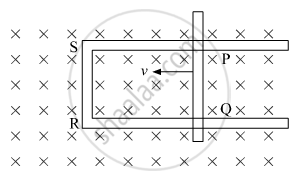
Figure shows a rectangular loop conducting PQRS in which the arm PQ is free to move. A uniform magnetic field acts in the direction perpendicular to the plane of the loop. Arm PQ is moved with a velocity v towards the arm Rs. Assuming that the arms QR, RS and SP have negligible resistances and the moving arm PQ has the resistance r, obtain the expression for (i) the current in the loop (ii) the force and (iii) the power required to move the arm PQ.
An inductor is connected to a battery through a switch. Explain why the emf induced in the inductor is much larger when the switch is opened as compared to the emf induced when the switch is closed.
Find magnetic flux density at a point on the axis of a long solenoid having 5000 tums/m when it carrying a current of 2 A.
The magnetic flux linked with the coil (in Weber) is given by the equation- Փ = 5t2 + 3t + 16. The induced EMF in the coil at time, t = 4 will be ______.
The magnetic flux linked with a coil in Wb is given by the equation Φ = 3t2 + 4t + 9. Then the magnitude of induced emf at t = 2 sec will be ______.
The dimensional formula of magnetic flux is ______.
A circular coil of 1000 turns each with area 1 m2 is rotated about its vertical diameter at the rate of one revolution per second in a uniform horizontal magnetic field of 0.07T. The maximum voltage generation will be ______ V.
