Please select a subject first
Advertisements
Advertisements
For the hydrolysis of methyl acetate in aqueous solution, the following results were obtained :
| t/s | 0 | 30 | 60 |
| [CH3COOCH3] / mol L–1 | 0.60 | 0.30 | 0.15 |
(i) Show that it follows pseudo first order reaction, as the concentration of water remains constant.
(ii) Calculate the average rate of reaction between the time interval 30 to 60 seconds.
(Given log 2 = 0.3010, log 4 = 0.6021)
Concept: undefined >> undefined
For a chemical reaction R → P, the variation in the concentration (R) vs. time (t) plot is given as:
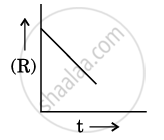
(i) Predict the order of the reaction.
(ii) What is the slope of the curve?
(iii) Write the unit of rate constant for this reaction.
Concept: undefined >> undefined
Advertisements
The following data were obtained during the first order thermal decomposition of SO2Cl2 at a constant volume :
SO2Cl2 (g) → SO2 (g) + Cl2 (g)
| Experiment | Time/s–1 | Total pressure/atm |
| 1 | 0 | 0.4 |
| 2 | 100 | 0.7 |
Calculate the rate constant.
(Given : log 4 = 0.6021, log 2 = 0.3010)
Concept: undefined >> undefined
Describe the roles of the following: SiO2 in the extraction of copper from copper matte
Concept: undefined >> undefined
Name the method used for refining of copper metal.
Concept: undefined >> undefined
Classify the following solids in different categories based on the nature of intermolecular forces operating in them:
Potassium sulphate, tin, benzene, urea, ammonia, water, zinc sulphide, graphite, rubidium, argon, silicon carbide.
Concept: undefined >> undefined
Classify each of the following solids as ionic, metallic, molecular, network (covalent) or amorphous.
- Tetra phosphorus decoxide (P4O10)
- Ammonium phosphate (NH4)3PO4
- SiC
- I2
- P4
- Plastic
- Graphite
- Brass
- Rb
- LiBr
- Si
Concept: undefined >> undefined
For a reaction, \[\ce{A + B -> Product}\]; the rate law is given by, `r = k[A]^(1/2)[B]^2`. What is the order of the reaction?
Concept: undefined >> undefined
The conversion of molecules X to Y follows second order kinetics. If concentration of X is increased to three times how will it affect the rate of formation of Y?
Concept: undefined >> undefined
From the rate expression for the following reaction, determine the order of reaction and the dimension of the rate constant.
\[\ce{3NO_{(g)} -> N2O_{(g)}}\] Rate = k[NO]2
Concept: undefined >> undefined
From the rate expression for the following reaction, determine the order of reaction and the dimension of the rate constant.
\[\ce{H2O2_{( aq)} + 3I^-_{( aq)} + 2H^+ -> 2H2O_{(l)} + I^-_3}\] Rate = k[H2O2][I−]
Concept: undefined >> undefined
From the rate expression for the following reaction, determine the order of reaction and the dimension of the rate constant.
\[\ce{CH3CHO_{(g)} -> CH4_{(g)} + CO_{(g)}}\] Rate = k [CH3CHO]3/2
Concept: undefined >> undefined
From the rate expression for the following reaction, determine the order of reaction and the dimension of the rate constant.
\[\ce{C2H5Cl_{(g)} -> C2H4_{(g)} + HCl_{(g)}}\] Rate = k [C2H5Cl]
Concept: undefined >> undefined
For the reaction:
\[\ce{2A + B → A2B}\]
the rate = k[A][B]2 with k = 2.0 × 10⁻⁶ mol−2 L2 s−1. Calculate the initial rate of the reaction when [A] = 0.1 mol L−1, [B] = 0.2 mol L−1. Calculate the rate of reaction after [A] is reduced to 0.06 mol L−1.
Concept: undefined >> undefined
Mention the factors that affect the rate of a chemical reaction.
Concept: undefined >> undefined
A reaction is second order with respect to a reactant. How is the rate of reaction affected if the concentration of the reactant is doubled?
Concept: undefined >> undefined
A reaction is first order in A and second order in B. Write the differential rate equation.
Concept: undefined >> undefined
A reaction is first order in A and second order in B. How is the rate affected on increasing the concentration of B three times?
Concept: undefined >> undefined
A reaction is first order in A and second order in B. How is the rate affected when the concentrations of both A and B are doubled?
Concept: undefined >> undefined
