Please select a subject first
Advertisements
Advertisements
What adjustments would you make for tuning a stringed instrument for it to emit a note of a desired frequency?
Concept: undefined >> undefined
The following diagram shows three ways in which the string of an instrument can vibrate.
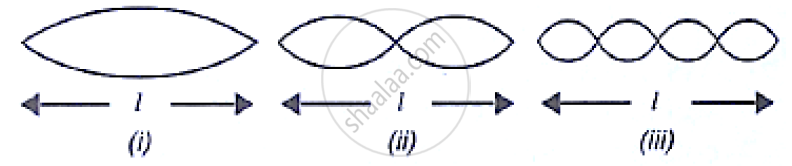
(a) which of the diagram shows the principal note?
(b) which has the frequency four times that of the first?
(c) what is the ratio of the frequency of the vibration in (i) and (ii)?
Concept: undefined >> undefined
Advertisements
A pair of scissors is used to cut a piece of a cloth by keeping it at a distance 8.0 cm from its rivet and applying an effort of 10 kgf by fingers at a distance 2.0 cm from the rivet.
- Find:
- the mechanical advantage of scissors and
- the load offered by the cloth.
- How does the pair of scissors act: as a force multiplier or as speed multiplier?
Concept: undefined >> undefined
The figure below shows the use of a lever.

- State the principle of moments as applied to the above lever.
- To which class of lever does it belong ? Give an example of this class of lever.
- If FA = 10 cm, AB = 490 cm calculate:
- the mechanical advantage and
- the minimum effort required to lift the load (= 50 N).
Concept: undefined >> undefined
Draw a circuit diagram to expain the ring system of house wiring. State two advantage of it.
Concept: undefined >> undefined
Draw a labelled diagram with necessary switch, regulator, etc. to connect a bulb and a fan with the mains. In what arrangement are they connected to the mains : series or parallel?
Concept: undefined >> undefined
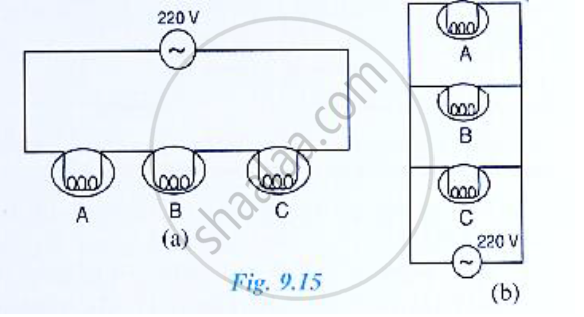
Fig 9.15 shows two ways (a) and (b) of connecting the three lamps A, B and C to a.c. supply of 220 V. Name the two arrangements. Which of them would you prefer in a household circuit? Give reason for your answer.
Concept: undefined >> undefined
State a law, which determines the direction of magnetic field around a current carrying wire.
Concept: undefined >> undefined
A current of 1.6 mA flows through a conductor. If charge on an electron is –1.6 × 10⁻¹⁹ coulomb, find the number of electrons that will pass each second through the cross section of that conductor.
Concept: undefined >> undefined
A straight wire lying in a horizontal plane carries a current from north to south.
- What will be the direction of magnetic field at a point just underneath it?
- Name the law used to arrive at the answer in part (a).
Concept: undefined >> undefined
The V-I graph for a series combination and for a parallel combination of two resistors is shown in Fig – 8.38. Which of the two, A or B, represents the parallel combination? Give a reason for your answer.
Concept: undefined >> undefined
Explain optical centre of a lens with the help of proper diagram(s).
Concept: undefined >> undefined
State the condition when a lens is called an equi-convex or equi-concave.
Concept: undefined >> undefined
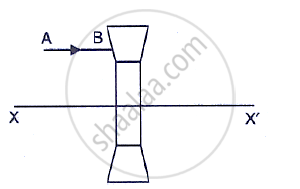
The diagram below shows a lens as a combination of a glass slab and two prisms.
- Name the lens formed by the combination.
- What is the line XX’ called?
- Complete the path of the incident ray AB after passing through the lens.
- The final emergent ray either meets XX’ at a point or appears to come from a point on XX’. Label it as F. What is this point called?
Concept: undefined >> undefined
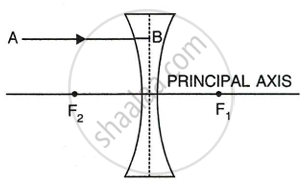
In the following figure (a) and (b), F1 and F2 are positions of the two foci of thin lenses. Draw the path taken by the light ray AB after it emerges from each lens.
 |
| (a) |
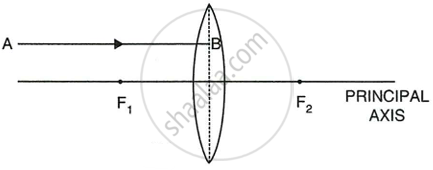 |
| (b) |
Concept: undefined >> undefined
In figure, (a) and (b), F1 and F2 are the two foci of thin lenses and AB is the incident ray. Complete the diagram to show the path of the ray AB after refraction through each lens.
 |
| (a) |
 |
| (b) |
Concept: undefined >> undefined
A ray of light after refraction through a lens emerges parallel to the principal axis of the lens. The incident ray either passes through ______.
Concept: undefined >> undefined
A ray of light incident on a lens parallel to its principal axis, after refraction passes through or appears to come from ______.
Concept: undefined >> undefined
In the diagram below, XX’ represents the principal axis, O the optical centre and F the focus of the lens. Complete the path of rays A and B as they emerge out of the lens.
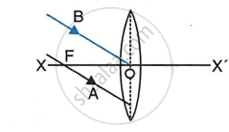 |
 |
| (a) | (b) |
Concept: undefined >> undefined
