Advertisements
Advertisements
Concept: undefined >> undefined
Advertisements
Concept: undefined >> undefined
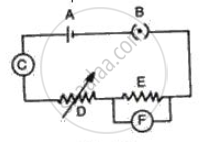
Fig. represents the circuit used for the verification of ohm's law. Label the different parts from A and F. State the function of each.
Concept: undefined >> undefined
Tick(✓) the correct choice in the following:
Ohm's law is applicable to
Concept: undefined >> undefined
Define the following:
Coulomb
Concept: undefined >> undefined
Concept: undefined >> undefined
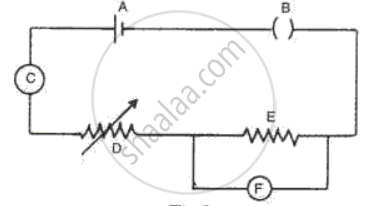
Fig. represents the circuit used for the verification of Ohm's law. Label the parts from A to F. state the function of each.
Concept: undefined >> undefined
A uniform metre rule balances horizontally on a knife edge placed at the 58 cm mark when a weight of 20 gf is suspended from one end.
- Draw a diagram of the arrangement.
- What is the weight of the rule?
Concept: undefined >> undefined
The diagram in Fig. shows a uniform metre rule weighing 100 gf, pivoted at its centre O. Two weights 150 gf and 250 gf hang from the point A and B respectively of the metre rule such that OA = 40 cm and OB = 20 cm. Calculate :
- the total anticlockwise moment about O,
- the total clockwise moment about O,
- the difference of anticlockwise and clockwise moments, and
- the distance from O where a 100 gf weight should be placed to balance the metre rule.

Concept: undefined >> undefined
A uniform metre rule of weight 10 gf is pivoted at its 0 mark.
- What moment of force depresses the rule?
- How can it be made horizontal by applying a least force?
Concept: undefined >> undefined
A uniform half-metre rule can be balanced at the 29.0 cm mark when a mass of 20 g is hung from its one end.
- Draw a diagram of the arrangement.
- Find the mass of the half-metre rule.
- In which direction would the balancing point shift if 20 g mass is shifted inside from its one end?
Concept: undefined >> undefined
A uniform metre rule of mass 100g is balanced on a fulcrum at mark 40cm by suspending an unknown mass m at the mark 20cm. What is the resultant moment now?
Concept: undefined >> undefined
A uniform metre rule of mass 100g is balanced on a fulcrum at mark 40cm by suspending an unknown mass m at the mark 20cm.
How can it be balanced by another mass 50 g ?
Concept: undefined >> undefined
A lever of length 9 cm has its load arm 5 cm long and the effort arm is 9 cm long.
- To which class does it belong?
- Draw a diagram of the lever showing the position of fulcrum F and directions of both the load L and effort E.
- What is the mechanical advantage and velocity ratio if the efficiency is 100%?
- What will be the mechanical advantage and velocity ratio if the efficiency becomes 50%?
Concept: undefined >> undefined
- Name and state the law which relates the potential difference and current in a conductor.
- What is the necessary condition for a conductor to obey the law named above in part (a) ?
Concept: undefined >> undefined
The filament of a bulb takes a current 100 mA when potential difference across it is 0.2 V. When the potential difference across it becomes 1.0 V, the current becomes 400 mA. Calculate the resistance of filament in each case and account for the difference.
Concept: undefined >> undefined
Which type of levers have mechanical advantage always more than 1? Give reasons.
Concept: undefined >> undefined
Give three examples for leavers of 1st order.
Concept: undefined >> undefined
Give three examples for leavers of second order.
Concept: undefined >> undefined
