Please select a subject first
Advertisements
Advertisements
State Mendel’s law of Independent Assortment.
Concept: undefined >> undefined
A homozygous Tall plant (T) bearing red coloured (R) flowers is crossed with a homozygous dwarf plant (t) bearing white flowers (r):
(1) Give the Genotype and Phenotype of the F2 generation.
(2) Give the possible combinations of the gametes that can be obtained from the F2 hybrid.
(3) Give the dihybrid ratio and the phenotype of the offsprings of the F2 generation when two plants of the F1 generation above are crossed.
Concept: undefined >> undefined
Advertisements
Give Technical Term:
The ratio of offspring on F2 generation in a dihybrid cross.
Concept: undefined >> undefined
How is root hair structurally adapted for absorption of water from the soil?
Concept: undefined >> undefined
Root hairs become flaccid, when fertilizers are added to the moist soil around it. Explain.
Concept: undefined >> undefined
What is toxicity ?
Concept: undefined >> undefined
Grapes shrink when immersed in a very strong sugar solution.” Explain.
Concept: undefined >> undefined
Complete the following sentence with appropriate word:
_______ is the ratio of dihybrid cross.
Concept: undefined >> undefined
Complete the following sentence with appropriate word:
A character that is suppressed is _________.
Concept: undefined >> undefined
A few RBC’s were kept in three test tubes containing isotonic, hypotonic and hypertonic solutions. What will be the expected observations after a few hours? Explain.
Concept: undefined >> undefined
Multiple Choice Question
When two individuals differing in at least one character are crossed, the process is known as:
Concept: undefined >> undefined
Differentiate between the following
Permeable and Semi-permeable membrane.
Concept: undefined >> undefined
The alongside diagram A shows a root hair growing through the soil particles. Diagram B is the root hair of an aquatic plant.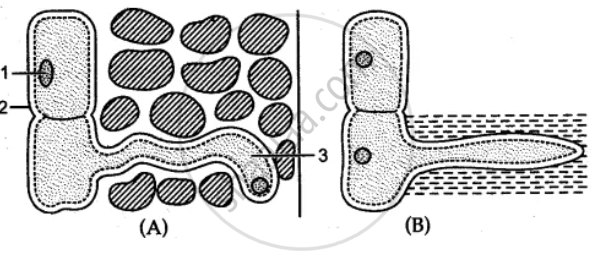
(i) Name the parts 1,2,3.
(ii) Name two substances which enter the root hair. What are their uses?
(iii) By what process do these substances enter the root hair?
(iv) Account for the different shapes of root hairs in the two diagrams.
Concept: undefined >> undefined
Given below is the diagram of a cell as seen under the microscope after having been placed in a solution:

(i) What is the technical term used for the state/condition of the cell given above?
(ii) Give the technical term for the solution in which the cell was placed.
(iii) Name the parts numbered 1 to 4.
(iv) Is the cell given above a plant cell or an animal cell ? Give two reasons in support of your answer as evident from the diagram.
(v) What would you do to bring this cell back to its original condition?
Concept: undefined >> undefined
Draw a cross-section of root showing association of soil particles with root hairs.
Concept: undefined >> undefined
Draw a diagram of the root hair cell as it would appear when a concentrated solution of fertilizers is added near it.
Concept: undefined >> undefined
The figure given below is a diagrammatic representation of a part of the cross-section of the root in the root hair zone. Study the same and then answer the questions that follow :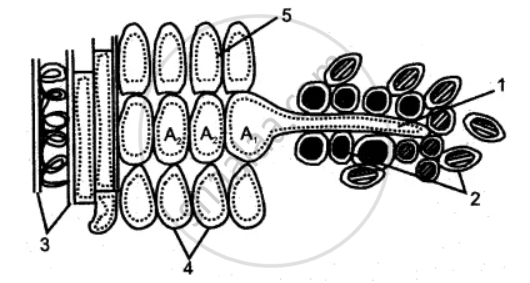
(i) Name the parts indicated by guidelines ‘1’ to ‘5’
(ii) Is the root hair cell unicellular or multi-cellular?
(iii) Draw a labeled diagram of the root hair cell as it would appear if some fertilizer is added to the soil close to it.
(iv) Name the process responsible for the entry of water molecules from the soil into A1 and then A2.
(v) What pressure is responsible for the movement of water in the direction indicated by arrows?
(vi) How is this pressure set up?
Concept: undefined >> undefined
The below figure shows a root hair: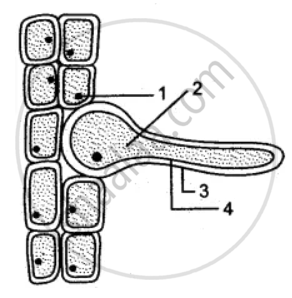
(i) Label the parts 1 to 4.
(ii) What is the role of part 4?
(iii) Why is the root hair one-celled?
(iv) What will happen to the root hair if some fertilizer is added to the soil near the root hair?
Concept: undefined >> undefined
The diagram given below represents the result of an experiment conducted on two freshly taken shoots of a green herbaceous plant. The lower ends dip in the water.
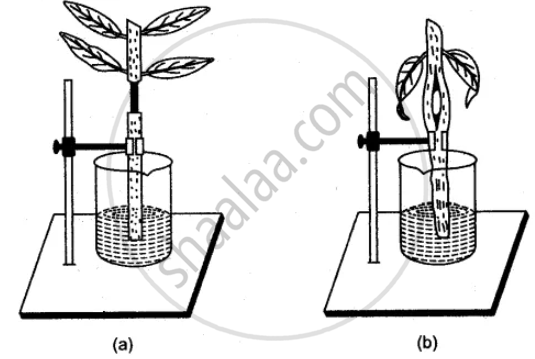
(i) What is the aim of the experiment?
(ii) Some parts of the stem in both the shoots have been removed. Name the conducting tissue in shoot A and in shoot B, that has been removed.
(iii) What are the results of this experiment?
Concept: undefined >> undefined
A thin strip of epidermal cells from the fleshy scales of an onion bulb was examined in a drop of water, under a microscope. All the epidermal cells looked alike and the figure alongside represents one of them. The thin strip was then transferred to a drop of strong sugar solution and re-examined under the microscope after about five minutes.

(i) Make a sketch of one of the epidermal cells, as it might appear after immersion in a strong sugar solution. Label any two parts which have undergone a change.
(ii) Give the scientific term for the change shown in Q.(i) above.
(iii) What would you do to bring this cell back to its original condition?
(iv) Give the scientific term used for the recovery of the cell as a result of the step taken in Q.(iii) above.
Concept: undefined >> undefined
