Advertisements
Advertisements
A uniform wire with a resistance of 27 Ω is divided into three equal pieces and then they are joined in parallel. Find the equivalent resistance of the parallel combination.
Concept: undefined >> undefined
A battery of e.m.f. 15 V and internal resistance 2 `Omega` is connected to two resistors of 4 ohm and 6 ohm joined.
(i) In series,
(ii) In parallel.
Find in each case the electrical energy spent per minute in 6 ohm resistor.
Concept: undefined >> undefined
Advertisements
Concept: undefined >> undefined
Show how would you connect three resistors, each of resistance 6 O so that
the combination has a resistance of(a) 9 Ω (b) 4 .Ω
Concept: undefined >> undefined
What are the advantages of a parallel connection?
Concept: undefined >> undefined
Explain, why is the p.d. between the terminals of a storage battery less when it is supplying current than when it is on open circuit. A battery of e.m.f. 10 volts and internal resistance 2.5 ohms has two resistances of 50 ohms each connected to it. Calculate the power dissipated in each resistance
(a) When they are in series,
(b) When they are in parallel.
In each case calculate the power dissipated in the battery.
Concept: undefined >> undefined
Tick (✓) the correct choice among the following :
Consider two cases of two parallel current carrying conductors. Current in
th e same direction and currents in th e opposi te directions will produce
Concept: undefined >> undefined
A cell supplies a current of 1.2 A through two 2Ω resistors connected in parallel. When the resistors are connected in series, if supplies a current of 0.4 A. Calculate the internal resistance and e.m.f of the cell.
Concept: undefined >> undefined
The circuit diagram Fig shows three resistors 2 Ω, 4 Ω and R Ω connected to a battery of e.m.f. 2 V and internal resistance 3 Ω. If main current of 0.25 A flows through the circuit, find:
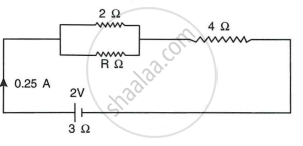
- the p.d. across the 4 Ω resistor,
- the p.d. across the internal resistance of the cell,
- the p.d. across the R Ω or 2 Ω resistors
- the value of R.
Concept: undefined >> undefined
Concept: undefined >> undefined
Concept: undefined >> undefined
Concept: undefined >> undefined
Show that the quantity 2K/v2 has the unit of mass, where K is the kinetic energy of the body.
Concept: undefined >> undefined
Two bodies A and B of masses m and M (M ≫ m) have same kinetic energy. Which body will have more momentum?
Concept: undefined >> undefined
A pebble is thrown up. It goes to a height and then comes back on the ground. State the different changes in form of energy during its motion.
Concept: undefined >> undefined
Name the form of energy in which potential energy can change.
Concept: undefined >> undefined
A body of mass 5 kg falls from a height of 10 m to 4 m. Calculate:
The total energy possessed by the body at any instant? (Take g = 10 ms-2).
Concept: undefined >> undefined
Calculate the decrease in the kinetic energy of a moving body if its velocity reduces to half of the initial velocity.
Concept: undefined >> undefined
A ball of mass 0.5 kg slows down from a speed of 5m/s-1 to that of 3m/s-1. Calculate the change in kinetic energy of the ball.
Concept: undefined >> undefined
A metal ball of mass 2kg is allowed to fall freely from rest from a height of 5m above the ground.
What the kinetic energy of the ball just before it hits the ground ?
Concept: undefined >> undefined
