Advertisements
Advertisements
In pairs, match A and B to produce likely phrases.
| A | B |
| A(n)
Some A pair of A piece of |
horse |
There is sometimes more than one sensible combination as in the example.

Concept: undefined >> undefined
Look at the pairs below. Draw a sketch to show the difference in meaning, as in the example:

- (a) cloth
(b) a cloth - (a) rubber
(b) a rubber - (a) lamb
(b) a lamb - (a) glass
(b) a glass
Concept: undefined >> undefined
Advertisements
Carbon Footprint - Project Work
A carbon footprint is a representation of the effect human activities have on the climate in terms of the total amount of greenhouse gases produced (measured in units of carbon dioxide). So, it is a measure of the impact we make individually on the earth; by the choices we make regarding our lifestyle. Many activities generate carbon emissions, which contribute towards accelerating global warming and climate change.
Total carbon footprint/ emission quantification would include energy emissions from human activities - such as, from heat, light, power and refrigeration and all transport related emissions from cars, freight and distribution.
By measuring the carbon footprint through such tools as carbon calculators, we can get a better sense of what the individual impact is and which parts of our lifestyle deserve strict regulation.
In groups, choose and research any one aspect of how we are leaving carbon footprints and how can we modify our lifestyle. Each group will then make a project on the various aspects.
Concept: undefined >> undefined
Compounds—someone, nothing etc.
| someone | anyone | none | everyone |
| somebody | anybody | nobody | everybody |
| something | anything | nothing | everything |
| somewhere | anywhere | nowhere | everywhere |
(Words ending with one and body mean the same.)
Fill in the gaps with some of the words from the table above:
- He can’t hear _____ . He’s completely deaf.
- _______ is going blurred. I can’t see!
- He’s looked ______ but he can’t find it.
- It must be _________ ! Look carefully.
- ______ must move or the horse will be scared.
- It doesn’t matter what you wear, ______ will do.
- She is very popular. _______ likes her.
- Shh! There is _____________ moving downstairs.
- Don’t worry! It’s _________ frightening. It is only the wind.
- It’s a public holiday, so____________ is open.
Concept: undefined >> undefined
Read the following excerpts from newspapers on various environmental issues.
Ban the Bag
The Indus Valley Civilisation left beautifullycrafted pottery that speaks volumes of the advances its people made. After 3,000 years, if the ruins we leave behind are excavated, chances are only plastic bags would be dug up. It may sound like an exaggeration, but these bags are not biodegradable. Apart from causing emissions when these are manufactured, noxious fumes are released while these are being burnt or disposed off. So, be kind to Mother Earth the next time you go shopping for groceries, remember to carry a cloth bag with you.

What India Should Do
India has released the National Action Plan on Climate Change. Is it adequate? Is there more that the country can do? Here are some ways how we can make a difference.
(a) SOLAR MISSION
1) To promote the use of solar energy through solar photovoltaic and thermal systems for power generation .
2) To integrate other renewable energy technologies like biomass and wind. 
(b) ENERGY EFFICIENCY
1) To mitigate GHG through sector-specific and cross-cutting technology and fuel switch options.
2) To use more LNG and biomass fuels besides seeking tech transfer. 
(c) SUSTAINABLE HABITAT
1) To promote energy efficiency in the residential and commercial sectors through LPG use.
2) To manage municipal solid waste and urban public transport in a better way. 
(d) WATER MISSION
1) To promote efficient water use, augment supply in critical areas and ensure effective management of water resources.
2) To have better management of surface and groundwater,and conserve wetlands. 
(e) SUSTAINING HIMALAYAS
1) To enhance monitoring and conservation of the Himalayan ecosystems, empower local communities for management of ecological resources and promote sustainable tourism. 
(f) GREEN INDIA
1) To reduce fragmentation of forests, enhance public and private investments for plantation, upscale joint forestry management and promote conservation of biodiversity. Need to afforest degraded lands.

(g) SUSTAINABLE AGRICULTURE :
1) To focus on four crucial areas - dry land agriculture, risk management, access to information and promoting the use of biotechnology.
2) To develop drought and pest resistant varieties. 
Concept: undefined >> undefined

Work in pairs and recognise how many words belong to each set. Complete the sentences as in the example. Use words only from the box above:
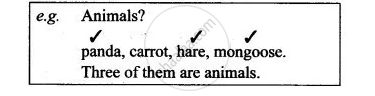
- Chemical elements?
Mercury, iron, ammonia__________ of___________ are chemical elements. - Countries in South America?
Brazil, Syria, Sumatra One____________ is a country in South America. - Rivers?
Hwang Ho, Mekong ____________ them are rivers. - Languages?
Telugu, Bengali, Punjabi, Holland____________are languages. - Capital cities?
Pokhara, Mandalay, New York, Melbourne___________of ____________a capital. - Grow on trees?
Pineapple, tomato_______________ of them grows on trees. - Religions?
Taoism, Democracy, Communism ____________of ____________ is a religion. - Units of currency?
rupee, kyat, yen, dollar, baht, rupiah ____________are units of currency.
Concept: undefined >> undefined
(a) Write three similar quiz questions on a piece of paper as part of homework.
(b) Pairwork: Swap questions with your partner. Write the answers to your partner’s questions and return them to be marked by your partner.
Concept: undefined >> undefined
Personal Pronouns
Read the following conversation:
Malavika and Deepak are looking through some photographs of Malavika’s family.
Malavika : Now … this is my brother Shantanu. Shantanu is in Class VIII. Shantanu is brilliant at playing tennis. Shantanu is also good at singing. Shantanu sings a lot.
Deepak : Shantanu sounds interesting. I’d like to meet Shantanu. I’m looking for someone to play tennis with.
Malavika : Well … why don’t you come around tonight and meet Shantanu? My parents will be out. My parents always go out on Tuesdays.
Improve the above conversation by using suitable pronouns where required.
Concept: undefined >> undefined
In groups, work on one of the topics mentioned in 8(a)-(g). Research your topic by collecting relevant articles from the print and electronic media (like the National Geographic). Make a power point presentation of 10-12 minutes. You can also use film clippings to enrich your presentation.
(a) SOLAR MISSION
1) To promote the use of solar energy through solar photovoltaic and thermal systems for power generation .
2) To integrate other renewable energy technologies like biomass and wind.
(b) ENERGY EFFICIENCY
1) To mitigate GHG through sector-specific and cross-cutting technology and fuel switch options.
2) To use more LNG and biomass fuels besides seeking tech transfer.
(c) SUSTAINABLE HABITAT
1) To promote energy efficiency in the residential and commercial sectors through LPG use.
2) To manage municipal solid waste and urban public transport in a better way.
(d) WATER MISSION
1) To promote efficient water use, augment supply in critical areas and ensure effective management of water resources.
2) To have better management of surface and groundwater,and conserve wetlands.
(e) SUSTAINING HIMALAYAS
1) To enhance monitoring and conservation of the Himalayan ecosystems, empower local communities for management of ecological resources and promote sustainable tourism.
(f) GREEN INDIA
1) To reduce fragmentation of forests, enhance public and private investments for plantation, upscale joint forestry management and promote conservation of biodiversity. Need to afforest degraded lands.
(g) SUSTAINABLE AGRICULTURE :
1) To focus on four crucial areas - dry land agriculture, risk management, access to information and promoting the use of biotechnology.
2) To develop drought and pest resistant varieties.
Concept: undefined >> undefined
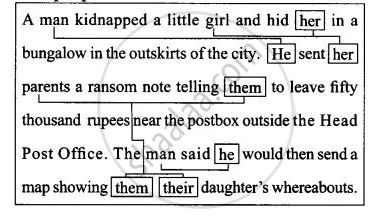
Look at the passage below and study how the personal pronouns refer to different people.
Concept: undefined >> undefined
Now read this extract from a story and draw arrows (as in the example above) to show how the personal pronouns refer to the different people and things.
Leena was on her annual visit to her uncle's house. She always enjoyed it because she was allowed to spend most of the day down at the mango grove. Leena's uncle was a friend of the man who owned the grove and he always gave a special rate. This year Leena's aunt joined her, and together they set off across the fields to the grove. The branches of the trees were covered with fruits, and so bowed down with the weight that they almost touched the ground. They spent hours picking fruit, eating most of it and sleeping in the shade.
Concept: undefined >> undefined
Read the following article on Global Warming and complete the Dow chart given below.
Global Warming is caused by the accumulation of Green house Gases - CO2, and methane in the atmosphere, resulting in the rise of Earth's over all surface temperature. India, a low latitude country, would face much of the misery due to climatic changes. Rainfall pattern is expected to undergo a major change in areas like Kerala, MP and North East.
Himalayan glaciers are melting. This could prove catastrophic for those living downstream in the plains.
Due to global warming heat is trapped in the atmosphere causing the ice to melt. Rising sea levels would inundate many of the coastal cities. Extreme weather conditions such as heavy rainfall is expected to occur soon resulting in loss of life and property.

Concept: undefined >> undefined
What is your opinion about 'Animals behind bars'? Share your views with the class.
Concept: undefined >> undefined
Read through the poem and quickly make a note of any thoughts that come to you, while you are reading it.
Dispute
A man and a tiger once had a dispute,
Which was reckoned greater, the man or the brute.
The tiger discoursed on his side at some length,
And greatly enlarged on his courage and strength,
Said the man, 'Don't be prating; look yonder, I pray,
At that sculpture of marble: now what will you say?
The tiger is vanquished; but as for the man,
He is striding upon him: deny if you can.'
'But pray,' said the tiger, 'Who sculptured that stone?
'One of us,' said the man. 'I must candidly own.'
'But when we are sculptors,' the other replied,
'You will then on the man see the tiger astride.'
Anonymous
Concept: undefined >> undefined
Answer the following question by ticking the correct option :
What was the cause of the dispute between the tiger and the man?
Concept: undefined >> undefined
Answer the following question by ticking the correct option :
What did the man do to prove his point?
Concept: undefined >> undefined
Understanding determiners.
Determiners are words that are used in front of nouns to indicate whether you are
referring to something specific or something of a particular type.
Singular nouns always need a determiner. In plural nouns, the determiner is
optional. Determiners may or may not be used with uncountable nouns depending
on context.
There are about 50 different determiners in the English language which include:
Articles: a, an, the
Possessives: my, your, our, their, his, hers, whose, etc.
Demonstratives: this, that these, those, which, etc.
Quantifiers: few, a few, many, much, each, every, some, any, etc.
Number: one, two, three, twenty, forty, etc.
Ordinals: first, second, last, next, etc.
Determiners are used
• to state the unit/ number of people, things or other nouns.
• to state possessives.
• to specify someone or something.
• to state how things or people are distributed.
• to state the difference between nouns.
Determiners can be classified under the following categories:
| EXAMPLES | ||
| MULTIPLIERS | double, twice, three times... | We want double portions. |
| FRACTIONS | half, a third, two fifths ..... | I drove at half speed. |
| INTENSIFIERS | What! Such! | Such impudence! |
| QUANTIFIERS | all, both, most | I like most people. |
| ARTICLES | a, an, the | Get a book from the shelf. |
| DEMONSTRATIVES | this, that, these, those, another, other | That tree is in another garden. |
| DISTRIBUTIVES | each, every, either, neither | I have a gift for each person. |
| POSSESSIVES | ||
| (i) PRONOMINAL | my, your, his, her, its, our, your, their | You can borrow Kim's video. |
| (ii) NOMINAL | Renata's, Adam's, People's ... | You can borrow my video. |
| INTERROGATIVES | What? Which? Whose? | Whose book is that? |
| QUANTIFIERS | some, any, no | I have no problem with them. |
| CARDINAL NUMBERS | one, two, three hundred ..... | Two heads are better than one. |
| ORDINAL NUMBERS | first, fewer, much, more, less, least ......... . | It was my first tennis match. |
| QUANTIFIERS | ||
| (i) SIMPLE | few, fewer, much, more, less, least ........... . |
I have few pals; Kim has more. |
| (ii) COMPOUND | a little, a lot of, a great deal of .... |
I have lots of time to spare. |
Concept: undefined >> undefined
Answer the following question by ticking the correct option :
What was the tiger's counter-argument?
Concept: undefined >> undefined
In pairs discuss the qualities and characteristics of the tiger and man. Complete the web charts. 

Concept: undefined >> undefined
