मराठी

Look at the Passage Below and Study How the Personal Pronouns Refer to Different People. - English - Communicative

Advertisements
Advertisements

प्रश्न

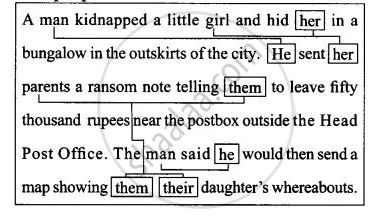
Look at the passage below and study how the personal pronouns refer to different people.

थोडक्यात उत्तर
टीपा लिहा
Advertisements

उत्तर

Do it yourself.

shaalaa.com
Reading
  या प्रश्नात किंवा उत्तरात काही त्रुटी आहे का?
पाठ 2.1: Determiners - Exercises [पृष्ठ ३१]

APPEARS IN

सीबीएसई English Communicative Workbook Interact in English [English] Class 9
पाठ 2.1 Determiners
Exercises | Q 10.1 | पृष्ठ ३१

संबंधित प्रश्‍न

Thinking about the Text
Answer these question.

They can’t hang me twice.”
(i)
Who says this?
(ii)
Why does the speaker say it?


What does he plant who plants a tree?
He plants cool shade and tender rain,
And seed and bud of days to be,
And years that fade and flush again;
He plants the glory of the plain;
He plants the forest's heritage;
The harvest of a coming age;
The joy that unborn eyes shall see___
These things he plants who plants a tree.

Read the lines given above and answer the question that follow:

Who is being referred to as the unborn eyes?


Continuous as the stars that shine
And twinkle on the milky way,
They stretched in never-ending line
Along the margin of a bay:
Ten thousand saw I at a glance,
Tossing their heads in springhtly dance.

Read the lines given above and answer the question that follow.

What were the daffodils doing? Which literary device is used here?


He looked at me very blankly and tiredly, and then said, having to share his worry with someone, “The cat will be all right, I am sure. There is no need to be unquiet about the cat. But the others. Now what do you think about the others?”
“Why they’ll probably come through it all right.”
“You think so?”
“Why not,” I said, watching the far bank where now there were no carts.
“But what will they do under the artillery when I was told to leave because of the artillery?”
“Did you leave the dove cage unlocked?” I asked.
“Yes.”
“Then they’ll fly.”
“Yes, certainly they’ll fly. But the others. It’s better not to think about the others,” he said.

Read the extract given below and answer the question that follow.

Why is the old man worried about the goats?


The boy looked up. He took his hands from his face and looked up at his teacher. The light from Mr. Oliver’s torch fell on the boy’s face, if you could call it a face. He had no eyes, ears, nose or mouth. It was just a round smooth head with a school cap on top of it.

And that’s where the story should end, as indeed it has for several people who have had similar experiences and dropped dead of inexplicable heart attacks. But for Mr. Oliver, it did not end there. The torch fell from his trembling hand. He turned and scrambled down the path, running blindly through the trees and calling for help. He was still running towards the school buildings when he saw a lantern swinging in the middle of the path. Mr. Oliver had never before been so pleased to see the night watchman. He stumbled up to the watchman, gasping for breath and speaking incoherently.

What is it, Sahib? Asked the watchman, has there been an accident? Why are you running?

I saw something, something horrible, a boy weeping in the forest and he had no face.
No face, Sahib?
No eyes, no nose, mouth, nothing.
Do you mean it was like this, Sahib? asked the watchman, and raised the lamp to his own face. The watchman had no eyes, no ears, no features at all, not even an eyebrow. The wind blew the lamp out and Mr. Oliver had his heart attack.

Read the extract given below and answer the question that follow.

What was Mr Oliver’s reaction when he saw the faceless boy? Whom did he stumble into?


Joe did not see the Guardians of the Poor on that day, on the next, nor on the day following. In fact, he never saw them at all on Maggie’s account, for in less than a week Mrs. Joe Thompson would as soon leave thought of taking up her own abode in the almshouse as sending Maggie there.

What light and blessing did that sick and helpless child bring to the home of Joe Thompson, the poor wheelwright! It had been dark, and cold, and miserable there for a long time just because his wife had nothing to love and care for out of herself, and so became soar, irritable, ill-tempered, and self-afflicting in the desolation of her woman’s nature. Now the sweetness of that sick child, looking ever to her in love, patience, and gratitude, was as honey to her soul, and she carried her in her heart as well as in her arms, a precious burden. As for Joe Thompson, there was not a man in all the neighbourhood who drank daily of a more precious wine of life than he. An angel had come into his house, disguised as a sick, helpless, and miserable child, and filled all its dreary chambers with the sunshine of love.

Read the extract given below and answer the question that follow.

What changed her ? Describe the change in her.


Margot stood alone. She was a very frail girl who looked as if she had been lost in the rain for years and the rain had washed out the blue from her eyes and the red from her mouth and the yellow from her hair. She was an old photograph dusted from an album, whitened away, and if she spoke at all her voice would be a ghost. Now she stood, separate, staring at the rain and the loud wet world beyond the huge glass. “What’re you looking at ?” said William. Margot said nothing. “Speak when you’re spoken to.” He gave her a shove. But she did not move; rather she let herself be moved only by him and nothing else. They edged away from her, they would not look at her. She felt them go away. And this was because she would play no games with them in the echoing tunnels of the underground city. If they tagged her and ran, she stood blinking after them and did not follow. When the class sang songs about happiness and life and games her lips barely moved. Only when they sang about the sun and the summer did her lips move as she watched the drenched windows.

Read the extract given below and answer the question that follow.

What did Margot look like?


Read the following passage carefully and answer the questions that follow: 

Granny knew I'd been in the train for two nights, and she had a huge breakfast ready for me. Later she told me there'd been a letter from Uncle Ken.
'He says he's the manager in Fitpo's hotel in Simla,' she said. 'The salary is very good. It's a steady job and I hope he keeps it.' Three days later Uncle Ken was on the veranda steps with his bedding roll and battered suitcase. 'Have you given up the hotel job?' asked Granny. 'No,' said Uncle Ken. 'They have closed down.' I hope it wasn't because of you.' 'No, Aunt Ellen_ The bigger hotels in the hill stations are closing down. 'Well, never mind. Come along and have your lunch. Over lunch; Uncle Ken talked very seriously about ways and means of earning a living. There is only one taxi in the whole of Debra, he mused. 'Surely there is business for another?' `I'm sure there is,' said Granny. 'But where does it get you? In the first place, you don't have a taxi. And in the second place, you can't drive.' I can soon learn. There's a driving school in town. And I can use Uncle's old car.' 'I don't think it will run now,' said Granny. 'Of course, it will. It just needs some oiling and greasing and a spot of paint.' 'All right, learn to drive.' So, Uncle Ken joined the driving school.After a month Uncle Ken announced that he could drive and that he was taking the car out for a trial run. 'You haven't got your license yet,' said Granny. 'Oh, I won't take it far,' said Uncle Ken. 'Just down the road and back again.' He spent all morning cleaning up the car. Granny gave him money for a can of petrol. After tea, Uncle Ken said, 'Come along, Ruskin, hop in and I will give you a ride. Bring Mohan along too.' Mohan and I needed no urging. We got into the car beside Uncle Ken. 'Now don't go too fast, Ken,' said Granny anxiously. 'You are not used to the car as yet.' Uncle Ken nodded and smiled and gave two sharp toots on the horn. He was feeling pleased with himself. Driving through the gate, he nearly ran over a cat. Miss Kellner, coming out for her evening rickshaw ride, saw Uncle Ken at the wheel of the car and ran indoors again. [40] Uncle Ken drove straight and fast, tootling the horn without a break. At the end of the road there was a roundabout. 'We’ll turn here,' said Uncle Ken, 'and then drive back again.' He turned tt;e steering wheel, we began going round the roundabout, but the steering wheel wouldn't turn all the way, not as much as Uncle Ken would have liked it to... So, instead he went on - and straight through the Maharaja of Jetpur’s garden wall. It was a single-brick wall, and the car knocked it down and emerged on the other, side without any damage to the car or any of its occupants. Uncle Ken brought it to a halt in the middle of the Maharaja's lawn. Running across the grass came the Maharaja himself. When he saw that it was Uncle Ken at the wheel, the Maharaja beamed with pleasure. 'Delighted to see you, old chap!' he exclaimed. 'Jolly decent of you to drop in again. How about a game of tennis?'

(a) Give the meaning of the following words as used in the passage: 
One word answers or short phrases will be accepted. 

(i) battered 

(ii) bused 

(iii) emerged 

(b) Answer the following questions briefly in your own words.
(i) Why did Granny hope Uncle Ken would keep his job at  Fitgo's hotel? 

(ii) When Uncle Ken arrived with his luggage, Granny remarked that she hoped the hotel had not closed down because of him. What does this remark tell you about Uncle Ken? 

(iii) Why did Uncle Ken think that driving a taxi in Dehra would be profitable? 

(iv) Which sentence tells you that the narrator and his friend were waiting to be invited for a drive in a car? 

(v) Why did Miss Kellner run indoors when she saw Uncle Ken at the wheel of the car? 

(vi) What was Uncle Ken's intention at the roundabout? 

(c)
(I) In not more than 60 words, describe what happened after the car went through the wall. 

(ii) Give a title to your summary in 3(c)(i). Give a reason to justify choice of the title. 


Answer the following question.

Why did Kari push his friend into the stream?


Discuss the following topic in groups.

If you had to live in a home like Tilloo’s, what parts of life would you find most difficult? What compensations might there be?


During which time of the day would the hermit would leave the forest and go out?


Mr Gessler in his last wasn’t in good health. Give three examples to prove this.


What have certain doctors found about dreams?


What was it that made Prem leave his village?


Describe Plan A and its consequences


Multiple Choice Question:
Which one of the following is not associated with the kite’s movement?


What are some of the notable features told about snakes in the lesson?


Speak to five adults in your neighbourhood. Ask them the following questions (in any language they are comfortable in). Then come back and share your findings with the class.

  1. Do they buy their provisions packed in plastic packets at a big store or loose, from a smaller store near their house?
  2. Where do they buy their footwear? Do they buy branded footwear or footwear made locally? What reasons do they have for their preference?
  3. Do they buy readymade clothes or buy cloth and get their clothes stitched by a tailor? Which do they think is better?

Which of the following statements is used by Angelou to describe the caged bird?


Complete the following sentence by providing a reason.

In the short story, Indigo, Aniruddha asked Sukhanram if there were ghosts in the bungalow because ______.


Share
Notifications

Englishहिंदीमराठी


      Forgot password?
Use app×