Advertisements
Advertisements
प्रश्न
Look at the passage below and study how the personal pronouns refer to different people.
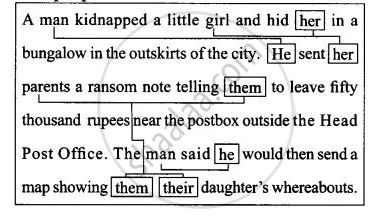
Advertisements
उत्तर
Do it yourself.
APPEARS IN
संबंधित प्रश्न
Thinking about the poem
Where does the traveller find himself? What problem does he face?
1. I first met Private Quelch at the training depot. A man is liable to acquire in his firs week of Army life - together with his uniform, rifle and equipment- a nickname. Anyone who saw Private Quelch, lanky, stooping, frowning through horn-rimmed spectacles, understood why he was known as the Professor. Those who had any doubts on the subject lost them after five minutes' conversation with him.
2. I remember the first lesson we had in musketry. We stood in an attentive circle while a Sergeant, a man as dark and sun-dried as raisins, wearing North-West Frontier ribbons, described the mechanism of a service rifle.
3. "The muzzle velocity or speed at which the bullet leaves the rifle", he told us, "is
well over two thousand feet per second."
4. A voice interrupted. "Two thousand, four hundred and forty feet per second." It
was the Professor.
5. "That's right," the Sergeant said without enthusiasm, and went on lecturing. When he had finished, he asked us questions; and, perhaps in the hope of revenge, he turned with his questions again and again to the Professor. The only result was to enhance the Professor's glory. Technical definitions, the parts of a rifle, its use and care, he had them all by heart.
6. The Sergeant asked, "Have you had any training before?"
7. The Professor answered with a phrase that was to become familiar to all of us. "No, Sergeant. It's all a matter of intelligent reading."
8. That was our introduction to him. We soon learned more about him. He saw to that. He meant to get on, he told us. He had the brains. He was sure to get a commission, before long. As a first step, he meant to get a stripe.
9. In pursuit of his ambition he worked hard. We had to give him credit for that. He borrowed training manuals and stayed up late at nights reading them. He badgered the instructors with questions. He drilled with enthusiasm, and on route marches he was not only miraculously tireless but infuriated us all with his horrible heartiness. "What about a song, chaps?" is not greeted politely at the end of thirty miles. His salute at the pay table was a model to behold. When officers were in sight he would swing his skinny arms and march to the canteen like a Guardsman.
10. And day in and day out, he lectured to us in his droning, remorseless voice on every aspect of human knowledge. At first we had a certain respect for him, but soon we lived in terror of his approach. We tried to hit back at him with clumsy sarcasms and practical jokes. The Professor scarcely noticed; he was too busy working for his stripe.
11. Each time one of us made a mistake the Professor would publicly correct him. Whenever one of us shone, the Professor outshone him. When, after a hard morning's work of cleaning out our hut, we listened in silence to the Orderly Officer's praise, the Professor would break out with a ringing, dutifully beaming, "Thank you, sir!" And how superior, how condescending he was. It was always,
"Let me show you, fellow," or, "No, you'll ruin your rifle that way, old man."
12. We used to pride ourselves on aircraft recognition. Once, out for a walk, we heard the drone of a plane flying high overhead. None of us could even see it in the glare of the sun. Without even a glance upward the Professor announced, "That, of course, is a North American Harvard Trainer. It can be unmistakably identified by the harsh engine note, due to the high tip speed of the airscrew."
What could a gang of louts like us do with a man like that? 13. None of us will ever forget the
drowsy summer afternoon which was such a turning-point in the Professor's life.
14. We were sprawling contentedly on the warm grass while Corporal Turnbull was taking a lesson on the hand grenade.
15. Corporal Turnbull was a young man, but he was not a man to be trifled with. He had come back from Dunkirk with all his equipment correct and accounted for and his kitten in his pocket. He was
our hero, and we used to tell each other that he was so tough that you could hammer nails into him without his noticing it.
16. _"The outside of a grenade, as you can see," Corporal Turnbull was saying, "is divided up into a large number of fragments to assist segmentation"
17. "Forty-four"
18. "What's that?" The Corporal looked over his shoulder
19. "Forty-four segments." The Professor beamed at him.
20. The Corporal said nothing, but his brow tightened. He opened his mouth to
resume.
21. "And by the way, Corporal." We were all thunder-struck.
22. The Professor was speaking again. "Shouldn't you have started off with the five characteristics of the grenade? Our instructor at the other camp always used to do that, you know."
23. In the silence that followed a dark flush stained the tan of the Corporal's face. "Here," he said at last, "you give this lecture". As if afraid to say any more, he tossed the grenade to the Professor. Quite unabashed, Private Quelch climbed to his feet and with the attitude of a man coming into his birth-right gave us an unexceptionable lecture on the grenade.
24. The squad listened in a cowed, horrified kind of silence. Corporal Turnbull stood and watched, impassive, except for a searching intentness of gaze. When the lecture was finished he said, "Thank you, Private Quelch. Fall in with the others now." He did not speak again until we had fallen in and were waiting to be dismissed. Then he addressed us. 25. "As some of you may have heard," he began deliberately, "the platoon officer has asked me to nominate one of you for…." He paused and looked lingeringly up and down the ranks as if seeking final confirmation of decision.
26. So this was the great moment! Most of us could not help glancing at Private Quelch, who stood rigidly to attention and stared straight in front of him with an expression of self-conscious innocence.
27. ______"…..for permanent cookhouse duties, I've decided that Private Quelch is just the man for the job."
28. Of course, it was a joke for days afterwards; a joke and joy to all of us.
29. I remember, though.............
30. My friend Trower and I were talking about it a few days later. We were returning from the canteen to our own hut.
31. Through the open door, we could see the three cooks standing against the wall as if at bay; and from within came the monotonous beat of a familiar voice.
32. "Really. I must protest against this abominably unscientific and unhygienic method of peeling potatoes. I need to only draw your attention to the sheer waste of vitamin values.............."
33. We fled.
About the Author
Alexander Baron (1917-1999) has written many novels, including 'There's no Home',
' The Human Kind', 'Queen of the East', 'Seeing Life' and The How Life', along with
film scripts and television plays. He started life as an Asstt. Editor of The Tribune and
later edited the 'New Theater.' He served in the army during the Second World War.
This is a meeting of the school's Parent-Teacher Association. Some student representatives have also been invited to participate to discuss the role that Information Technology I Computers play in the growth and development of children.

Old Kaspar took it from the boy,
Who stood expectant by;
And then the old man shook his head,
And,with a natural sigh,
"Tis some poor fellow's skull," said he,
"Who fell in the great victory.
"I find them in the garden,
For there's many here about;
And often when I go to plough,
The ploughshare turns them out!
For many thousand men,"said he,
"Were slain in that great victory."
Read the lines given above and answer the question that follow.
What words show that there were many such skulls to be found there?
Continuous as the stars that shine
And twinkle on the milky way,
They stretched in never-ending line
Along the margin of a bay:
Ten thousand saw I at a glance,
Tossing their heads in springhtly dance.
Read the lines given above and answer the question that follow.
Explain with reference to context.
As it turned out, Luz broke his own past record. In doing so, he pushed me on to a peak performance. I remember that at the instant I landed from my final jump—the one which set the Olympic record of 26 feet 5-5/16 inches—he was at my side, congratulating me. Despite the fact that Hitler glared at us from the stands not a hundred yards away, Luz shook my hand hard—and it wasn’t a fake “smile with a broken heart” sort of grip, either.
You can melt down all the gold medals and cups I have, and they couldn’t be a plating on the 24-carat friendship I felt for Luz Long at that moment. I realized then, too, that Luz was the epitome of what Pierre de Coubertin, founder of the modern Olympic Games, must have had in mind when he said, “The important thing in the Olympic Games is not winning but taking part. The essential thing in life is not conquering but fighting well.”
Read the extract given below and answer the question that follow.
What do you understand of Hitler from Jesse’s account?
Read the extract given below and answer the questions that follow:
Trotter: Yes. You've been extraordinarily foolish, you know. You've run a very good chance of being killed by holding out on me. As a result, you've been in serious danger more than once.
Mollie: I don't know what you mean.
Trotter: (moving slowly above the sofa table to the Right of the sofa, still quite natural and friendly) Come now, Mrs. Ralston. We, policemen, aren't quite so dumb as you think. All along I've realized that you had first-hand knowledge of the Langridge Farm affair. You know Mrs. Boyle was the magistrate concerned. In fact, you knew all about it. Why didn't you speak up and say so?
Mollie: (Very much affected) I don't understand. I wanted to forget-forget. (She sits at the Left end of the sofa.)
(i) What was the 'Longridge Farm' affair?
(ii) Trotter revealed to Mollie some facts that he had uncovered about her past. What were they?
(iii) What did Mollie want to forget? How was she linked with the ‘Longridge Farm affair’?
(iv) How did Trotter manage a pass himself off as a policeman? How had he reached Monkswell Manor?
(v) What did Trotter reveal to Mollie about this true identity? How was Mollie saved at the end of the play?
Answer the following question
Did Kari enjoy his morning bath in the river? Give a reason for your answer.
Imagine you are the hermit. Write briefly the incident of your meeting the king. Begin like this: One day I was digging in my garden. A man in ordinary clothes came to see me. I knew it was the king...
“A sharp V-shaped line had formed between her eyebrows.” What does it suggest to you about Rukku Manni’s mood?
What all facts Maya collected about Mr Nath?
We should not mess up with things that belong to others. Elaborate.
Why and when did Dad say the following?
Funny joke
How does father react to the mother's warning?
Fill in the blank in the sentence below with the words or phrases from the box. (You may not know the meaning of all the words. Look such words up in a dictionary, or ask your teacher.)
Who stole the diamond is still a ____________.
What did Taro’s father wish for one cold day?
Answer the following question:
How did she become an astronaut? What gave her the idea that she could be an astronaut?
Answer the question.
What are the things normal people do that the poet talks about?
Multiple Choice Question:
Which of the fears is not applied to the speaker?
In Act V of the play Macbeth, which one of the following do you think reflects the tragic arc of the play?
(P) Macbeth’s soliloquy; “Out, out brief candle, Life’s but a walking shadow.”
(Q) Lady Macbeth’s breakdown: “What’s done cannot be undone.”
(R) Macduff’s greeting: “Hail, King of Scotland.”
(S) Malcolm’s final words: “So, thanks to all at once and to each one, whom we invite to see us crowned at Scone.”
