Advertisements
Advertisements
Two convex lenses, each of focal length 10 cm, are placed at a separation of 15 cm with their principal axes coinciding. (a) Show that a light beam coming parallel to the principal axis diverges as it comes out of the lens system. (b) Find the location of the virtual image formed by the lens system of an object placed far away. (c) Find the focal length of the equivalent lens. (Note that the sign of the focal length is positive although the lens system actually diverges a parallel beam incident on it.)
Concept: undefined >> undefined
A ball is kept at a height h above the surface of a heavy transparent sphere made of a material of refractive index μ. The radius of the sphere is R. At t = 0, the ball is dropped to fall normally on the sphere. Find the speed of the image formed as a function of time for \[t < \sqrt{\frac{2h}{g}}\] . Consider only the image by a single refraction.
Concept: undefined >> undefined
Advertisements
Consider the self-inductance per unit length of a solenoid at its centre and that near its ends. Which of the two is greater?
Concept: undefined >> undefined
A tangent galvanometer shows a deflection of 45° when 10 mA of current is passed through it. If the horizontal component of the earth's magnetic field is `B_H = 3.6 xx 10^-5 "T"` and radius of the coil is 10 cm, find the number of turns in the coil.
Concept: undefined >> undefined
A constant current i is maintained in a solenoid. Which of the following quantities will increase if an iron rod is inserted in the solenoid along its axis?
(a) magnetic field at the centre
(b) magnetic flux linked with the solenoid
(c) self-inductance of the solenoid
(d) rate of Joule heating.
Concept: undefined >> undefined
Two solenoids have identical geometrical construction but one is made of thick wire and the other of thin wire. Which of the following quantities are different for the two solenoids?
(a) self-inductance
(b) rate of Joule heating if the same current goes through them
(c) magnetic field energy if the same current goes through them
(d) time constant if one solenoid is connected to one battery and the other is connected to another battery.
Concept: undefined >> undefined
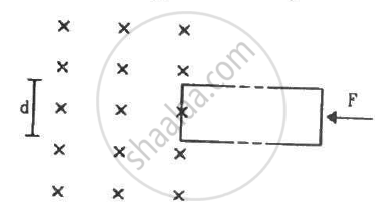
The rectangular wire-frame, shown in figure, has a width d, mass m, resistance R and a large length. A uniform magnetic field B exists to the left of the frame. A constant force F starts pushing the frame into the magnetic field at t = 0. (a) Find the acceleration of the frame when its speed has increased to v. (b) Show that after some time the frame will move with a constant velocity till the whole frame enters into the magnetic field. Find this velocity v0. (c) Show that the velocity at time t is given by
v = v0(1 − e−Ft/mv0).
Concept: undefined >> undefined
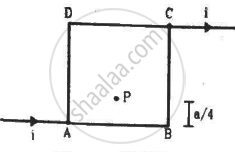
Figure shows a square loop of edge a made of a uniform wire. A current i enters the loop at the point A and leaves it at the point C. Find the magnetic field at the point P which is on the perpendicular bisector of AB at a distance a/4 from it.
Concept: undefined >> undefined
Find the magnetic field B at the centre of a rectangular loop of length l and width b, carrying a current i.
Concept: undefined >> undefined
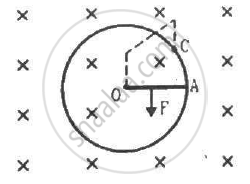
Figure shows a conducting circular loop of radius a placed in a uniform, perpendicular magnetic field B. A thick metal rod OA is pivoted at the centre O. The other end of the rod touches the loop at A. The centre O and a fixed point C on the loop are connected by a wire OC of resistance R. A force is applied at the middle point of the rod OAperpendicularly, so that the rod rotates clockwise at a uniform angular velocity ω. Find the force.
Concept: undefined >> undefined
An average emf of 20 V is induced in an inductor when the current in it is changed from 2.5 A in one direction to the same value in the opposite direction in 0.1 s. Find the self-inductance of the inductor.
Concept: undefined >> undefined
A magnetic flux of 8 × 10⁻⁴ weber is linked with each turn of a 200-turn coil when there is an electric current of 4 A in it. Calculate the self-inductance of the coil.
Concept: undefined >> undefined
An inductor-coil carries a steady-state current of 2.0 A when connected across an ideal battery of emf 4.0 V. If its inductance is 1.0 H, find the time constant of the circuit.
Concept: undefined >> undefined
When an electron strikes the target in a Coolidge tube, its entire kinetic energy
(a) is converted into a photon
(b) may be converted into a photon
(c) is converted into heat
(d) may be converted into heat.
Concept: undefined >> undefined
A coil having inductance 2.0 H and resistance 20 Ω is connected to a battery of emf 4.0 V. Find (a) the current at the instant 0.20 s after the connection is made and (b) the magnetic field energy at this instant.
Concept: undefined >> undefined
An inductor of inductance 5.0 H, having a negligible resistance, is connected in series with a 100 Ω resistor and a battery of emf 2.0 V. Find the potential difference across the resistor 20 ms after the circuit is switched on.
Concept: undefined >> undefined
What are the values of the self-induced emf in the circuit of the previous problem at the times indicated therein?
Concept: undefined >> undefined
Consider a small cube of volume 1 mm3 at the centre of a circular loop of radius 10 cm carrying a current of 4 A. Find the magnetic energy stored inside the cube.
Concept: undefined >> undefined
A long wire carries a current of 4.00 A. Find the energy stored in the magnetic field inside a volume of 1.00 mm3 at a distance of 10.0 cm from the wire.
Concept: undefined >> undefined
Free 238U nuclei kept in a train emit alpha particles. When the train is stationary and a uranium nucleus decays, a passenger measures that the separation between the alpha particle and the recoiling nucleus becomes x in time t after the decay. If a decay takes place when the train is moving at a uniform speed v, the distance between the alpha particle and the recoiling nucleus at a time t after the decay, as measured by the passenger will be
Concept: undefined >> undefined
