Please select a subject first
Advertisements
Advertisements
In a parallel plate capacitor, the capacity increases if ______.
Concept: undefined >> undefined
Two identical capacitors are joined in parallel, charged to a potential V, separated and then connected in series, the positive plate of one is connected to the negative of the other. Which of the following is true?
Concept: undefined >> undefined
Advertisements
Consider an uncharged conducting sphere. A positive point charge is placed outside the sphere. The net charge on the sphere is then, ______.
Concept: undefined >> undefined
A positive charge Q is uniformly distributed along a circular ring of radius R. A small test charge q is placed at the centre of the ring (figure). Then
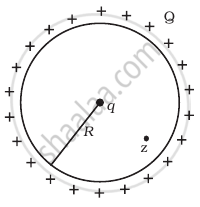
- If q > 0 and is displaced away from the centre in the plane of the ring, it will be pushed back towards the centre.
- If q < 0 and is displaced away from the centre in the plane of the ring, it will never return to the centre and will continue moving till it hits the ring.
- If q < 0, it will perform SHM for small displacement along the axis.
- q at the centre of the ring is in an unstable equilibrium within the plane of the ring for q > 0.
Concept: undefined >> undefined
A parallel plate capacitor is connected to a battery as shown in figure. Consider two situations:

- Key K is kept closed and plates of capacitors are moved apart using insulating handle.
- Key K is opened and plates of capacitors are moved apart using insulating handle.
Choose the correct option(s).
- In A: Q remains same but C changes.
- In B: V remains same but C changes.
- In A: V remains same and hence Q changes.
- In B: Q remains same and hence V changes.
Concept: undefined >> undefined
Two charges – q each are separated by distance 2d. A third charge + q is kept at mid point O. Find potential energy of + q as a function of small distance x from O due to – q charges. Sketch P.E. v/s x and convince yourself that the charge at O is in an unstable equilibrium.
Concept: undefined >> undefined
Consider a ray of light incident from air onto a slab of glass (refractive index n) of width d, at an angle θ. The phase difference between the ray reflected by the top surface of the glass and the bottom surface is ______.
Concept: undefined >> undefined
Suppose we consider a large number of containers each containing initially 10000 atoms of a radioactive material with a half life of 1 year. After 1 year ______.
Concept: undefined >> undefined
When a nucleus in an atom undergoes a radioactive decay, the electronic energy levels of the atom ______.
Concept: undefined >> undefined
Samples of two radioactive nuclides A and B are taken. λA and λB are the disintegration constants of A and B respectively. In which of the following cases, the two samples can simultaneously have the same decay rate at any time?
- Initial rate of decay of A is twice the initial rate of decay of B and λA = λB.
- Initial rate of decay of A is twice the initial rate of decay of B and λA > λB.
- Initial rate of decay of B is twice the initial rate of decay of A and λA > λB.
- Initial rate of decay of B is the same as the rate of decay of A at t = 2h and λB < λA.
Concept: undefined >> undefined
The variation of decay rate of two radioactive samples A and B with time is shown in figure.
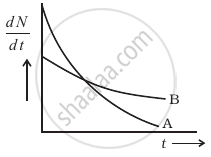
Which of the following statements are true?
- Decay constant of A is greater than that of B, hence A always decays faster than B.
- Decay constant of B is greater than that of A but its decay rate is always smaller than that of A.
- Decay constant of A is greater than that of B but it does not always decay faster than B.
- Decay constant of B is smaller than that of A but still its decay rate becomes equal to that of A at a later instant.
Concept: undefined >> undefined
Draw a graph showing the variation of decay rate with number of active nuclei.
Concept: undefined >> undefined
Which sample, A or B shown in figure has shorter mean-life?

Concept: undefined >> undefined
Consider a radioactive nucleus A which decays to a stable nucleus C through the following sequence:
A→B→C
Here B is an intermediate nuclei which is also radioactive. Considering that there are N0 atoms of A initially, plot the graph showing the variation of number of atoms of A and B versus time.
Concept: undefined >> undefined
A piece of wood from the ruins of an ancient building was found to have a 14C activity of 12 disintegrations per minute per gram of its carbon content. The 14C activity of the living wood is 16 disintegrations per minute per gram. How long ago did the tree, from which the wooden sample came, die? Given half-life of 14C is 5760 years.
Concept: undefined >> undefined
Sometimes a radioactive nucleus decays into a nucleus which itself is radioactive. An example is :
\[\ce{^38Sulphur ->[half-life][= 2.48h] ^{38}Cl ->[half-life][= 0.62h] ^38Air (stable)}\]
Assume that we start with 1000 38S nuclei at time t = 0. The number of 38Cl is of count zero at t = 0 and will again be zero at t = ∞ . At what value of t, would the number of counts be a maximum?
Concept: undefined >> undefined
The activity R of an unknown radioactive nuclide is measured at hourly intervals. The results found are tabulated as follows:
| t (h) | 0 | 1 | 2 | 3 | 4 |
| R (MBq) | 100 | 35.36 | 12.51 | 4.42 | 1.56 |
- Plot the graph of R versus t and calculate the half-life from the graph.
- Plot the graph of ln `(R/R_0)` versus t and obtain the value of half-life from the graph.
Concept: undefined >> undefined
What can be the causes of helical motion of a charged particle?
Concept: undefined >> undefined
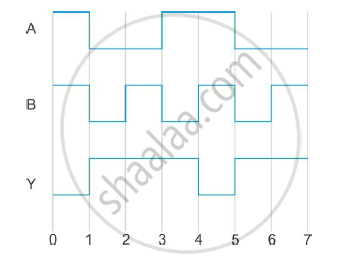
The following figure shows the input waveforms (A, B) and the output waveform (Y) of a gate. Identify the gate, write its truth table and draw its logic symbol.
Concept: undefined >> undefined
The Earth's magnetic field at the Equator is approximately 0.4 G. Estimate the Earth's magnetic dipole moment. Given : Radius of the Earth = 6400 km.
Concept: undefined >> undefined
