Please select a subject first
Advertisements
Advertisements
Pressure decreases as one ascends the atmosphere. If the density of air is ρ, what is the change in pressure dp over a differential height dh?
Concept: undefined >> undefined
Considering the pressure p to be proportional to the density, find the pressure p at a height h if the pressure on the surface of the earth is p0.
Concept: undefined >> undefined
Advertisements
A bimetallic strip is made of aluminium and steel (αAl > αsteel) . On heating, the strip will ______.
Concept: undefined >> undefined
A uniform metallic rod rotates about its perpendicular bisector with constant angular speed. If it is heated uniformly to raise its temperature slightly ______.
Concept: undefined >> undefined
An aluminium sphere is dipped into water. Which of the following is true?
Concept: undefined >> undefined
As the temperature is increased, the time period of a pendulum ______.
Concept: undefined >> undefined
The radius of a metal sphere at room temperature T is R, and the coefficient of linear expansion of the metal is α. The sphere is heated a little by a temperature ∆T so that its new temperature is T + ∆T. The increase in the volume of the sphere is approximately ______.
Concept: undefined >> undefined
A student records the initial length l, change in temperature ∆T and change in length ∆l of a rod as follows:
| S.No. | l(m) | ∆T (C) | ∆l (m) |
| 1. | 2 | 10 | `4 xx 10^-4` |
| 2. | 1 | 10 | `4 xx 10^-4` |
| 3. | 2 | 20 | `2 xx 10^-4` |
| 4. | 3 | 10 | `6 xx 10^-4` |
If the first observation is correct, what can you say about observations 2, 3 and 4.
Concept: undefined >> undefined
Find out the increase in moment of inertia I of a uniform rod (coefficient of linear expansion α) about its perpendicular bisector when its temperature is slightly increased by ∆T.
Concept: undefined >> undefined
Calculate the stress developed inside a tooth cavity filled with copper when hot tea at temperature of 57°C is drunk. You can take body (tooth) temperature to be 37°C and α = 1.7 × 10⁻⁵/°C, bulk modulus for copper = 140 × 109 N/m2.
Concept: undefined >> undefined
A rail track made of steel having length 10 m is clamped on a raillway line at its two ends (figure). On a summer day due to rise in temperature by 20° C, it is deformed as shown in figure. Find x (displacement of the centre) if αsteel = 1.2 × 10⁻⁵/°C.
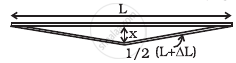
Concept: undefined >> undefined
Show that for a particle executing S.H.M, velocity and displacement have a phase difference of π/2.
Concept: undefined >> undefined
The displacement of an elastic wave is given by the function y = 3 sin ωt + 4 cos ωt. where y is in cm and t is in second. Calculate the resultant amplitude.
Concept: undefined >> undefined
For the harmonic travelling wave y = 2 cos 2π (10t – 0.0080x + 3.5) where x and y are in cm and t is second. What is the phase difference between the oscillatory motion at two points separated by a distance of 4 m.
Concept: undefined >> undefined
For the harmonic travelling wave y = 2 cos 2π (10t – 0.0080x + 3.5) where x and y are in cm and t is second. What is the phase difference between the oscillatory motion at two points separated by a distance of 0.5 m
Concept: undefined >> undefined
For the harmonic travelling wave y = 2 cos 2π (10t – 0.0080x + 3.5) where x and y are in cm and t is second. What is the phase difference between the oscillatory motion at two points separated by a distance of `λ/2`
Concept: undefined >> undefined
For the harmonic travelling wave y = 2 cos 2π (10t – 0.0080x + 3.5) where x and y are in cm and t is second. What is the phase difference between the oscillatory motion at two points separated by a distance of `(3λ)/4` (at a given instant of time)
Concept: undefined >> undefined
For the harmonic travelling wave y = 2 cos 2π (10t – 0.0080x + 3.5) where x and y are in cm and t is second. What is the phase difference between the oscillatory motion at two points separated by a distance of What is the phase difference between the oscillation of a particle located at x = 100 cm, at t = T s and t = 5 s?
Concept: undefined >> undefined
Though India now has a large base in science and technology, which is fast expanding, it is still a long way from realizing its potential of becoming a world leader in science. Name some important factors, which in your view have hindered the advancement of science in India.
Concept: undefined >> undefined
It is often said that the world is witnessing now a second industrial revolution, which will transform the society as radically as did the first. List some key contemporary areas of science and technology, which are responsible for this revolution.
Concept: undefined >> undefined
