Please select a subject first
Advertisements
Advertisements
What do you understand by the power of a lens?
Concept: undefined >> undefined
What is the unit of power of a lens? Define the unit of power of a lens.
Concept: undefined >> undefined
Advertisements
A combination of lenses for a camera contains two converging lenses of focal lengths 20 cm and 40 cm and a diverging lens of focal length 50 cm. Find the power and focal length of the combination.
Concept: undefined >> undefined
A converging lens has a focal length of 50 cm. The power of this lens is:
Concept: undefined >> undefined
A diverging lens has a focal length of 0.10 m. The power of this lens will be:
Concept: undefined >> undefined
The power of a lens is +2.0D. Its focal length should be :
Concept: undefined >> undefined
Name the type of lens whose power is positive.
The image of an object formed by a lens is real, inverted and of the same size as the object. If the image is at a distance of 40 cm from the lens, what is the nature and power of the lens ? Draw ray diagram to justify your answer.
Concept: undefined >> undefined
Mohan obtained a sharp inverted image of a distant tree on the screen placed behind the lens. He then moved the screen and tried to look through the lens in the direction of the object. He would see:
(1) a blurred image on the wall of the laboratory.
(2) an erect image of the tree on the lens.
(3) no image as the screen has been removed
(4) an inverted image of the tree at the focus of the lens.
Concept: undefined >> undefined
Detergents can be used for washing of clothes ______.
Concept: undefined >> undefined
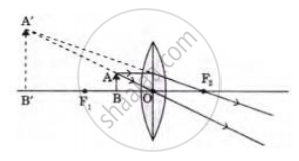
The above lens has a focal length of 10 cm. The object of height 2 mm is placed at a distance of 5 cm from the pole. Find the height of the image.
Concept: undefined >> undefined
Which of the following statements is correct for the water with detergents dissolved in it?
Concept: undefined >> undefined
If a sample of water containing detergents is provided to you, which of the following methods will you adopt to neutralize it?
Concept: undefined >> undefined
Detergents are better than soaps. Justify.
Concept: undefined >> undefined
Define power of a lens. What is its unit? One student uses a lens of focal length 50 cm and another of –50 cm. What is the nature of the lens and its power used by each of them?
Concept: undefined >> undefined
How is soap chemically different from detergents?
Concept: undefined >> undefined
An object is kept at a distance of 1m from a lens of power +2D:
- Identify the type of lens.
- Calculate its focal length and distance of the image formed.
Concept: undefined >> undefined
In case the ova does not fertilize, which of the following events will take place?
Concept: undefined >> undefined
Distinguish between pollination and fertilisation. Mention the site and product of fertilisation in a flower.
Draw a neat, labelled diagram of a pistil showing pollen tube growth and its entry into the ovule.
Concept: undefined >> undefined
Name one method for the refining of metals.
Concept: undefined >> undefined
