Advertisements
Advertisements
Complete the correlation:
Farsightedness : Convex lens : : Presbyopia : ______
Concept: Defects of Vision and Their Corrections > Presbyopia
Write a short note on Presbyopia.
Concept: Defects of Vision and Their Corrections > Presbyopia
Observe the figure whether it is correct or not and explain the phenomenon.

Concept: Defects of Vision and Their Corrections > Myopia
The power of convex lens of focal length 20 cm is ______.
Concept: Power of a Lens
Observe the figure and answer the following questions:

- Name the defect of vision represented in the above figure.
- State the reasons for this defect.
- How is it corrected?
- Draw the diagram to show the correction of this defect.
Concept: Defects of Vision and Their Corrections > Myopia
Complete the following table by observing the given figures:
| Figure → |  |
 |
| Points ↓ | ||
| (a) Name of the defect | ______ | ______ |
| (b) Position of the image | ______ | ______ |
| (c) Lens used to correct the defect | ______ | ______ |
Concept: Defects of Vision and Their Corrections > Myopia
What are amphoteric oxides?
Concept: Chemical Properties of Metal
Observe the following picture a write down the chemical reaction with the explanation.
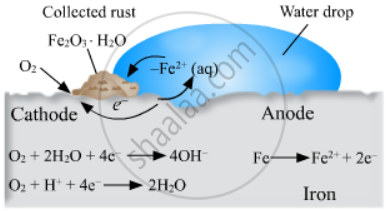
Concept: Corrosion of Metals
Write scientific reasons.
Lemon or tamarind is used for cleaning copper vessels turned greenish.
Concept: Corrosion of Metals
Complete the following flow chart and answer the questions below:
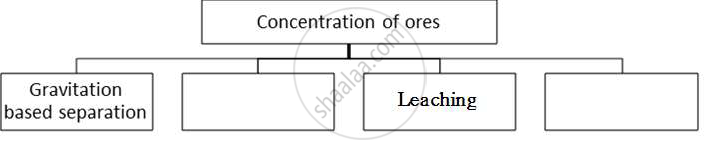
i) In which method pine oil is used?
ii) Explain what method of concentration in brief.
Concept: Metallurgy
Complete the process of iron rusting by filling the blanks. Suggest a way to prohibit the process.
The iron rust is formed due to........................... reaction. Different
regions on iron surface become anode and cathode.
Reaction on anode region :
`F_e(s) → Fe^(2+) (aq) +2e^-`
Reaction on anode region :
`O_2(g) + 4H^+(aq) +............................ → 2H_2 O (l) `
When Fe2+ ions migrate from anode region they react with ................... to form Fe3+ ions.
A reddish coloured hydrated oxide is formed from ............... ions. It is called rust.
`2Fe_(3+) (aq) + 4H_2O(l) → ................. + 6H_+(aq) `
A way to prevent rusting ..................................................................
Concept: Corrosion of Metals
Which of the following process to be carried out to avoid the
formation of greenish layer on brass vessels due to corrosion?
Concept: Basic Principles of Metallurgy > Refining of Metals
Identify the process shown in the diagram and explain it in short

Concept: Corrosion of Metals
An element has its electron configuration as 2,8,8,2. Now answer the following questions.
a) What is the atomic number of this element?
b) What is the group of this element?
c) To which period does this element belong?
Concept: Basic Principles of Metallurgy > Extraction of Metals
Identify the process given in following passage and draw neat labelled diagram showing the process.
Electrolysis of molten mixture of alumina (melting point > 20000C) is done in a steel tank. The tank has a graphite lining on the inner side. This lining does the work of a cathode. A set of graphite rods dipped in the molten electrolyte works as anode. Cryolite (Na3AlF6) and fluorspar (CaF2) are added in the mixture to lower its melting point upto 10000C.
Concept: Basic Principles of Metallurgy > Extraction of Metals
Answer the following question.
a) What is meant by corrosion?
b) Write names of any two methods of prevention of corrosion.
c) In which method, metal like copper, aluminium are coated with a thin layer of their oxides by means of electrolysis.
d) Explain this method with diagram.
Concept: Corrosion of Metals
Choose the correct alternative and rewrite the following:
Iron is _____________________.
Concept: Corrosion of Metals
Answer the following question:
What is corrosion? Do gold ornaments corrode? Justify.
Concept: Corrosion of Metals
