Advertisements
Advertisements
Write the mechanism of the following reaction :

Concept: Chemical Reactions of Alcohols and Phenols >> Reactions Involving Cleavage of Carbon–Oxygen (C–O) Bond in Alcohols
Calculate the e.m.f. of the following cell at 298 K:
Fe(s) | Fe2+ (0.001 M) | | H+ (0.01 M) | H2(g) (1 bar) | Pt(s)
Given that \[\ce{E^0_{cell}}\] = 0.44 V
[log 2 = 0.3010, log 3 = 0.4771, log 10 = 1]
Concept: Nernst Equation - Introduction
For a reaction A + B ⟶ P, the rate is given by
Rate = k [A] [B]2
How is the rate of reaction affected if the concentration of B is doubled?
Concept: Factors Influencing Rate of a Reaction
For a reaction A + B ⟶ P, the rate is given by
Rate = k [A] [B]2
What is the overall order of reaction if A is present in large excess?
Concept: Factors Influencing Rate of a Reaction
For a chemical reaction R → P, the variation in the concentration (R) vs. time (t) plot is given as:
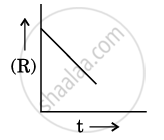
(i) Predict the order of the reaction.
(ii) What is the slope of the curve?
(iii) Write the unit of rate constant for this reaction.
Concept: Factors Influencing Rate of a Reaction
Account for the following:
Mn shows the highest oxidation state of +7 with oxygen but with fluorine, it shows oxidation state of +4.
Concept: General Properties of the Transition Elements (d-block)
Account for the following:
Cu+2 salts are coloured, while Zn2+ salts are white.
Concept: General Properties of the Transition Elements (d-block)
Give a reason for the following:
Actinoids show irregularities in their electronic configurations.
Concept: F-block Elements >> The Actinoids
Give an example and suggest a reason for the following feature of the transition metal chemistry:
The lowest oxide of transition metal is basic, the highest is amphoteric/acidic.
Concept: Some Important Compounds of Transition Elements - Oxides and Oxoanions of Metals
What is the reason for the stability of colloidal sols?
Concept: Properties of Colloidal Solutions
Define the following term:
Zeta potential
Concept: Properties of Colloidal Solutions
[NiCl4]2− is paramagnetic, while [Ni(CO)4] is diamagnetic, though both are tetrahedral. Why? (Atomic number of Ni = 28)
Concept: Bonding in Coordination Compounds >> Valence Bond Theory (VBT)
How do you convert:
2-bromobutane to but-2-ene
Concept: Hydrocarbons: Alkanes >> Reactions of Haloalkanes - Elimination Reactions
What is the role of coke in the extraction of iron from its oxides?
Concept: Occurrence of Metals
Draw the structures of the following molecules: BrF3
Concept: Group 17 Elements - The Halogen Family >> Interhalogen Compounds
Write the equations involved in the following reactions : Williamson synthesis
Concept: Preparation of Ethers
Why carboxylic acid does not give reactions of carbonyl group?
Concept: Acids >> Structure of the Carboxyl group
Write the chemical equations to illustrate the following name reactions : Rosenmund reduction
Concept: Concepts of Aldehydes, Ketones, and Carboxylic Acids >> Preparation of Aldehydes
How will you convert ethanal into the following compound?
But-2-enal
Concept: Concepts of Aldehydes, Ketones, and Carboxylic Acids >> Chemical Reactions of Aldehydes and Ketones - Reactions Due to α-hydrogen
How will you bring about the following conversion in not more than two steps?
Benzoic acid to Benzaldehyde
Concept: Acids >> Chemical Reactions of Carboxylic Acids - Reactions Involving –COOH Group
