Advertisements
Advertisements
Explain the meaning of the term mutual inductance.
Concept: Inductance >> Mutual Inductance
When a bar magnet is pushed towards (or away) from the coil connected to a galvanometer, the pointer in the galvanometer deflects. Identify the phenomenon causing this deflection and write the factors on which the amount and direction of the deflection depends. State the laws describing this phenomenon.
Concept: Introduction to Electromagnetic Induction
A square loop MNOP of side 20 cm is placed horizontally in a uniform magnetic field acting vertically downwards as shown in the figure. The loop is pulled with a constant velocity of 20 cm s−1 till it goes out of the field.
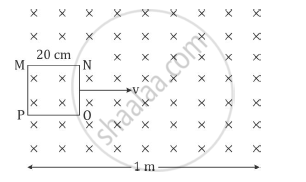
(i) Depict the direction of the induced current in the loop as it goes out of the field. For how long would the current in the loop persist?
(ii) Plot a graph showing the variation of magnetic flux and induced emf as a function of time.
Concept: Magnetic Flux
A long solenoid with 15 turns per cm has a small loop of area 2.0 cm2 placed inside the solenoid normal to its axis. If the current carried by the solenoid changes steadily from 2.0 A to 4.0 A in 0.1 s, what is the induced emf in the loop while the current is changing?
Concept: Inductance >> Mutual Inductance
A pair of adjacent coils has a mutual inductance of 1.5 H. If the current in one coil changes from 0 to 20 A in 0.5 s, what is the change of flux linkage with the other coil?
Concept: Magnetic Flux
What is the direction of induced currents in metal rings 1 and 2 when current I in the wire is increasing steadily?
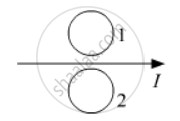
Concept: Lenz’s Law and Conservation of Energy
A pair of adjacent coils has a mutual inductance of 1.5 H. If the current in one coil changes from 0 to 20 A in 0.5 s, what is the change of flux linkage with the other coil?
Concept: Inductance >> Mutual Inductance
Consider two concentric circular coils, one of radius r1 and the other of radius r2 (r1 < r2) placed coaxially with centers coinciding with each other. Obtain the expression for the mutual inductance of the arrangement.
Concept: Inductance >> Mutual Inductance
Show that Lenz's law is a consequence of conservation of energy.
Concept: Lenz’s Law and Conservation of Energy
Define self-inductance. Write its SI units.
Concept: Inductance >> Self Inductance
Welders wear special glass goggles while working. Why? Explain.
Concept: Introduction to Electromagnetic Induction
A toroidal solenoid with air core has an average radius of 15 cm, area of cross-section 12 cm2 and has 1200 turns. Calculate the self-inductance of the toroid. Assume the field to be uniform across the cross-section of the toroid.
Concept: Inductance >> Self Inductance
The currents flowing in the two coils of self-inductance L1 = 16 mH and L2 = 12 mH are increasing at the same rate. If the power supplied to the two coil is equal, find the ratio of induced voltages ?
Concept: Inductance >> Self Inductance
The currents flowing in the two coils of self-inductance L1 = 16 mH and L2 = 12 mH are increasing at the same rate. If the power supplied to the two coil is equal, find the ratio of the currents ?
Concept: Inductance >> Self Inductance
The currents flowing in the two coils of self-inductance L1 = 16 mH and L2 = 12 mH are increasing at the same rate. If the power supplied to the two coil is equal, find the ratio of the energies stored in the two coils at a given instant ?
Concept: Inductance >> Self Inductance
Figure shows a rectangular loop conducting PQRS in which the arm PQ is free to move. A uniform magnetic field acts in the direction perpendicular to the plane of the loop. Arm PQ is moved with a velocity v towards the arm Rs. Assuming that the arms QR, RS and SP have negligible resistances and the moving arm PQ has the resistance r, obtain the expression for (i) the current in the loop (ii) the force and (iii) the power required to move the arm PQ.
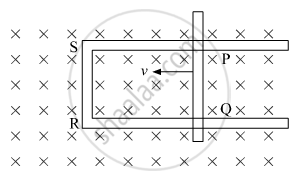
Concept: Magnetic Flux
A light metal disc on the top of an electromagnet is thrown up as the current is switched on. Why? Give reason.
Concept: Introduction to Electromagnetic Induction
Predict the directions of induced currents in metal rings 1 and 2 lying in the same plane where current I in the wire is increasing steadily.
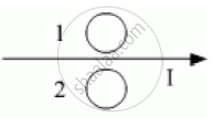
Concept: Lenz’s Law and Conservation of Energy
Define self-inductance of a coil. Show that magnetic energy required to build up the current I in a coil of self inductance L is given by `1/2 LI^2`
Concept: Inductance >> Self Inductance
Predict the direction of induced current in a metal ring when the ring is moved towards a straight conductor with constant speed v. The conductor is carrying current I in the direction shown in the figure.
Concept: Lenz’s Law and Conservation of Energy
