Please select a subject first
Advertisements
Advertisements
The emf of a cell is always greater than its terminal voltage. Why? Give reason.
Concept: Potential Difference and Emf of a Cell
A heating element is marked 210 V, 630 W. Find the resistance of the element when connected to a 210 V dc source.
Concept: Resistivity of Various Materials
Calculate the value of the resistance R in the circuit shown in the figure so that the current in the circuit is 0.2 A. What would b the potential difference between points B and E?

Concept: Kirchhoff’s Laws
Calculate the value of the resistance R in the circuit shown in the figure so that the current in the circuit is 0.2 A. What would b the potential difference between points A and B?

Concept: Kirchhoff’s Laws
In the given circuit, assuming point A to be at zero potential, use Kirchhoff’s rules to determine the potential at point B.

Concept: Kirchhoff’s Laws
Plot a graph showing the variation of stopping potential with the frequency of incident radiation for two different photosensitive materials having work functions W1 and W2 (W1 > W2). On what factors does the (i) slope and (ii) intercept of the lines depend?
Concept: Resistivity of Various Materials
A cell of emf ‘E’ and internal resistance ‘r’ is connected across a variable resistor ‘R’. Plot a graph showing the variation of terminal potential ‘V’ with resistance R. Predict from the graph the condition under which ‘V’ becomes equal to ‘E’.
Concept: Cells, Emf, Internal Resistance
Derive an expression for drift velocity of free electrons in a conductor in terms of relaxation time.
Concept: Drift of Electrons and the Origin of Resistivity
Obtain the expression for the current flowing through a conductor having number density of the electron n, area of cross-section A in terms of the drift velocity vd .
Concept: Drift of Electrons and the Origin of Resistivity
How does the resistivity of a semiconductor change with rise of temperature ? Explain.
Concept: Resistivity of Various Materials
Answer the following question.
How is the drift velocity in a conductor affected with the rise in temperature?
Concept: Concept of Electric Currents in Conductors
A carbon resistor is shown in the figure. Using color code, write the value of the resistance.
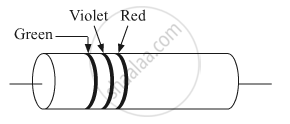
Concept: Specific Resistance
Twelve wires each having a resistance of 3 Ω are connected to form a cubical network. A battery of 10 V and negligible internal resistance is connected across the diagonally opposite corners of this network. Determine its equivalent resistance and the current along each edge of the cube.
Concept: Kirchhoff’s Laws
V-I graph for a metallic wire at two different temperatures T1 and T2 is as shown in the figure. Which of the two temperatures is higher and why?
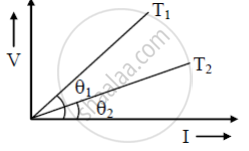
Concept: V-I Characteristics (Linear and Non-linear)
A variable resistor R is connected across a cell of emf ε and internal resistance r as shown in the figure. Draw a plot showing the variation of
(i) Terminal voltage V and
(ii) the current I, as a function of R.
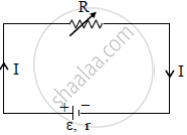
Concept: Temperature Dependence of Resistance
Sunita and her friends visited the exhibition. The policeman asked them to pass through a metal detector. Sunita's friends were initially scared of it. Sunita, however, explained to them the purpose and working of the metal detector.
Answer the following questions :
(a) On what principle does a metal detector work?
(b) Why does the detector emit a sound when a person carrying any metallic object walks through it?
(c) State any two qualities which Sunita displayed while explaining the purpose of walking through the detector.
Concept: Flow of Electric Charges in a Metallic Conductor
Define internal resistance of a cell.
Concept: Measurement of Internal Resistance of a Cell
The temperature (T) dependence of resistivity of materials A and material B is represented by fig (i) and fig (ii) respectively. Identify material A and material B.
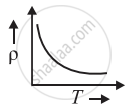 fig. (i) |
 fig. (ii) |
Concept: Temperature Dependence of Resistance
Two cells of emfs E1 and E2 and internal resistances r1 and r2 respectively are connected in parallel as shown in the figure. Deduce the expression for the
- equivalent emf of the combination
- equivalent internal resistance of the combination
- potential difference between the points A and B.

Concept: Cells in Series
State the two Kirchhoff’s rules used in the analysis of electric circuits and explain them.
Concept: Kirchhoff’s Laws
