CBSE Science (English Medium) इयत्ता १२ Important Questions for Physics - Ray Optics and Optical Instruments
Advertisements
Advertisements
Chapter wise important questions with answers and solutions for Physics in CBSE Science (English Medium) इयत्ता १२.
A double convex lens is made of a glass of refractive index 1.55, with both faces of the same radius of curvature. Find the radius of curvature required, if the focal length is 20 cm.
पाठ: [9] Ray Optics and Optical Instruments
Draw a labelled ray diagram of an astronomical telescope to show the image formation of a distant object. Write the main considerations required in selecting the objective and eyepiece lenses in order to have large magnifying power and high resolution of the telescope.
पाठ: [9] Ray Optics and Optical Instruments
Draw a labeled ray diagram of a reflecting telescope. Mention its two advantages over the refracting telescope.
पाठ: [9] Ray Optics and Optical Instruments
How does focal length of a lens change when red light incident on it is replaced by violet light? Give reason for your answer.
पाठ: [9] Ray Optics and Optical Instruments
Define power of a lens. Write its units. Deduce the relation `1/f =1/f_1 +1/f_2`for two thin lenses kept in contact coaxially.
पाठ: [9] Ray Optics and Optical Instruments
Draw a labelled ray diagram of an astronomical telescope in the near point adjustment position. A giant refracting telescope at an observatory has an objective lens of focal length 15 m and an eyepiece of focal length 1.0 cm. If this telescope is used to view the Moon, find the diameter of the image of the Moon formed by the objective lens. The diameter of the Moon is `3.48 xx 10^6`m, and the radius of the lunar orbit is `3.48 xx 10^8`m.
पाठ: [9] Ray Optics and Optical Instruments
Answer the following question.
Under what conditions is the phenomenon of total internal reflection of light observed? Obtain the relation between the critical angle of incidence and the refractive index of the medium.
पाठ: [9] Ray Optics and Optical Instruments
Answer the following question.
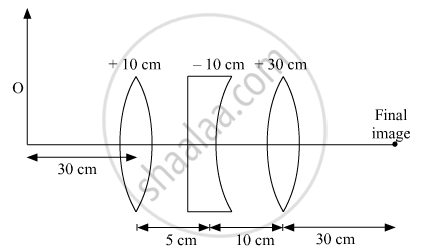
Three lenses of focal length +10 cm, —10 cm and +30 cm are arranged coaxially as in the figure given below. Find the position of the final image formed by the combination.
पाठ: [9] Ray Optics and Optical Instruments
With the help of a ray diagram, obtain the relation between its focal length and radius of curvature.
पाठ: [9] Ray Optics and Optical Instruments
Define the term ‘resolving power of a telescope’.
पाठ: [9] Ray Optics and Optical Instruments
Define the term ‘focal length of a mirror’.
पाठ: [9] Ray Optics and Optical Instruments
Draw a ray diagram of astronomical telescope for the final image formed at infinity.
पाठ: [9] Ray Optics and Optical Instruments
An object is placed in front of a converging lens. Obtain the conditions under which the magnification produced by the lens is
- negative and
- positive.
पाठ: [9] Ray Optics and Optical Instruments
In the given figure the radius of curvature of the curved face in the planoconvex and the planoconcave lens is 15 cm each. The refractive index of the material of the lenses is 1.5. Find the final position of the image formed.

पाठ: [9] Ray Optics and Optical Instruments
Draw a labeled ray diagram to obtain the real image formed by an astronomical telescope in normal adjustment position. Define its magnifying power.
पाठ: [9] Ray Optics and Optical Instruments
- A giant refracting telescope at an observatory has an objective lens of focal length 15 m. If an eyepiece of focal length 1.0 cm is used, what is the angular magnification of the telescope?
- If this telescope is used to view the moon, what is the diameter of the image of the moon formed by the objective lens? The diameter of the moon is 3.48 × 10⁶ m, and the radius of lunar orbit is 3.8 × 10⁸ m.
पाठ: [9] Ray Optics and Optical Instruments
Why should the objective of a telescope have large focal length and large aperture? Justify your answer.
पाठ: [9] Ray Optics and Optical Instruments
Draw a ray diagram depicting the formation of the image by an astronomical telescope in normal adjustment.
पाठ: [9] Ray Optics and Optical Instruments
You are given the following three lenses. Which two lenses will you use as an eyepiece and as an objective to construct an astronomical telescope ? Give reason
| Lenses | Power (D) | Aperture (cm) |
| L1 | 3 | 8 |
| L2 | 6 | 1 |
| L3 | 10 | 1 |
पाठ: [9] Ray Optics and Optical Instruments
You are given three lenses of power 0.5 D, 4 D, and 10 D to design a telescope.
1) Which lenses should be used as objective and eyepiece? Justify your answer.
2) Why is the aperture of the objective preferred to be large?
