Advertisements
Advertisements
The selectivity of a series LCR a.c. circuit is large, when ______.
Concept: AC Voltage Applied to a Series LCR Circuit
Why are microwaves considered suitable for radar systems used in aircraft navigation?
Concept: Electromagnetic Spectrum
Name the phenomenon which shows the quantum nature of electromagnetic radiation.
Concept: Electromagnetic Spectrum
Gamma rays and radio waves travel with the same velocity in free space. Distinguish between them in terms of their origin and the main application.
Concept: Electromagnetic Spectrum
Electromagnetic waves of wavelengths λ1, λ2 and λ3 are used in a radar system, in water purifiers and in remote switches of TV, respectively.
- Identify the electromagnetic waves.
- Write one source for each of them.
Concept: Electromagnetic Spectrum
Which one of the following electromagnetic radiation has the least wavelength?
Concept: Electromagnetic Spectrum
Draw a schematic ray diagram of a reflecting telescope showing how rays coming from a distant object are received at the eyepiece.
Concept: Introduction to Optical Instruments >> Telescope
You have learnt that plane and convex mirrors produce virtual images of objects. Can they produce real images under some circumstances? Explain.
Concept: Refraction by a Lens
A double convex lens is made of a glass of refractive index 1.55, with both faces of the same radius of curvature. Find the radius of curvature required, if the focal length is 20 cm.
Concept: Reflection of Light by Spherical Mirrors
Draw a labelled ray diagram of an astronomical telescope to show the image formation of a distant object. Write the main considerations required in selecting the objective and eyepiece lenses in order to have large magnifying power and high resolution of the telescope.
Concept: Introduction to Optical Instruments >> Telescope
Draw a labeled ray diagram of a reflecting telescope. Mention its two advantages over the refracting telescope.
Concept: Introduction to Optical Instruments >> Telescope
How does focal length of a lens change when red light incident on it is replaced by violet light? Give reason for your answer.
Concept: Power of a Lens
Define power of a lens. Write its units. Deduce the relation `1/f =1/f_1 +1/f_2`for two thin lenses kept in contact coaxially.
Concept: Power of a Lens
Draw a labelled ray diagram of an astronomical telescope in the near point adjustment position. A giant refracting telescope at an observatory has an objective lens of focal length 15 m and an eyepiece of focal length 1.0 cm. If this telescope is used to view the Moon, find the diameter of the image of the Moon formed by the objective lens. The diameter of the Moon is `3.48 xx 10^6`m, and the radius of the lunar orbit is `3.48 xx 10^8`m.
Concept: Introduction to Optical Instruments >> Telescope
Answer the following question.
Under what conditions is the phenomenon of total internal reflection of light observed? Obtain the relation between the critical angle of incidence and the refractive index of the medium.
Concept: Reflection of Light by Spherical Mirrors
Answer the following question.
Three lenses of focal length +10 cm, —10 cm and +30 cm are arranged coaxially as in the figure given below. Find the position of the final image formed by the combination.
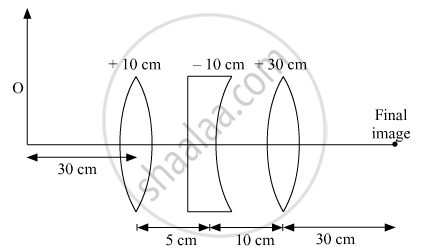
Concept: Reflection of Light by Spherical Mirrors
With the help of a ray diagram, obtain the relation between its focal length and radius of curvature.
Concept: Reflection of Light by Spherical Mirrors
Define the term ‘resolving power of a telescope’.
Concept: Introduction to Optical Instruments >> Telescope
Define the term ‘focal length of a mirror’.
Concept: Refraction at a Spherical Surfaces
Draw a ray diagram of astronomical telescope for the final image formed at infinity.
Concept: Introduction to Optical Instruments >> Telescope
