Please select a subject first
Advertisements
Advertisements
Read the following passage and answer the questions given below.
|
Two motorcycles A and B are running at the speed more than the allowed speed on the roads represented by the lines `vecr = λ(hati + 2hatj - hatk)` and `vecr = (3hati + 3hatj) + μ(2hati + hatj + hatk)` respectively.
|
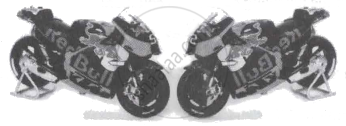
Based on the above information, answer the following questions:
- Find the shortest distance between the given lines.
- Find the point at which the motorcycles may collide.
Concept: Shortest Distance Between Two Lines
Equation of a line passing through (1, 1, 1) and parallel to z-axis is ______.
Concept: Equation of a Line in Space
If a line makes angles of 90°, 135° and 45° with the x, y and z axes respectively, then its direction cosines are ______.
Concept: Direction Cosines and Direction Ratios of a Line
The angle between the lines 2x = 3y = – z and 6x = – y = – 4z is ______.
Concept: Angle Between Two Lines
Find the distance between the lines:
`vecr = (hati + 2hatj - 4hatk) + λ(2hati + 3hatj + 6hatk)`;
`vecr = (3hati + 3hatj - 5hatk) + μ(4hati + 6hatj + 12hatk)`
Concept: Shortest Distance Between Two Lines
A dealer in rural area wishes to purchase a number of sewing machines. He has only Rs 5,760 to invest and has space for at most 20 items for storage. An electronic sewing machine cost him Rs 360 and a manually operated sewing machine Rs 240. He can sell an electronic sewing machine at a profit of Rs 22 and a manually operated sewing machine at a profit of Rs 18. Assuming that he can sell all the items that he can buy, how should he invest his money in order to maximize his profit? Make it as a LPP and solve it graphically.
Concept: Methods to Solve LPP (Graphical / Corner Point Method)
A manufacturer produces two products A and B. Both the products are processed on two different machines. The available capacity of first machine is 12 hours and that of second machine is 9 hours per day. Each unit of product A requires 3 hours on both machines and each unit of product B requires 2 hours on first machine and 1 hour on second machine. Each unit of product A is sold at Rs 7 profit and B at a profit of Rs 4. Find the production level per day for maximum profit graphically.
Concept: Methods to Solve LPP (Graphical / Corner Point Method)
Find graphically, the maximum value of z = 2x + 5y, subject to constraints given below :
2x + 4y ≤ 83
x + y ≤ 6
x + y ≤ 4
x ≥ 0, y≥ 0
Concept: Methods to Solve LPP (Graphical / Corner Point Method)
A manufacturing company makes two types of teaching aids A and B of Mathematics for class XII. Each type of A requires 9 labour hours for fabricating and 1 labour hour for finishing. Each type of B requires 12 labour hours for fabricating and 3 labour hours for finishing. For fabricating and finishing, the maximum labour hours available per week are 180 and 30, respectively. The company makes a profit of Rs 80 on each piece of type A and Rs 120 on each piece of type B. How many pieces of type A and type B should be manufactured per week to get maximum profit? Make it as an LPP and solve graphically. What is the maximum profit per week?
Concept: Methods to Solve LPP (Graphical / Corner Point Method)
A small firm manufactures necklaces and bracelets. The total number of necklaces and bracelets that it can handle per day is at most 24. It takes one hour to make a bracelet and half an hour to make a necklace. The maximum number of hours available per day is 16. If the profit on a necklace is Rs 100 and that on a bracelet is Rs 300. Formulate on L.P.P. for finding how many of each should be produced daily to maximize the profit?
It is being given that at least one of each must be produced.
Concept: Linear Programming Problem and Its Mathematical Formulation
The objective function Z = ax + by of an LPP has maximum vaiue 42 at (4, 6) and minimum value 19 at (3, 2). Which of the following is true?
Concept: Methods to Solve LPP (Graphical / Corner Point Method)
Solve the following Linear Programming Problem graphically:
Maximize: P = 70x + 40y
Subject to: 3x + 2y ≤ 9,
3x + y ≤ 9,
x ≥ 0,y ≥ 0.
Concept: Methods to Solve LPP (Graphical / Corner Point Method)
Assume that each born child is equally likely to be a boy or a girl. If a family has two children, what is the conditional probability that both are girls? Given that
- the youngest is a girl.
- at least one is a girl.
Concept: Conditional Probability
A card from a pack of 52 playing cards is lost. From the remaining cards of the pack three cards are drawn at random (without replacement) and are found to be all spades. Find the probability of the lost card being a spade.
Concept: Independent Events
Three persons A, B and C apply for a job of Manager in a Private Company. Chances of their selection (A, B and C) are in the ratio 1 : 2 :4. The probabilities that A, B and C can introduce changes to improve profits of the company are 0.8, 0.5 and 0.3, respectively. If the change does not take place, find the probability that it is due to the appointment of C
Concept: Bayes’ Theorem
If A and B are two independent events such that `P(barA∩ B) =2/15 and P(A ∩ barB) = 1/6`, then find P(A) and P(B).
Concept: Independent Events
There are three coins. One is a two-headed coin (having head on both faces), another is a biased coin that comes up heads 75% of the times and the third is also a biased coin that comes up tails 40% of the time. One of the three coins is chosen at random and tossed and it shows heads. What is the probability that it was the two-headed coin?
Concept: Bayes’ Theorem
Concept: Independent Events
Often it is taken that a truthful person commands, more respect in the society. A man is known to speak the truth 4 out of 5 times. He throws a die and reports that it is a six. Find the probability that it is actually a six.
Do you also agree that the value of truthfulness leads to more respect in the society?
Concept: Bayes’ Theorem
Events A and Bare such that P(A) = `1/2`, P(B) = `7/12` and `P(barA ∪ barB) = 1/4`. Find whether the events A and B are independent or not.
Concept: Independent Events
