Please select a subject first
Advertisements
Advertisements
Three persons A, B and C apply for a job a manager in a private company. Chances of their selection are in the ratio 1:2:4. The probability that A, B and C can introduce chances to increase the profits of a company are 0.8, 0.5 and 0.3 respectively. If increase in the profit does not take place, find the probability that it is due to the appointment of A.
Concept: Bayes’ Theorem
The probability that A hits the target is `1/3` and the probability that B hits it, is `2/5`. If both try to hit the target independently, find the probability that the target is hit.
Concept: Independent Events
Read the following passage and answer the questions given below.
|
A shopkeeper sells three types of flower seeds A1, A2, A3. They are sold is the form of a mixture, where the proportions of these seeds are 4:4:2 respectively. The germination rates of the three types of seeds are 45%, 60% and 35% respectively.
|
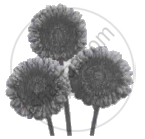
Based on the above information:
- Calculate the probability that a randomly chosen seed will germinate.
- Calculate the probability that the seed is of type A2, given that a randomly chosen seed germinates.
Concept: Bayes’ Theorem
If the sum of numbers obtained on throwing a pair of dice is 9, then the probability that number obtained on one of the dice is 4, is ______.
Concept: Conditional Probability
If for any two events A and B, P(A) = `4/5` and P(A ∩ B) = `7/10`, then `P(B/A)` is equal to ______.
Concept: Conditional Probability
Read the following passage:
|
Recent studies suggest the roughly 12% of the world population is left-handed.
Assuming that P(A) = P(B) = P(C) = P(D) = `1/4` and L denotes the event that child is left-handed. |

Based on the above information, answer the following questions:
- Find `P(L/C)` (1)
- Find `P(overlineL/A)` (1)
- (a) Find `P(A/L)` (2)
OR
(b) Find the probability that a randomly selected child is left-handed given that exactly one of the parents is left-handed. (2)
Concept: Conditional Probability
In answering a question on a multiple choice test, a student either knows the answer or guesses. Let `3/5` be the probability that he knows the answer and `2/5` be the probability that he guesses. Assuming that a student who guesses at the answer will be correct with probability `1/3`. What is the probability that the student knows the answer, given that he answered it correctly?
Concept: Bayes’ Theorem
What is the purpose of Rikli and Jones fitness test? Explain the procedure of any two test items in detail.
Concept: Rikli and Jones Senior Citizen Fitness Test
Elucidate any four types of fractures.
Concept: Causes, Prevention, and Treatment of Hard Tissue Injuries
With the help of suitable examples, discuss the application of Newton’s Laws of Motion in sports.
Concept: Application of Newton's First Law of Motion (Law of Inertia) in Sports
Assertion (A): Aggression is part of human behaviour and is necessary for an individual to live and struggle for higher achievements.
Reason (R): Aggression is inevitable and inseparable in sport activities.
In the context of the above two statements, which one of the following is correct?
Concept: Aggression in Sports
Define strength.
Concept: Strength and Its Classification
List down the types of flexibility.
Concept: Types of Flexibility
Which one of the following is a princely state of India that initially resisted joining the Indian Union?
Concept: Integration of Princely States
In the given political map of India, four states have been marked as A, B, C, and D. Identify these states on the basis of the information given below and write their correct names in your answer book along with the respective serial number of the information used and the concerned alphabet as per the format that follows:

- The state to which Raj Kumari Amrit Kaur, Health Minister in Nehru's Cabinet, belonged.
- The state to which former Congress President. S. Nijalingappa, belonged.
- The state where Karpoori Thakur was the Chief Minister.
- The State to which the political party DMK belongs.
| S. No. of the Information used | Concerned alphabet | Name of the State |
| (i) | ______ | ______ |
| (ii) | ______ | ______ |
| (iii) | ______ | ______ |
| (iv) | ______ | ______ |
Concept: Nehru's Approach to Nation-building
Which one of the following countries was NOT a part of the Soviet Union?
Concept: Why Did the Soviet Union Disintegrate?
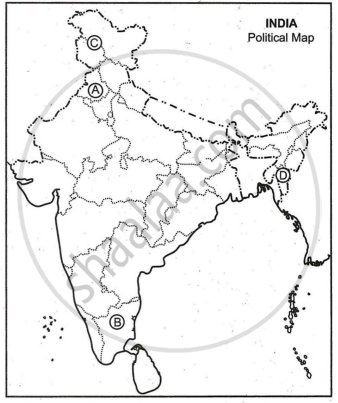
In the given political outline map of India, four states have been marked as (A), (B), (C) and (D). Identify these states on the basis of the information given below and write their correct names in your answer book along with the respective serial number of the information used and the concerned alphabets given in the ‘map as per the format that follows:
| S.No.of the information used |
Concerned Alphabet |
Name of the State |
| (i) | ||
| (ii) | ||
| (iii) | ||
| (iv) |
- The state which has been bifurcated in two Union Territories recently.
- The state where Rajiv Gandhi-Longowal Accord was signed.
- The state to which Laldenga belonged.
- The state from where the Dravidian Movement started.
Concept: Integration of Princely States
Who advanced the 'Two Nation Theory' that led to the partition of British India?
Concept: Partition: Displacement and Rehabilitation
Highlight any three problems faced by Government of India immediately after independence related to the displaced population.
Concept: Partition: Displacement and Rehabilitation
“The ‘Arab Spring’ was the people’s revolution against injustice.” Support the statement with any two examples.
Concept: New Entities in World Politics: Russia, Balkan States and Central Asian States
