Advertisements
Advertisements
प्रश्न
Who advanced the 'Two Nation Theory' that led to the partition of British India?
पर्याय
Abdul Gaffar Khan
Muslim League
British Government
Congress Party
Advertisements
उत्तर
Muslim League
APPEARS IN
संबंधित प्रश्न
Which among the following statements about the partition is incorrect?
(a) Partition of India was the outcome of the “two-nation theory”.
(b) Punjab and Bengal were the two provinces divided on the basis of religion.
(c) East Pakistan and West Pakistan were not contiguous.
(d) The scheme of Partition included a plan for transfer of population across the border.
The Cities that were divided into ‘communal zones’ during the partition violence were:
The main reason for India’s partition is:
Read the given passage carefully and answer the question that follows:
Thus it was decided that what was till then known as ‘India’ would be divided into two countries, ‘India’ and ‘Pakistan’. Such a division was not only very painful but also very difficult to decide and implement. It was decided to follow the principle of religious majorities. This basically means that areas, where the Muslims were in majority, would make up the territory of Pakistan. The rest was to stay with India. The idea might appear simple, but it presented all kinds of difficulties.
Why did the partition of India in 1947 prove to be very painful?
Read the given passage carefully and answer the question that follows:
Thus it was decided that what was till then known as ‘India’ would be divided into two countries, ‘India’ and ‘Pakistan’. Such a division was not only very painful but also very difficult to decide and implement. It was decided to follow the principle of religious majorities. This basically means that areas, where the Muslims were in majority, would make up the territory of Pakistan. The rest was to stay with India. The idea might appear simple, but it presented all kinds of difficulties.
What would have been India’s position in the world, had there been no partition of India?
- India would have been a much larger nation in terms of territorial area.
- India would have played a more vital role in the world scenario.
Observe the diagram below and answer accordingly.

Who propounded the ‘two nation theory?
Observe the diagram below and answer accordingly.
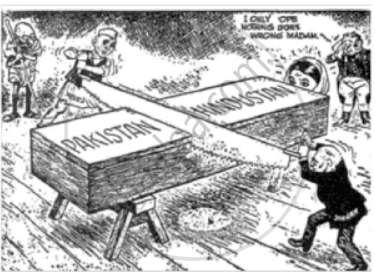
On what basis was the two-nation theory proposed?
Observe the diagram below and answer accordingly.
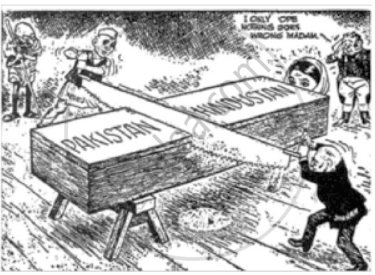
Which two states were undecided to be part of either of these countries, at the time of partition?
British India was divided into British Indian provinces and princely states. Consider the following statements in this regard.
- British Indian provinces were directly governed by the British East India Company.
- Princely states enjoyed full control over their internal affairs but not on issues related to foreign relations.
Choose the incorrect statements
Who among the following influence British to come to India?
Who authorise British East India Company to trade in the East?
Who propounded two-Nation theory?
The concept of 'two-nation theory' was based on ______.
Which of the following were the problems faced at the time of Partition of India?
What does the term ‘religious majorities’ mean in context with the partition?
Muslim population in India in 1951 was ______.
Which statement about the consequence of partition is correct?
Writers and poets described partition of India as ______.
Highlight any three problems faced by Government of India immediately after independence related to the displaced population.
