Definitions [25]
Define thrust.
The force which produces compression is called thrust. Its S.I unit is the newton.
The mass per unit volume of a substance is called density: ρ = M/V
-
SI Unit: kg/m³, Dimensions: [ML−3T0]
The difference between the hydrostatic pressure (P) and the atmospheric pressure (P₀), measured by a manometer, is called gauge pressure: P − P0 = ρgh
The thrust (Normal Force) exerted by a liquid at rest on unit area of the surface in contact is called pressure.
P = \[\frac {F_⊥}{A}\]
-
SI Unit: pascal (Pa) = 1 Nm⁻²
Dimensions: [ML−1T−2]
The ratio of the density of a given fluid to the density of pure water at 4°C is called relative density. It is a unitless quantity.
The weight per unit volume of a substance is called specific weight or weight density: W = mg/V
-
SI Unit: N/m³
Define the SI unit of pressure.
SI unit of pressure is the pascal (Pa) or Nm−2
One Pascal: When a force of one newton acts normally on an area of one square metre (1 m2) then the pressure acting on the surface acting on the surface is called one Pascal.
When a liquid flows such that each particle passing through a specific point follows the exact same path at the same speed as the particle before it, this type of flow is called streamline flow or steady flow.
When a liquid flows such that particles passing through a given point have different velocities from the predecessor, such a flow is called turbulent flow.
The property of a fluid by virtue of which it opposes the relative motion between its different layers, with the force that comes into play, is called viscosity; and that force is called the viscous force.
where η is the coefficient of viscosity.
Define the coefficient of viscosity of a liquid.
The coefficient of viscosity of a liquid is defined as the viscous force acting tangentially per unit area of a liquid layer having a unit velocity gradient in a direction perpendicular to the direction of flow of the liquid.
Define terminal velocity.
The maximum constant velocity acquired by a body while falling freely through a viscous medium is called the terminal velocity VT.
Define velocity gradient.
The rate of change of velocity (dv) with distance (dx) measured from a stationary layer is called velocity gradient.
∴ Velocity gradient = `(dv)/dx`
Define the angle of contact for a given pair of solid and liquid.
The angle between tangents drawn at the point of contact to the liquid surface and the solid surface inside the liquid is called the angle of contact for a pair of solid and liquid. It is denoted by θ.
Define surface tension.
Surface tension is defined as the force per unit length acting at right angles to an imaginary line drawn on the free surface of the liquid.
Define angle of contact.
When a liquid is in contact with a solid, the angle between the tangent drawn to the free surface of the liquid and the surface of solid at the point of contact measured inside the liquid is called the angle of contact.
Define the surface tension of a liquid.
Surface tension is defined as the force acting on a unit length of an imaginary line drawn on the free surface of the liquid, the direction of the force being perpendicular to the line so drawn and acting parallel to the surface.
The constant maximum velocity acquired by a body while falling through a viscous fluid is called terminal velocity.
The limiting velocity up to which flow is streamline and beyond which it changes to turbulent is called critical velocity.
vC = (Re × η)/(ρl)
The resultant of all the forces exerted by a fluid on a body partly or wholly dipped in it, due to hydrostatic pressure, is called upthrust or buoyancy.
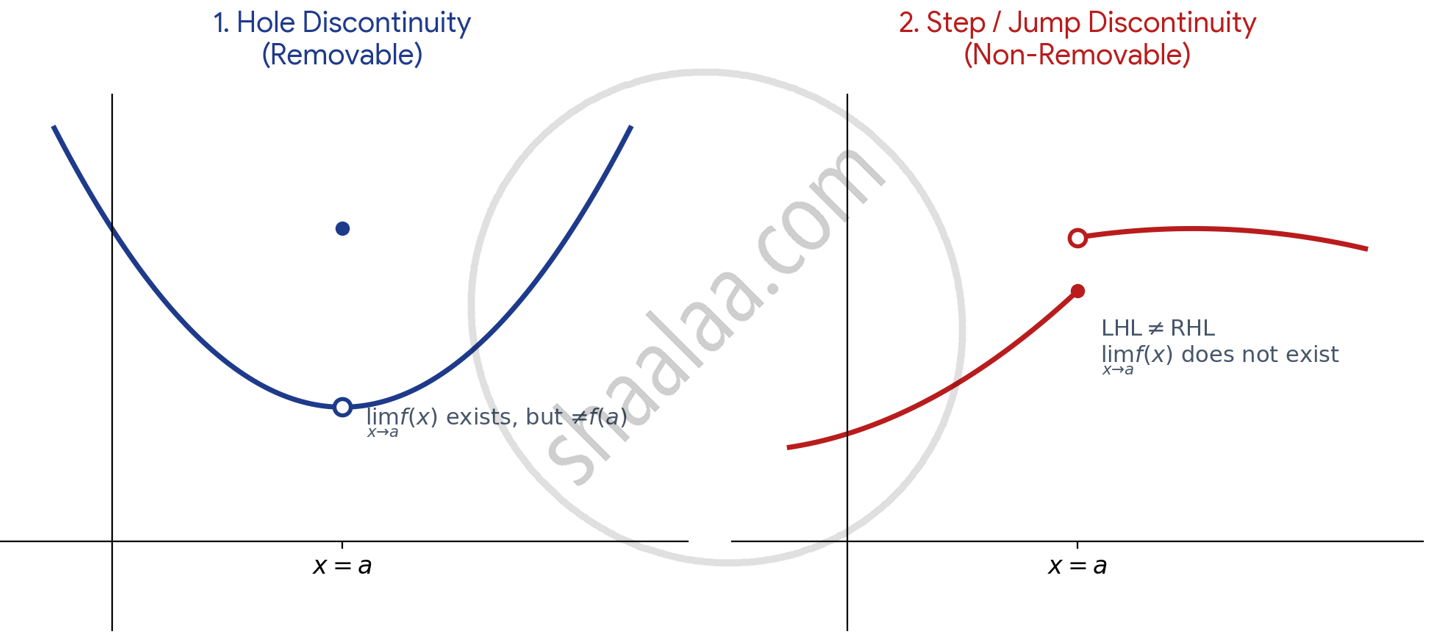
A function f(x) is said to be discontinuous at x = a if it is not continuous at x = a, i.e.
- \[\lim_{x\to a}f\left(a\right)\] does not exist.
- The left-hand limit and the right-hand limit are not equal.
- \[\lim_{x\to a}f\left(x\right)\neq f\left(a\right)\].
Removable Discontinuity:
If \[\lim_{x\to a^{-}}f\left(x\right)=\lim_{x\to a^{+}}f\left(x\right)\neq f\left(a\right),\] then f(x) is said to be removable discontinuous.
Non Removable Discontinuity:
If \[\lim_{x\to a^{+}}f\left(x\right)\neq\lim_{x\to a^{-}}f\left(x\right),\] then f(x) is said to be non-removable discontinuous.
A real function \[f\] is said to be a continuous function if it is continuous at every point in its domain.
\[ \boxed{\lim_{x \to c} f(x) = f(c)} \] for every \[c\] in the domain of \[f\].
Continuity at End Points
If \[f\] is defined on a closed interval \[[a, b]\]:
At the left endpoint \[a\], \[ \boxed{\lim_{x \to a^+} f(x) = f(a)} \]
At the right endpoint \[b\], \[ \boxed{\lim_{x \to b^-} f(x) = f(b)} \]
Only the appropriate one-sided limit is considered at an endpoint.
A real-valued function \[f\] is said to be continuous at \[x = c\] if
\[ \boxed{\lim_{x \to c} f(x) = f(c)} \]
In terms of one-sided limits,
\[ \boxed{\lim_{x \to c^-} f(x) = \lim_{x \to c^+} f(x) = f(c)} \]
Thus, for continuity at \[x = c\]:
- \[f(c)\] must be defined.
- Left-hand limit must exist.
- Right-hand limit must exist.
- Both limits must be equal to \[f(c)\]
If any of these conditions fails, \[f\] is discontinuous at \[x = c\].
Formulae [1]
v = \[\frac{2}{9}\cdot\frac{r^2(\rho-\sigma)g}{\eta}\]
where:
- v = terminal velocity
- r = radius of the body
- ρ = density of the body
- σ = density of the fluid
- g = acceleration due to gravity
- η = coefficient of viscosity of the fluid
Theorems and Laws [4]
Statement: Pascal's Law states that when pressure is applied to a confined (enclosed) fluid, it is transmitted undiminished and equally in all directions throughout the fluid and to the walls of its container.
Mathematical Expression:
Key Points:
- Pressure changes by the same value at every point inside an incompressible, confined liquid.
- Used in hydraulic machines where a small force on a small area produces a large force on a large area.
- Applications: Hydraulic lift, hydraulic brake, hydraulic press, hydraulic jack.
A solid sphere moves at a terminal velocity of 20 m s−1 in air at a place where g = 9.8 m s−2. The sphere is taken in a gravity-free hall having air at the same pressure and pushed down at a speed of 20 m s−1.
(a) Its initial acceleration will be 9.8 m s−2 downward.
(b) It initial acceleration will be 9.8 m s−2 upward.
(c) The magnitude of acceleration will decrease as the time passes.
(d) It will eventually stop
(b) There is no gravitational force acting downwards. However, when the starting velocity is 20 m/s, the viscous force, which is directly proportional to velocity, becomes maximum and tends to accelerate the ball upwards.
\[\text{ When the ball falls under gravity, }\]
\[\text{ neglecting the density of air: } \]
\[\text{ Mass of the sphere = m }\]
\[\text{ Radius = r }\]
\[\text{ Viscous drag coeff . }= \eta\]
\[\text{Terminal velocity is given by}: \]
\[\text{ mg }= 6\pi\eta r v_T \]
\[ \Rightarrow \frac{6\pi\eta r v_T}{m} = g . . . (1)\]
\[\text{ Now, at terminal velocity, the acceleration of the ball due to the viscous force is given by: } \]
\[a = \frac{6\pi\eta r v_T}{m}\]
\[\text{ Comparing equations (1) and (2), we find that : } \]
\[ \text{ a = g }\]
Thus, we see that the initial acceleration of the ball will be 9.8 ms - 2 .
(c) The velocity of the ball will decrease with time because of the upward viscous drag. As the force of viscosity is directly proportional to the velocity of the ball, the acceleration due to the viscous force will also decrease.
(d) When all the kinetic energy of the ball is radiated as heat due to the viscous force, the ball comes to rest.
"When a body is partly or wholly dipped in a fluid, the fluid exerts a force on the body due to hydrostatic pressure. At any small portion of the surface of the body, the force exerted by the fluid is perpendicular to the surface and is equal to the pressure at that point multiplied by the area. The resultant of all these constant forces is called upthrust or buoyancy."
Statement: Stokes' Law describes the force of viscosity exerted on a spherical object as it moves through a fluid. The viscous drag on a spherical body of radius r, moving with velocity v, in a medium of viscosity η is given by:
Key Points:
- The negative sign in F = −ηA\[\frac {dv}{dx}\] shows that viscous force opposes the direction of motion.
- At terminal velocity, upward viscous force + buoyant force = weight of the body.
- Terminal velocity formula derived from Stokes' Law:
v0 = \[\frac{2gr^2(\rho-\sigma)}{9\eta}\] - Terminal velocity is proportional to r² — larger spheres fall faster.
- The coefficient of viscosity η has dimensional formula [ML−1T−1].
- SI unit of viscosity: Ns/m² (or Pa·s); CGS unit: dyne·s/cm² = poise.
Key Points
- Hydraulic Press — Two cylinders (C & D) filled with liquid; small force applied on piston P₁ (smaller area A₁) is converted into a very large upward force on piston P₂ (larger area A₂), since A₂ > A₁.
- Hydraulic Lift — Works on Pascal's Law to lift or support heavy objects such as cars and trucks using liquid pressure.
- Hydraulic Brakes — Small force on the brake pedal is instantly transmitted equally through brake fluid to all cylinders, producing a large thrust on the wheels to stop the vehicle.
- Flow is streamline when velocity is low (parallel, orderly layers).
- Flow turns turbulent when velocity exceeds critical velocity (disordered, mixing layers).
- At low velocity → dye filament stays parallel in pipe (laminar).
- At high velocity → dye filament breaks and spreads (turbulent).
- Aerofoil / Airplane Wing: Air moves faster over the curved top surface → lower pressure above, higher below → upward dynamic lift.
- Spray / Atomizer: High-speed air over a tube creates low pressure → liquid rises and is expelled as droplets.
- Blowing off Roofs: High-velocity wind above roof creates low pressure → atmospheric pressure inside lifts the roof off.
- Magnus Effect (Spinning Ball): A spinning ball drags air, creating pressure difference between upper and lower sides → ball moves in a curved path.
- Venturimeter: Used to measure flow rate of liquid through pipes using pressure difference between wide and narrow sections.
- Attraction between Two Boats: Water between boats moves faster → pressure decreases → boats are pulled toward each other.
- A highly soluble impurity increases surface tension, while a partially soluble impurity (e.g., detergent) decreases it; a waterproofing agent increases it.
- Surface tension decreases with increase in temperature, given by T = T0(1 − αθ), where T0 is surface tension at 0°C and α is the temperature coefficient.
- When a soap bubble is charged (positively or negatively), force acts outward on the surface, increasing its radius — thus electrification always decreases surface tension.
- Continuity at \[x = c\]: \[ \boxed{\lim_{x \to c} f(x) = f(c)} \]
- Practical test: \[ \boxed{\text{LHL} = \text{RHL} = f(c)} \]
If this condition fails, the function is discontinuous at \[c\]. - A function is continuous if it is continuous at every point in its domain.
- Constant, identity and polynomial functions are continuous on their domains.
- \[\dfrac{1}{x}\] is continuous for \[x \neq 0\].
- For a piecewise function, check continuity particularly at the point where the rule changes.
- The greatest integer function \[[x]\] is discontinuous at every integer.
Concepts [19]
- Thrust and Pressure
- Pascal’s Law
- Variation of Pressure with Depth
- Atmospheric Pressure and Gauge Pressure
- Hydraulic Machines
- Streamline and Turbulent Flow
- Applications of Bernoulli’s Equation
- Viscous Force or Viscosity
- Reynold's Number
- Surface Tension
- Effect of Gravity on Fluid Pressure
- Terminal Velocity
- Critical Velocity
- Excess of Pressure Across a Curved Surface
- Introduction of Mechanical Properties of Fluids
- Archimedes' Principle
- Stoke's Law
- Continuous and Discontinuous Functions
- Torricelli's Law
