Definitions [3]
Compounds in which one or more hydrogen atom(s) of an alkane is (are) replaced by halogen.
General formula: R–X.
Compounds in which one or more hydrogen atom(s) directly bonded to an aromatic ring is (are) replaced by halogen.
General formula: Ar–X.
Define racemic mixture.
A mixture containing two enantiomers in equal proportions will have zero optical rotation, as the rotation due to one isomer will be cancelled by the rotation due to the other isomer. Such a mixture is called a racemic mixture or a racemic modification.
Key Points
Common Names:
- Alkyl halide or aryl halide
- e.g., CH₃Cl → Methyl chloride; CH₂=CHCl → Vinyl chloride
IUPAC Names:
- Haloalkane or arylhalide
- Rule 1: Find the longest carbon chain containing the halogen. If a double/triple bond is present, give it priority.
- Rule 2: Number from the end nearer the first substituent. Assign each substituent a position number.
- Multiple same halogens → di-, tri-, tetra- prefix.
- Different halogens → list alphabetically and number to give the alphabetically first halogen the lowest possible number.
Examples:
- CH₃Cl → Chloromethane
- CH₂=CHCl → Chloroethene
- (CH₃)₃CCl → 2-Chloro-2-methylpropane (common: tert-butyl chloride)
- 2-Chloro-1-methylbenzene → o-Chlorotoluene → IUPAC: 1-Chloro-2-methylbenzene
Melting and Boiling Points
- Depend on Van der Waals dispersion forces and dipole–dipole interactions.
- Boiling point ∝ size of halogen atom and number of electrons: R–I > R–Br > R–Cl > R–F (for the same carbon chain)
- Boiling point ∝ surface area ∝ no. of carbons in chain (longer chain → higher B.P.)
- Branching reduces B.P.: B.P. ∝ 1/branching (isomers go from primary → tertiary, B.P. falls)
- Para-isomers of dihalobenzenes have higher melting points than ortho- and meta-isomers due to symmetry fitting better in the crystal lattice.
Density
- Density ∝ no. of halogen atoms / molecular mass.
- Bromo, iodo, and polychloro derivatives are heavier than water: Density: R–I > R–Br > R–Cl > R–F
- For isomers of chlorobenzene: density ∝ molecular mass → benzene < chlorobenzene < dichlorobenzene < bromochlorobenzene.
Solubility
- Haloalkanes are very slightly soluble in water (attraction between alkyl halide molecules is stronger than attraction between alkyl halide and water, and they fail to form H-bonds with water).
- Solubility order in water: R–F > R–Cl > R–Br > R–I
- Haloalkanes dissolve readily in organic solvents (due to similar intermolecular forces).
Alkyl iodide is so unstable that it decomposes in sunlight: 2R–I → 2R + I₂ (violet vapours)
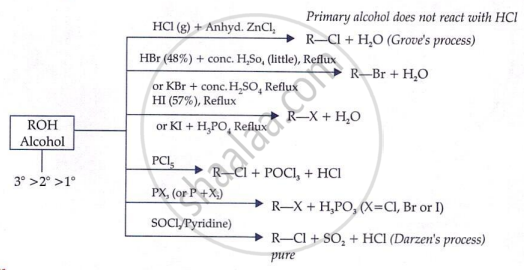
Formation of Alkyl Halide from Alcohols:
From Alkenes
(a) Addition of halogen acids:

(b) Allylic halogenation:
\[\ce{\underset{Propene}{CH3 - CH} = CH2 + Cl2 ->[775K] \underset{\underset{(Allyl chloride)}{3-Chloro-1-propene}}{ClCH2 - CH = CH2 + HCl}}\]
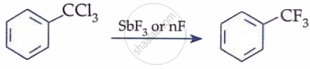
From alkanes (Swarts reaction)
Alkyl chloride or bromide react with AgF, SbF3, or Hg2F2 give alkyl fluoride. This reaction is known Swarts reaction. Antimony trifluoride (SbF2) is commonly used in this reaction.
2CH3CH3CI + Hg2F2→ 2CH3CH2F+ Hg2Cl2
From the halide exchange method (Finkelstein reaction)
Alkyl chloride or bromide react with Nal or KI in presence of acetone give alkyl iodide. It is halide exchange reaction or Finkelstein reaction. It is a SN2 reaction.
\[\ce{R - Cl + Nal ->[Acetone or Methanol] R - I + NaCl}\]
\[\begin{array}{cc}
\phantom{..........}\ce{Cl}\phantom{................................................}\ce{I}\phantom{..}\\
\phantom{..........}|\phantom{..................................................}|\phantom{.}\\
\phantom{}\ce{CH3 - CH2 - CH - CH3 ->[Nal][Acetone] CH3 - CH2 - CH - CH3}\phantom{}
\end{array}\]
Borodine-Hunsdiecker reaction
Silver salt of carboxylic acid on heating with Br2 + carbon tetrachloride give alkyl bromide
\[\ce{\underset{Silver acetate}{CH3COOAg} + Br2 ->[CCl4/Reflux] \underset{Methyl bromide}{CH3 - Br} + AgBr + CO2}\]
Note: If silver salt of carboxylic acid is heated with I2 in presence of CCI4 ester is obtained. This reaction is known as simonini reaction.
\[\ce{2RCOOAg + I2 ->[CCl4] \underset{Ester}{RCOOR} + 2CO2 + 2AgI}\]
If silver salt of carboxylic acid is heated with I2 in presence of HgO or lead tetra acetate than alkyl iodide is obtained
\[\ce{2RCOOAg ->[I2/HgO][Δ] 2R - X + 2CO2 + HgI2 + H2O}\]
The C–X bond in alkyl halides is polarised (Cδ+–Xδ–), making alkyl halides reactive towards nucleophiles.
Two Types of SN Reactions
SN1 (Unimolecular Nucleophilic Substitution):
- First-order kinetics: Rate = k[RX] (depends only on substrate concentration)
- Two-step mechanism: Step 1 (slow) — ionisation to form carbocation; Step 2 (fast) — attack by nucleophile.
- Intermediate: Trigonal planar carbocation.
- More substituted alkyl halides react faster (more stable carbocation).
- Reactivity order: R₃CX > R₂CHX > RCH₂X (3° > 2° > 1°)
- Gives a racemic mixture (optically inactive product) because the nucleophile can attack from both faces.
- For aryl/vinyl halides: Ar₂CX > Ar₂CHX > ArCH₂X = CH₂=CHX > CH₂=CHCH₂X
SN2 (Bimolecular Nucleophilic Substitution):
- Second-order kinetics: Rate = k[RX][Nu] (depends on both substrate and nucleophile concentration)
- One-step mechanism (concerted): Nucleophile attacks from the back side as leaving group departs simultaneously → Transition State is formed.
- Results in Walden Inversion (inversion of configuration at the carbon — stereochemistry inverted).
- Reactivity order: Methyl halide > Primary > Secondary > Tertiary (CH₃X > 1° > 2° > 3°)
- The SN2 reaction rate depends on the concentration of both alkyl halide and nucleophile.
Important Questions [14]
- How is Nitromethane Prepared from the Following? Alkyl Halide
- Iupac Name of Is C6h5 − Ch2 − C − Ch2 − Ch2 − Ch2 − Ch3
- How is Nitromethane Prepared from the Following? α-nitroalkene
- Complete and Rewrite the Balanced Chemical Equations Chlorobenzene
- How Are the Following Conversions Carried Out? 2-methylbutan-1-ol into 2 -methylbutanoic Acid.
- But-1-ene on Reaction with Hcl in the Presence of Sodium Peroxide Yields
- Which of the Following Carbocations is Least Stable?
- Define racemic mixture.
- What is the action of the following on ethyl bromide? silver acetate
- The Stability Order for Carbocation is
- Identify 'A' in the Following Reaction -
- What is the Action of the Following on Ethyl Bromide Alcoholic Solution of Potassium Hydroxide.
- What is the Action of the Following on Ethyl Bromide: Moist Silver Oxide
- Discuss the Mechanism of Alkaline Hydrolysis of Bromomethane.
Concepts [7]
- Concept of Haloalkanes and Haloarenes
- Nomenclature of Haloalkanes and Haloarenes
- Nature of C-X Bond of Haloalkanes and Haloarenes
- Physical Properties of Haloalkanes and Haloarenes
- Methods of Preparation of Haloalkanes
- Reactions of Haloalkanes - Nucleophilic Substitution Reactions
- R-s and D-l Configuration
