Definitions [2]
A circle is defined as the figure (closed curve) obtained by joining all those points in a plane which are at a constant distance from a fixed point in the same plane.
-
Centre → Fixed point
-
Radius → Constant distance
-
Circumference → Perimeter of the circle
The line segment, joining any two points on the circumference of the circle, is called a chord.
Theorems and Laws [13]
Prove that the parallelogram, inscribed in a circle, is a rectangle.
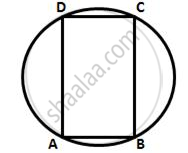
Let ABCD be a parallelogram inscribed in a circle.
Now, ∠BAD + ∠BCD
(Opposite angles of a parallelogram are equal.)
And ∠BAD + ∠BCD = 180°
(A pair of opposite angles in a cyclic quadrilateral are supplementary.)
∠BAD + ∠BCD = `(180^circ)/2` = 90°
The other two angles are 90°, and the opposite pair of sides are equal.
∴ ABCD is a rectangle.
Statement:
The angle in a semicircle is a right angle.
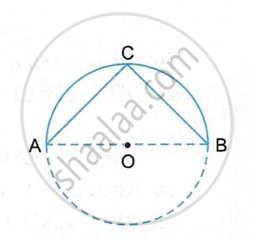
Result:
∠ACB = 90∘
Short Proof (Idea):
-
Diameter subtends an angle of 180° at the centre.
-
The angle at the circle is half of it.
-
Therefore, angle = 90°.
Statement:
Angles in the same segment of a circle are equal.
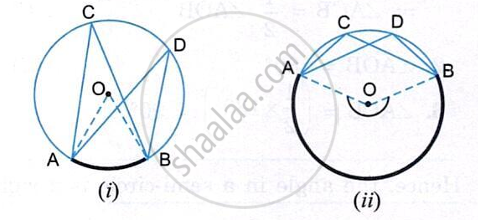
Result:
∠ACB = ∠ADB
Short Proof (Idea):
-
Both angles stand on the same arc.
-
The angle at the centre is double each of them.
-
Hence, both angles are equal.
Statement:
The angle subtended by an arc at the centre of a circle is double the angle subtended by it at any point on the remaining part of the circle.
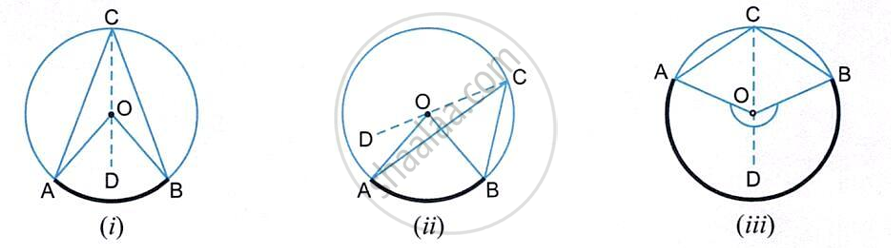
Result:
∠AOB = 2∠ACB
Short Proof (Idea):
-
Join the centre to the points on the circle.
-
Radii form isosceles triangles.
-
Angle at centre = sum of angles at the circle.
-
Hence, the angle at the centre is double the angle at the circle.
Statement:
If an arc of a circle subtends a right angle at any point on the remaining part of the circle, then the arc is a semicircle.
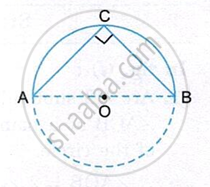
Result:
Arc AB is a semicircle
(or AB is a diameter)
Short Proof (Idea):
-
Given angle at the circle ∠ACB = 90°.
-
The angle at the centre is double the angle at the circle.
-
Therefore, ∠AOB = 2 × 90° = 180°.
-
Hence, A, O, and B lie on a straight line, so AB is a diameter.
-
Therefore, arc AB is a semicircle.
Prove that the line of centres of two intersecting circles subtends equal angles at the two points of intersection.
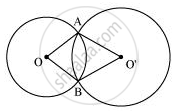
Let two circles having their centres as O and O’ intersect each other at point A and B respectively. Let us join OO’.
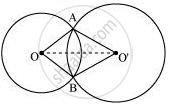
In ΔAOO’ and BOO’,
OA = OB ...(Radius of circle 1)
O’A = O’B ...(Radius of circle 2)
OO’ = OO’ ...(Common)
ΔAOO’ ≅ ΔBOO’ ...(By SSS congruence rule)
∠OAO’ = ∠OBO’ ...(By CPCT)
Therefore, line of centres of two intersecting circles subtends equal angles at the two points of intersection.
Statement:
The sum of the opposite angles of a cyclic quadrilateral is 180°.
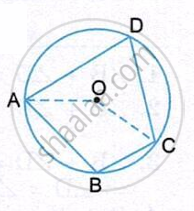
Short Proof (Idea):
-
Let ABCD be a cyclic quadrilateral.
-
Arc ABC subtends an angle ∠ADC at the circle and ∠AOC at the centre.
-
The angle at the centre is double the angle at the circle.
∠ADC=`1/2`∠AOC
-
Similarly, the other arc subtends:
∠ABC = `1/2`(reflex ∠AOC)
-
The sum of angles around the centre is 360°.
-
Therefore,
∠ADC + ∠ABC = `1/2`(360°) = 180∘
Conclusion:
Hence, the opposite angles of a cyclic quadrilateral are supplementary.
Statement:
If the sum of a pair of opposite angles of a quadrilateral is 180°, then the quadrilateral is cyclic.
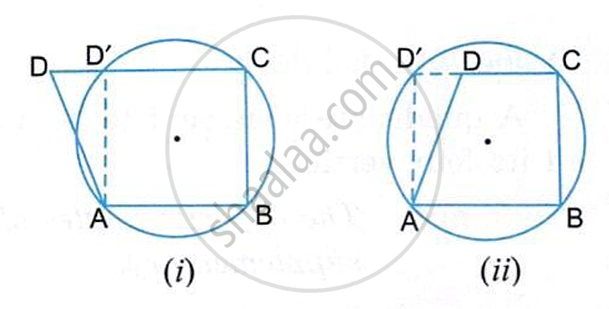
Short Proof (Idea):
-
Given, ∠B + ∠D = 180°.
-
Draw a circle through three vertices of the quadrilateral.
-
If the fourth vertex does not lie on the circle, an exterior angle becomes equal to its interior opposite angle, which is not possible.
-
Hence, the fourth vertex must lie on the same circle.
Conclusion:
Therefore, ABCD is a cyclic quadrilateral.
Statement:
The exterior angle of a cyclic quadrilateral is equal to the interior opposite angle.
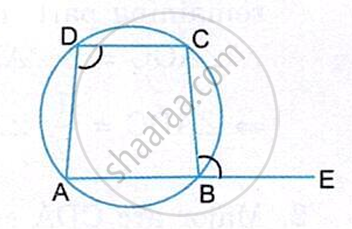
Short Proof (Idea):
-
In a cyclic quadrilateral, the sum of opposite angles is 180°.
-
The exterior angle and the adjacent interior angle form a straight line, so their sum is 180°.
-
Since both are supplementary to the same angle, they are equal.
Conclusion:
Therefore, the exterior angle of a cyclic quadrilateral is equal to the interior opposite angle.
ABC and ADC are two right triangles with common hypotenuse AC. Prove that ∠CAD = ∠CBD.

In ΔABC,
∠ABC + ∠BCA + ∠CAB = 180° ...(Angle sum property of a triangle)
⇒ 90° + ∠BCA + ∠CAB = 180°
⇒ ∠BCA + ∠CAB = 90° ...(1)
In ΔADC,
∠CDA + ∠ACD + ∠DAC = 180° ...(Angle sum property of a triangle)
⇒ 90° + ∠ACD + ∠DAC = 180°
⇒ ∠ACD + ∠DAC = 90° ...(2)
Adding equations (1) and (2), we obtain
∠BCA + ∠CAB + ∠ACD + ∠DAC = 180°
⇒ (∠BCA + ∠ACD) + (∠CAB + ∠DAC) = 180°
∠BCD + ∠DAB = 180° ...(3)
However, it is given that
∠B + ∠D = 90° + 90° = 180° ...(4)
From equations (3) and (4), it can be observed that the sum of the measures of opposite angles of quadrilateral ABCD is 180°. Therefore, it is a cyclic quadrilateral.
Consider chord CD.
∠CAD = ∠CBD ...(Angles in the same segment)

Prove that ‘Opposite angles of a cyclic quadrilateral are supplementary’.
Given: `square`ABCD is a cyclic quadrilateral.
To prove: ∠BAD + ∠BCD = 180º
∠ABC + ∠ADC = 180º
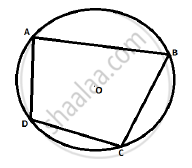
Proof: Arc BCD is intercepted by the inscribed ∠BAD.
∠BAD = `1/2` m(arc BCD) ...(i) [Inscribed angle theorem]
Arc BAD is intercepted by the inscribed ∠BCD.
∴ ∠BCD = `1/2` m(arc DAB) ...(ii) [Inscribed angle theorem]
From (1) and (2) we get
∠BAD + ∠BCD = `1/2` [m(arc BCD) + m(arc DAB)]
∴ (∠BAD + ∠BCD) = `1/2 xx 360^circ` ...[Completed circle]
= 180°
Again, as the sum of the measures of angles of a quadrilateral is 360°
∴ ∠ADC + ∠ABC = 360° – [∠BAD + ∠BCD]
= 360° – 180°
= 180°
Hence, the opposite angles of a cyclic quadrilateral are supplementary.
Bisectors of angles A, B and C of a triangle ABC intersect its circumcircle at D, E and F respectively. Prove that the angles of the triangle DEF are 90°-A, 90° − `1/2 A, 90° − 1/2 B, 90° − 1/2` C.
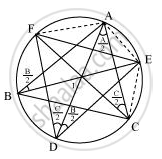
It is given that BE is the bisector of ∠B.
∴ ∠ABE = ∠B/2
However, ∠ADE = ∠ABE (Angles in the same segment for chord AE)
⇒ ∠ADE = ∠B/2
Similarly, ∠ACF = ∠ADF = ∠C/2 (Angle in the same segment for chord AF)
∠D = ∠ADE + ∠ADF
`= (angleB)/2 + (angleC)/2`
`= 1/2(angleB + angleC)`
`= 1/2(180^@ - angleA)`
`= 90^@ - 1/2angleA`
Similarly, it can be proved that
`angleE = 90^@ - 1/2angleB`
`angleF = 90^@ - 1/2angleC`
If circles are drawn taking two sides of a triangle as diameters, prove that the point of intersection of these circles lie on the third side.
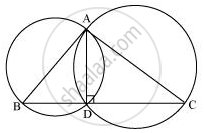
Consider a ΔABC.
Two circles are drawn while taking AB and AC as the diameter.
Let them intersect each other at D, and let D not lie on BC.
Join AD.
∠ADB = 90°...(Angle subtended by semi-circle)
∠ADC = 90° ...(Angle subtended by semi-circle)
∠BDC = ∠ADB + ∠ADC = 90° + 90° = 180°
Therefore, BDC is a straight line, and hence, our assumption was wrong.
Thus, point D lies on the third side BC of ΔABC.
Key Points
-
Concentric circles → Same centre, different radii
-
Equal circles → Same radius
-
Circumscribed circle → Circle passes through all vertices of a polygon
Centre → Circumcentre -
Inscribed circle → Circle touches all sides of a polygon
Centre → Incentre
-
Diameter → Longest chord of a circle
-
Perpendicular from centre to a chord → Bisects the chord
-
Line joining centre to midpoint of a chord → Perpendicular to the chord
-
The greater the chord → Nearer to the centre
-
The smaller the chord, → farther from the centre
-
Equal chords → Equidistant from the centre
-
Chords equidistant from centre → Equal in length
-
Only one circle passes through three non-collinear points
-
Arc Definition: An arc is a curved portion of a circle's circumference between two points.
-
Two Types: Minor arc (< 180°) and Major arc (> 180°).
-
Semicircle: When the arc angle is exactly 180°, it's called a semicircle.
-
Complete Circle: Minor arc + Major arc = 360° (complete circumference).
Definition: A segment is a region of a circle bounded by a chord and its arc
Two Main Types:
-
Minor Segment = smaller piece
-
Major Segment = larger piece
Semicircle Special Case:
-
Formed when chord = diameter
-
Creates two perfectly equal segments
-
Each semicircle = half the circle's area
-
Intersecting Circles (Collinearity):
If two circles with centres O and O′ intersect at two points and diameters are drawn through these points, then the given points lie on a straight line. -
Cyclic Parallelogram:
Every parallelogram inscribed in a circle is a rectangle. -
Isosceles Trapezium:
An isosceles trapezium is always a cyclic quadrilateral. -
Cyclic Trapezium Properties:
A cyclic trapezium is isosceles, and its diagonals are equal. -
Regular Polygon:
Any four vertices of a regular polygon lie on a circle. -
Chords Bisecting Each Other:
If two chords of a circle bisect each other, then both the chords are diameters of the circle. -
Angle Bisectors of a Cyclic Quadrilateral:
The quadrilateral formed by the angle bisectors of a cyclic quadrilateral is also cyclic. -
Mid-point of Hypotenuse:
The mid-point of the hypotenuse of a right-angled triangle is equidistant from all three vertices of the triangle. -
Equal Chords and Angles at the Centre:
In a circle, equal chords subtend equal angles at the centre. -
Converse of Equal Chords Theorem:
In a circle, chords which subtend equal angles at the centre are equal in length.
Important Questions [4]
- In the Figure, M∠Dbc = 58°. Bd is the Diameter of the Circle. Calculate: M∠Bdc and M∠Bec and M∠Bac
- In the Given Figure, ∠Bad = 65°, ∠Abd = 70°, ∠Bdc = 45° 1) Prove that Ac is a Diameter of the Circle. 2) Find ∠Acb
- Calculate the Area of the Shaded Region, If the Diameter of the Semicircle is Equal to 14 Cm. Take `Pi = 22/7`
- Using Ruler and a Compass Only Construct a Semi-circle with Diameter Bc = 7cm. Locate a Point a on the Circumference of the Semicircle Such that a is Equidistant from B and C.
