Definitions [28]
Biomolecules are organic compounds present in living organisms as essential constituents of different cells, such as carbohydrates, proteins, fats, and amino acids.
Define carbohydrates.
Carbohydrates are optically active polyhydroxy aldehydes or polyhydroxy ketones or compounds that can be hydrolysed to polyhydroxy aldehydes or polyhydroxy ketones.
The sugars that reduce the Tollen's reagent and Fehling's solution are called reducing sugars.
Carbohydrates may be defined as optically active polyhydroxy aldehydes or ketones or compounds which produce such units on hydrolysis, such as cellulose, glycogen, starch, etc.
Carbohydrates that are amorphous solids, tasteless and insoluble in water are catled non-sugars.
Carbohydrates that are crystalline solids, sweet in taste and soluble in water are called sugars.
Fructose is another commonly known monosaccharide having the same molecular formula as glucose. It is levorotatory and a ketohexose. It is present abundantly in fruits, and hence it is also called fruit sugar.
Define α-amino acids.
α-Amino acids are carboxylic acids having an amino (–NH2) group bonded to the α-carbon, that is, the carbon next to the carboxyl (–COOH) group.
Define peptide bond.
The bond that connects α-amino acids to each other is called a peptide bond.
Define the term Protein.
Chemically proteins are polyamides which are high molecular weight polymers of the monomer units, i.e., α-amino acids. OR It can also be defined as proteins are the biopolymers of a large number of α-amino acids and they are naturally occurring polymeric nitrogenous organic compounds containing 16% nitrogen and peptide linkages (-CO-NH-)
Define enzymes.
Enzymes are biological catalysts that speed up chemical reactions in living cells without being consumed in the process.
Proteins are complex polyamides formed from amino acids. They are essential for the proper growth and maintenance of the body. They have many peptide (-CO–NH )bonds.
Chemically, proteins are polyamides, which are high molecular weight polymers of the monomer units called \[\alpha\]-amino acids.
Bifunctional organic compounds containing a carboxylic and an amino group either at the same carbon atom or at nearby carbon atoms are called amino acids.
Define the following term:
Essential amino acids
Amino acids that cannot be synthesised in the human body and must be obtained through diet are known as essential amino acids.
Define Zwitter ion
An ∝-amino acid molecule contains both acidic carboxyl (-COOH) group as well as basic amino (-NH2) group. Proton transfer from acidic group to basic group of amino acid forms a salt, which is a dipolar ion called zwitter ion.
Define the following as related to proteins:
Peptide linkage
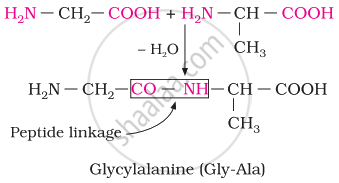
Chemically, peptide linkage is an amide formed between the –COOH group and –NH2 group. The reaction between two molecules of similar or different amino acids proceeds through the combination of the amino group of one molecule with the carboxyl group of the other. This results in the elimination of a water molecule and the formation of a peptide bond –CO–NH–. The product of the reaction is called a dipeptide because it is made up of two amino acids.
For example, when the carboxyl group of glycine combines with the amino group of alanine, we get a dipeptide, glycylalanine.
When a protein, in its native form, is exposed to changes, such as temperature or pH, the hydrogen bonds are disrupted. Due to this, globules unfold, the helix uncoils, and the protein loses its biological activity. It is called denaturation of proteins, e.g., coagulation of egg white on boiling, curdling of milk, etc.
Define the following term as related to proteins:
Denaturation
Denaturation is the process in which the secondary and tertiary structure of a protein is disrupted due to heat, a change in pH, or chemicals, while the primary structure remains unchanged. In denaturation, peptide bonds are not broken; only the weak bonds (like hydrogen bonds) are disturbed.
A colloidal solution of protein which works as a biological catalyst is known as an enzyme.
Vitamins are organic compounds essential for the average growth of life for animals, some bacteria and microorganisms.
A nucleoside consists of a nitrogenous base linked to a pentose sugar without a phosphate group.
Nucleic acids are large biological macromolecules that store and transmit genetic information in living organisms.
DNA is a double-stranded nucleic acid that stores and transmits hereditary information and can replicate itself.
A nucleotide is the basic structural unit of nucleic acids, composed of a nitrogenous base, a pentose sugar, and a phosphate group.
A nitrogenous base is an organic molecule (purine or pyrimidine) that carries genetic information in nucleic acids.
RNA is a single-stranded nucleic acid that helps in protein synthesis and information transfer.
Define the following term.
nucleoside
The unit formed by joining the anomeric carbon of the furanose (sugar) with a nitrogen of a base is called nucleoside.
Key Points
- Common Composition - All living organisms are made of the same elements, like carbon, hydrogen, and oxygen, detected through elemental analysis.
- Same Elements, Different Abundance - Both living and non-living matter contain the same elements, but carbon and hydrogen are more abundant in living organisms.
- Major Elements in Human Body - Oxygen (65%), Carbon (18.5%), Nitrogen (3.3%), Hydrogen (0.5%).
- Earth's Crust vs Human Body - Silicon (27.7%) and Oxygen (46.6%) dominate Earth's crust, while Carbon dominates living matter despite being only 0.03% in the crust.
- Significance - Living organisms selectively concentrate certain elements, making their composition different from non-living matter.
| Category | Meaning | Sub-classification | Examples |
|---|---|---|---|
| Monosaccharides | Simplest carbohydrates cannot be hydrolysed | Aldoses (contain –CHO group); Ketoses (contain C=O group) | Glucose (aldose), Fructose (ketose) |
| Disaccharides | Carbohydrates which on hydrolysis yield two monosaccharide units | Reducing sugars (have free –CHO group); Non-reducing sugars (no free –CHO group) | Maltose, Lactose (reducing); Sucrose (non-reducing) |
| Oligosaccharides | Carbohydrates which on hydrolysis yield 2–10 monosaccharide units | Includes trisaccharides, tetrasaccharides, etc. | Raffinose, Stachyose, Verbascose |
| Polysaccharides | Carbohydrates which on hydrolysis yield many monosaccharide units | Homopolysaccharides (same units); Heteropolysaccharides (different units) | Starch, Glycogen (homo); Cellulose, Chondroitin sulphate (hetero) |
- Carbohydrates are organic biomolecules made of C, H and O, usually fitting the general formula Cx(H₂O)y and existing as aldoses or ketoses.
- They are classified into monosaccharides, disaccharides and polysaccharides; monosaccharides cannot be hydrolysed further, disaccharides are formed by two monosaccharides via glycosidic bonds, and polysaccharides are long polymers.
- Some sugars like digitoxose (C₆H₁₂O₄) and rhamnose (C₆H₁₂O₅) do not obey the typical Cx(H₂O)y formula.
- All monosaccharides are reducing sugars because they possess a free aldehyde or ketone group.
- Cellulose is a linear polymer of β‑D‑glucose, unlike starch and glycogen, which are polymers of α‑glucose and show branching.
- Biologically, carbohydrates supply energy for metabolism; glucose is the main substrate for ATP synthesis, and lactose provides energy to infants.
- Polysaccharides such as starch and glycogen act as storage products and also contribute to structural components of cell membranes and cell walls.
- Glucose is a monosaccharide, an aldohexose, and a reducing sugar, commonly found in fruits and also known as dextrose.
- It can be prepared by hydrolysis of sucrose (using dilute acid) or hydrolysis of starch under heat and pressure.
- Glucose confirms a straight-chain structure of six carbon atoms when reduced to n-hexane.
- Presence of functional groups is shown by reactions: –CHO (aldehyde), five –OH groups, and formation of derivatives like oxime and cyanohydrin.
- Oxidation reactions indicate the formation of gluconic acid (mild oxidation) and saccharic acid (strong oxidation), confirming functional groups in glucose.
| Product | Inference |
|---|---|
| n-Hexane (hot HI) | 6 C in a straight chain |
| Glucoxime (NH₂OH) / Cyanohydrin (HCN) | Carbonyl group present |
| Gluconic acid (Br₂ water) | —CHO group present |
| Glucose pentaacetate (acetic anhydride) | Five —OH groups present |
| Saccharic acid (dil. HNO₃) | One primary —OH group present |
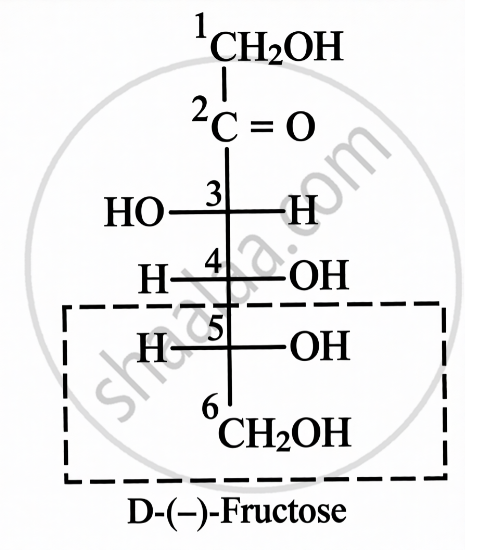
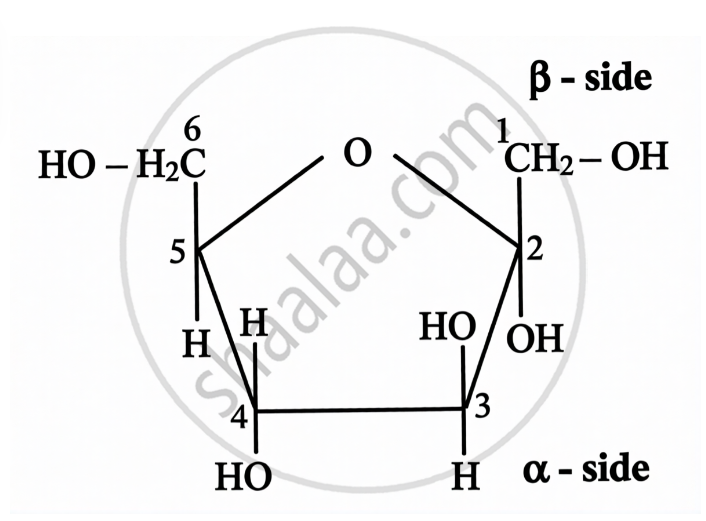
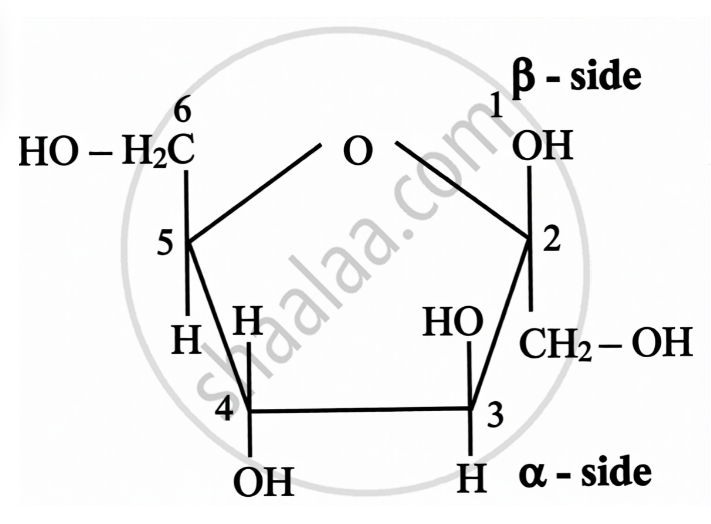
Structure of Fructose:
| Open Chain Structure | Ring Structure | |
 |
\[\alpha\]-D-(-)-Fructofuranose | \[\beta\]-D-(-)-Fructofuranose |
 |
 |
|
Preparation of Fructose:
-
From hydrolysis of cane sugar (sucrose):
\[ \underset{\text{Sucrose}}{\mathrm{C}_{12}\mathrm{H}_{22}\mathrm{O}_{11}} + \mathrm{H}_2\mathrm{O} \xrightarrow{\text{Dil } \mathrm{H}_2\mathrm{SO}_4} \underset{\text{Glucose}}{\mathrm{C}_6\mathrm{H}_{12}\mathrm{O}_6} + \underset{\text{Fructose}}{\mathrm{C}_6\mathrm{H}_{12}\mathrm{O}_6} \] -
From inulin:
\[ (\mathrm{C}_6\mathrm{H}_{10}\mathrm{O}_5)_n + n\mathrm{H}_2\mathrm{O} \xrightarrow{\text{Dil } \mathrm{H}_2\mathrm{SO}_4} \underset{\text{Fructose}}{n\mathrm{C}_6\mathrm{H}_{12}\mathrm{O}_6} \]
- Determined by the orientation of –OH on the asymmetric carbon farthest from the carbonyl (C5 in glucose, C5 in fructose)
- D-configuration: –OH on the right side (Fischer projection)
- L-configuration: –OH on the left side
- Carbohydrates of physiological significance are in the D-configuration
- Mirror images are called enantiomers (L-configuration)
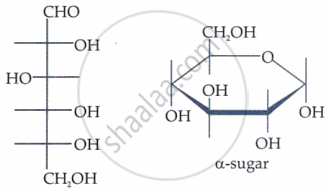
A Haworth projection is important to quickly and easily see the 3D orientation of a cyclic sugar. The Haworth projection is important with sugar molecules.
If the sugar is a D-sugar place a -СН2ОН above the ring on the carbon to the left of the oxygen, for an L-sugar place it below the ring.
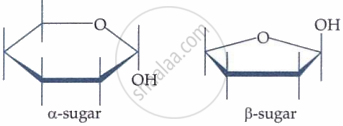
Finally, -OH groups on the right go below the ring and those on the left above, using the -CН2OH group as the reference point for both projection.
- Glucose is an aldohexose with molecular formula \[C_{6}H_{12}O_{6},\mathrm{M.P.146^{\circ}C.}\]
- 'D' in D-(+)-Glucose = configuration; (+) = dextrorotatory nature; 'D'/'L' have no relation to optical activity.
- Glucose has five —OH groups (confirmed by glucose pentaacetate) and one aldehydic carbonyl group (confirmed by oxime & cyanohydrin formation).
- Glucose is soluble in water, sparingly soluble in alcohol, and insoluble in ether.
- The additional chiral centre in glucose ring structures is formed due to ring closure.
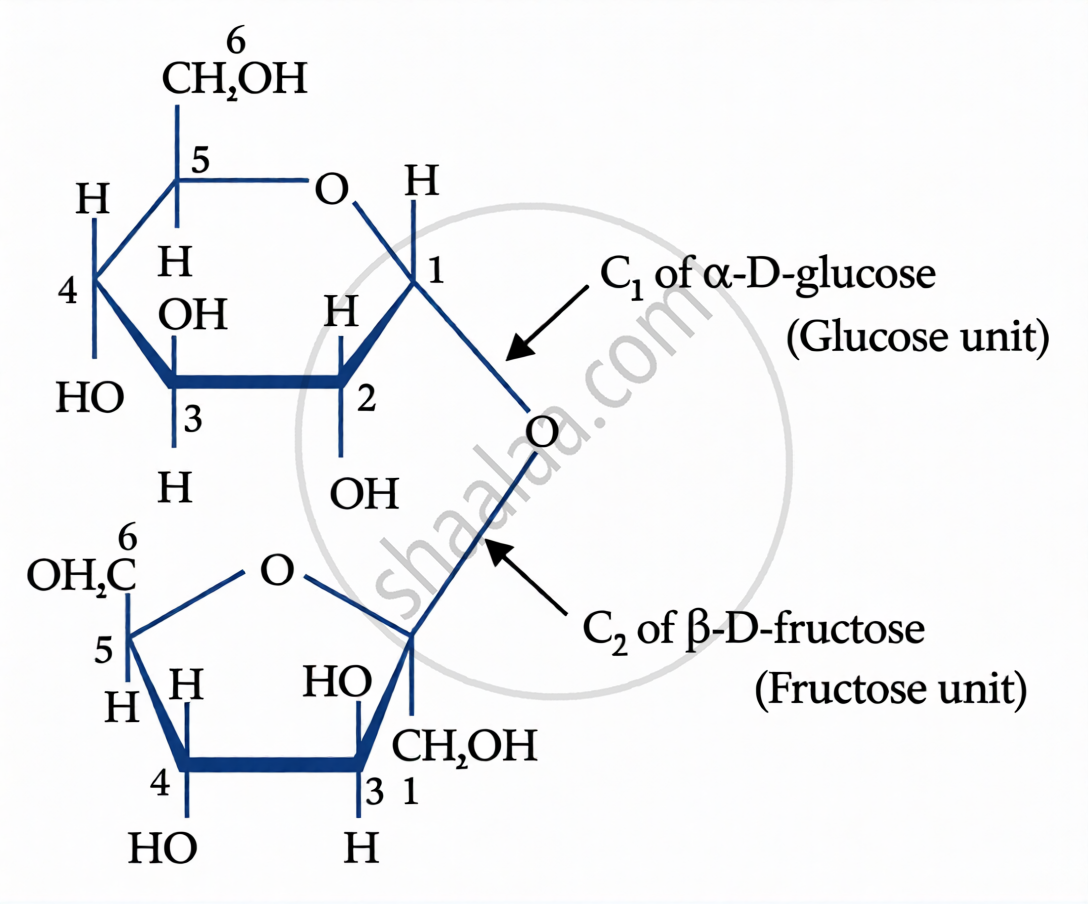
- Disaccharide of α-D-glucose + β-D-fructose linked by α-1,2-glycosidic bond (C1 of glucose + C2 of fructose)
- Since both anomeric carbons are involved in the bond → non-reducing sugar
- Hydrolysis (acid/enzyme invertase): Sucrose → 1 glucose + 1 fructose
- Dextrorotatory (+) but the product (invert sugar) is levorotatory (–)
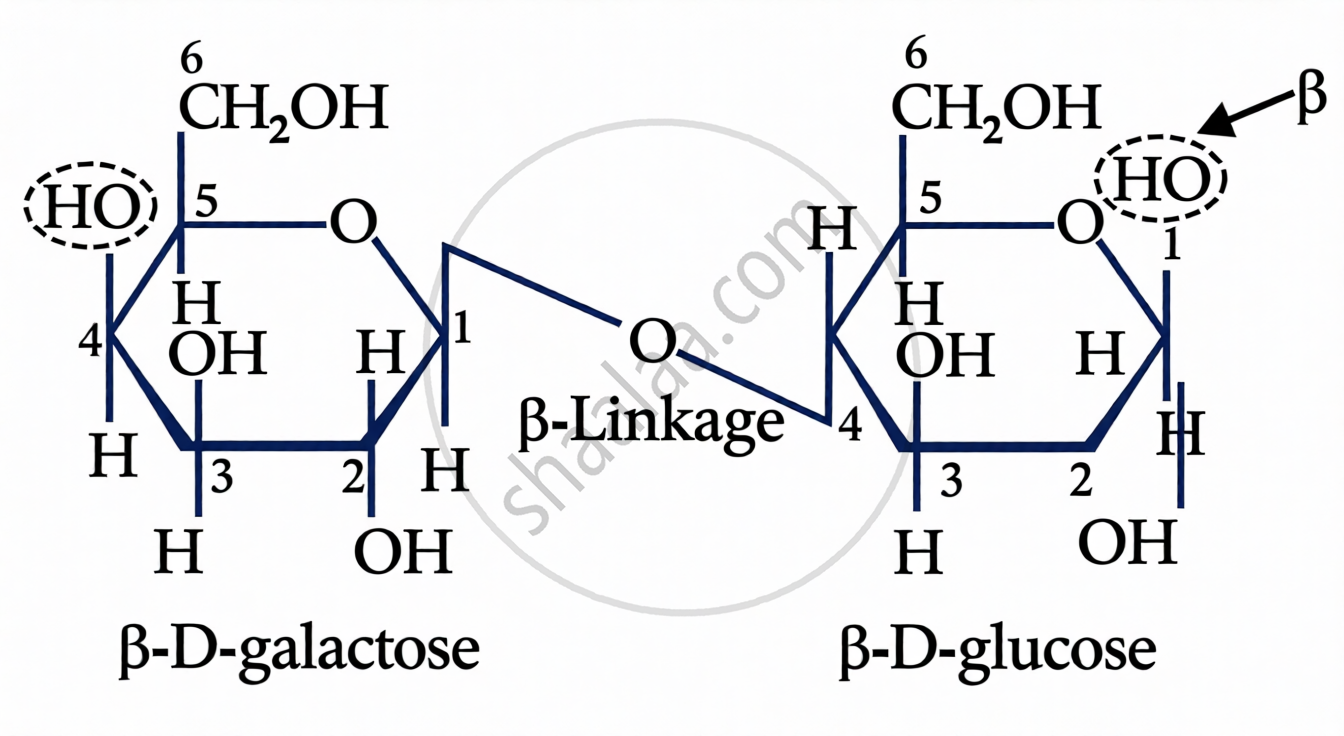
- Called milk sugar; found in milk
- Made of β-D-galactose + β-D-glucose linked by β-1,4-glycosidic bond
- Free –CHO at C1 of glucose unit → reducing sugar
- Hydrolysis: Lactose → D-galactose + D-glucose (equimolar)
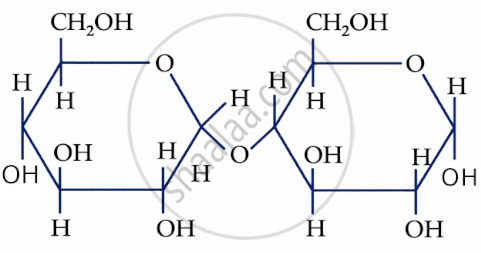
- Produced by partial hydrolysis of starch by enzyme diastase
- Made of two α-D-glucose units linked by α-1,4-glycosidic bond (C1 of one + C4 of other)
- Free aldehyde group at C1 of the second glucose → reducing sugar
- Complete hydrolysis: Maltose → 2 glucose
- Primary source of energy for plants and animals
- Honey consists of a mixture of carbohydrates (source of quick energy)
- Starch and cellulose are stored in plants; glycogen is stored in animals/humans
- Used in the textile, paper, and alcohol industry
- Found in combination with proteins and lipids (e.g., glycoproteins, glycolipids)
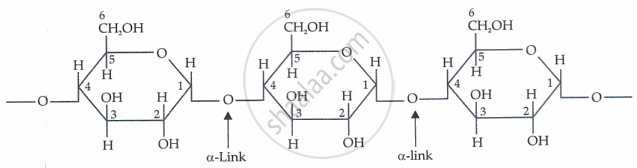
- Constitutes about 20% of starch; it is water-soluble
- Straight chain polymer of 200–1000 α-D-(+)-glucose units
- Linked by C₁–C₄ glycosidic (α) linkage — long unbranched chain
- Forms a blue-black colour with iodine (used in starch test)
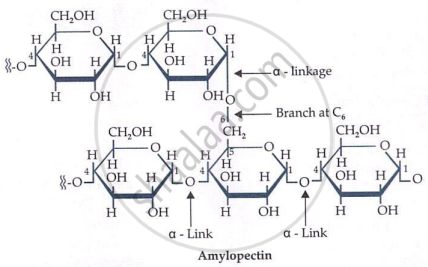
- Constitutes 80–85% of starch; NOT soluble in water
- Branched-chain polymer of α-D-glucose
- Main chain: C₁–C₄ α-linkage; Branching: C₁–C₆ α-linkage
- Branching occurs every 24–30 glucose units
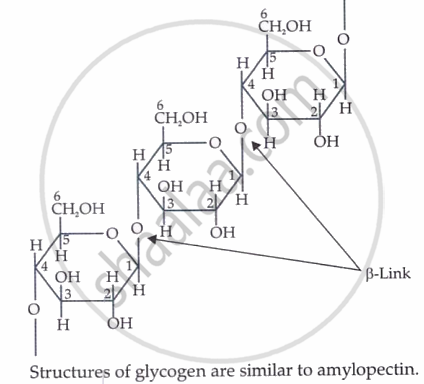
- The structure of glycogen is similar to amylopectin, but is more highly branched
- Most abundant organic substance in the plant kingdom
- Straight chain polymer of β-D-glucose units
- Linked by β-1,4-glycosidic bond (C1 of one unit to C4 of next)
- Cannot be digested by humans (no enzyme to break β-1,4 bonds)
- Used as a dietary fibre; also used in the textile, paper, and explosives industries
- Proteins are polymers of amino acids (polypeptides) in which amino acids are linked by peptide bonds.
- There are 20 types of amino acids, so proteins are heteropolymers (not homopolymers).
- Amino acids are of two types: essential (must be obtained from diet) and non-essential (can be synthesised in the body).
- Proteins are high molecular weight biomolecules (polyamides) made of α-amino acids with a general structure R-CH(NH₂)-COOH.
- Proteins perform various functions such as enzymatic activity, transport, hormonal regulation, immunity, and sensory reception.
- Proteins are of two main types: fibrous proteins (insoluble, structural, e.g., keratin) and globular proteins (soluble, functional, e.g., enzymes, insulin).
- Collagen is the most abundant protein in animals, while RuBisCO is the most abundant enzyme in the biosphere.
α-Amino acids: Carboxylic acids where α-hydrogen is replaced by the –NH₂ group
General structure: \[ \mathrm{R} - \underset{\underset{\displaystyle \mathrm{NH}_2}{|}}{\overset{\overset{\displaystyle \alpha}{\displaystyle \mathrm{CH}}}{}} - \mathrm{COOH}\]
(where R = H or alkyl group at α-carbon)
Essential amino acids (not synthesised in the body; must be taken in food):
- Leucine
- Isoleucine
- Lysine
- Methionine
- Phenylalanine
- Threonine
- Tryptophan
- Valine
Non-essential amino acids (synthesised in the body):
- Alanine
- Asparagine
- Aspartic acid
- Cysteine
- Glutamic acid
- Glutamine
- Glycine
- Proline
- Serine
- Tyrosine
Semi-essential (50% body + 50% food):
- Arginine
- Histidine
Glycine is the only optically inactive amino acid (no chiral centre; R = H)
Isoelectric Point (pI):
- pH at which an amino acid does not migrate in an electric field → exists as a zwitterion (+NH₃–CH(R)–COO⁻)
- At pI, the concentration of zwitterions is maximum; anionic and cationic forms are equal
- At pI, an amino acid has the least solubility in water (used in separation by isoelectric precipitation)
- For neutral amino acid: \[pI=\frac{1}{2}(pk_{a_1}+pk_{a_2})\]
- Bond formed between –COOH of one amino acid and –NH₂ of another by the elimination of water
\[ \begin{array}{c} \mathrm{H}_2\mathrm{N} - \mathrm{CH}_2 - \mathrm{COOH} + \mathrm{H}_2\mathrm{N} - \underset{\underset{\displaystyle \mathrm{CH}_3}{|}}{\mathrm{CH}} - \mathrm{COOH} \\ \downarrow \\ \mathrm{H}_2\mathrm{N} - \mathrm{CH}_2 - \boxed{\mathrm{CO}-\mathrm{NH}} - \underset{\underset{\displaystyle \mathrm{CH}_3}{|}}{\mathrm{CH}} - \mathrm{COOH} \\ \uparrow \\[-1ex] \text{Peptide linkage} \end{array} \]
- Dipeptide = 2 amino acids, 1 peptide bond
- Tripeptide = 3 amino acids, 2 peptide bonds
- Polypeptide = more than 10 amino acids
- Polypeptide chain has –NH₂ terminus (N-terminal) and –COOH terminus (C-terminal)
| Feature | Fibrous Proteins | Globular Proteins |
|---|---|---|
| Shape | Thread-like; lie side by side → fibres | Folded into a compact spheroidal shape |
| Solubility | Usually insoluble in water | Usually soluble in water |
| Function | Structural | Functional (enzymes, hormones, antibodies) |
| Examples | Keratin (hair, nails), Collagen (connective tissue), Myosin | Insulin, Albumin, Haemoglobin, Enzymes |
| Level | Description | Stabilising Forces |
|---|---|---|
| Primary | Linear sequence of amino acids linked by peptide bonds | Peptide bonds |
| Secondary | α-helix (right-handed coil, –NH of one AA H-bonded to C=O of 4th residue) OR β-pleated sheet (when R group is small) | Hydrogen bonds |
| Tertiary | Further folding of secondary structure; 3D shape | Hydrophobic interactions, H-bonds, disulphide bonds, van der Waals, ionic interactions |
| Quaternary | Two or more polypeptide chains arranged spatially | All forces present in tertiary structure |
- Enzymes are biological catalysts, mostly proteins, that increase the rate of biochemical reactions without being consumed.
- Some enzymes are ribozymes, which are RNA molecules that act like enzymes.
- Enzymes have primary, secondary, and tertiary structures, and their 3D structure determines their specificity and function.
- Each enzyme has a specific active site where the substrate binds to form an enzyme–substrate complex.
- Enzymes are highly specific and lower the activation energy of reactions.
- Enzyme activity is affected by temperature and pH; most enzymes are denatured at high temperatures, while thermophilic enzymes remain stable at 80–90°C.
- Examples of enzymes include amylase (starch → glucose), pepsin (proteins → amino acids), lactase (lactose → glucose + galactose), and maltase (maltose → glucose).
Mechanism of Enzyme Action (Lock and Key model):
- Enzyme (E) binds to substrate (S) → ES complex (E + S → ES)
- Product formation: ES → EP
- Product released: EP → E + P (enzyme regenerated)
- Enzymes work best at 298 K to 313 K (25°C to 40°C) — optimum temperature
- Activity decreases with temperature increase or decrease beyond optimum range; stops at ~273 K
Hormones are chemical substances produced by ductless (endocrine) glands; released into the bloodstream to regulate organ functions
Classified into: Steroid hormones, Amine hormones, Peptide hormones
| Type | Example | Gland | Function |
|---|---|---|---|
| Steroid | Testosterone | Testes | Development of male sex organs |
| Steroid | Oestrogen & Progesterone | Ovary | Female sex organ development; pregnancy |
| Steroid | Cortisone | Adrenal cortex | Regulates water and mineral salt metabolism |
| Amine | Adrenaline | Adrenal medulla | Increases blood pressure and pulse rate |
| Amine | Thyroxine | Thyroid | Stimulates oxidative metabolism; growth |
| Peptide | Oxytocin | Posterior pituitary | Contraction of uterus during childbirth |
| Peptide | Vasopressin | Posterior pituitary | Controls water reabsorption in kidneys |
| Peptide | Insulin | Pancreas (posterior pituitary) | Controls blood glucose (lowers) |
| Peptide | Glucagon | Pancreas | Increases blood glucose level |
Vitamins = organic compounds essential in small amounts for normal growth and functioning
Not synthesised in adequate amounts by the body → must be supplied in the diet.
| Category | Vitamins | Key Feature |
|---|---|---|
| Fat-soluble | A (Retinol), D (Calciferol), E (Tocopherol), K (Phylloquinone) | Stored in the liver and adipose tissue; insoluble in water |
| Water-soluble | B complex (B₁, B₂, B₃, B₅, B₆, B₁₂), C | Transferred to blood frequently; not stored |
- Nucleic acids are biomacromolecules present in the acid-insoluble fraction and are responsible for the storage and transmission of genetic information (DNA and RNA).
- They are polynucleotides, formed by repeated units called nucleotides.
- Each nucleotide consists of three components: a nitrogenous base, a pentose sugar, and a phosphate group.
- Nitrogenous bases are of two types: purines (adenine, guanine) and pyrimidines (cytosine, thymine, uracil).
- The sugar present is either ribose (in RNA) or 2′-deoxyribose (in DNA).
- DNA is double-stranded and contains bases A, T, G, and C, while RNA is single-stranded and contains A, U, G, and C.
- DNA stores genetic information, while RNA plays a key role in protein synthesis and the expression of genetic information.
Nucleotide = Phosphate group + Sugar + Nitrogenous base
Hydrolysis pathway:
- DNA → Nucleotide → Phosphoric acid + Nucleoside → Sugar (2-deoxyribose) + Purine/Pyrimidine base
- RNA → Nucleotide → Phosphoric acid + Nucleoside → Sugar (Ribose) + Purine/Pyrimidine base
Nitrogen Bases:
| Type | DNA bases | RNA bases |
|---|---|---|
| Purines (double ring) | Adenine (A), Guanine (G) | Adenine (A), Guanine (G) |
| Pyrimidines (single ring) | Cytosine (C), Thymine (T) | Cytosine (C), Uracil (U) |
Concepts [28]
- Concept of Biomolecules
- Classification of Carbohydrates
- Biomolecules in the Cell > Carbohydrates
- Preparation of Glucose
- Fructose
- D- and L-configuration
- Haworth Representation
- Structures of Glucose
- Sucrose
- Lactose
- Maltose
- Importance of Carbohydrates
- Amylose
- Amylopectin
- Cellulose
- Biomolecules in the Cell > Proteins
- Amino Acids
- Peptide Bond
- Classification of Proteins on the Basis of Molecular Shape
- Structure of Proteins
- Denaturation of Proteins
- Biomolecules in the Cell > Enzymes
- Biomolecules in the Cell > Hormones
- Biomolecules in the Cell > Vitamins
- Classification of Vitamins
- Important Vitamins, Their Sources and Their Deficiency Diseases
- Biomolecules in the Cell > Nucleic Acids
- Chemical Composition of Nucleic Acids
