Commerce (English Medium)
Science (English Medium)
Arts (English Medium)
Academic Year: 2024-2025
Date & Time: 22nd March 2025, 10:30 am
Duration: 3h
Advertisements
GENERAL INSTRUCTIONS:
Read the following instructions very carefully and follow them:
- This question paper contains 30 questions. All questions are compulsory.
- The question paper is divided into five sections - Sections A, B, C, D, and E.
- Section A - question numbers 1 to 12 are Multiple Choice type questions. Each question carries 1 mark.
- Section B - question numbers 13 to 18 are Short Answer type questions. Each question carries 2 marks. Write answer to each question in 50 to 60 words.
- Section C - question numbers 19 to 23 are Long Answer Type - I questions. Each question carries 4 marks. Write answer to each question in 100 to 120 words.
- Section D - question numbers 24 to 26 are Passage, Cartoon/Picture and Map-based questions. Answer each question accordingly.
- Section E - question numbers 27 to 30 are Long Answer Type - II questions. Each question carries 6 marks. Write answer to each question in 170 to 180 words.
- There is no overall choice in the question paper. However, an internal choice has been provided in few questions. Only one of the choices in such questions has to be attempted.
- In addition to this, NOTE that a separate question has been provided for Visually Impaired. candidates in lieu of questions having visual inputs, Map etc. Such questions are to be attempted by Visually Impaired candidates only.
Statement- I: Pakistan formed an elected government under the leadership of Zulfikar Ali Bhutto which lasted from 1971 to 1977.
Statement- II: The Zulfikar Ali Bhutto government was removed by General Pervez Musharraf in 1977.
Both Statement I and Statement II are true.
Both Statement I and Statement II are false.
Statement I is true, but Statement II is false.
Statement I is false, but Statement II is true.
Chapter:
Arrange the following in chronological order of their formation:
- The World Trade Organisation
- World Bank
- The International Atomic Energy Agency
- United Nations Organisation
Choose the correct option:
I, II, III, IV
II, IV, III, I
IV, I, III, II
III, I, II, IV
Chapter:
Institutional safeguards to minimize the negative effects of globalization on those who are economically weak are known as ______.
Welfare measures
Social safety nets
Economic liberalization
Voluntary services
Chapter:
Assertion (A): The entry and the increased role of multinational companies all over the world leads to a reduction in the capacity of governments to take decisions on their own.
Reason (R): The state continues to discharge its essential functions and consciously withdraws from certain domains from which it wishes to.
Both the Assertion (A) and the Reason (R) are correct and the Reason (R) is the correct explanation of the Assertion (A).
Both the Assertion (A) and the Reason (R) are correct, but the Reason (R) is not the correct explanation of the Assertion (A).
The Assertion (A) is incorrect, but the Reason (R) is correct.
The Assertion (A) is correct, but the Reason (R) is incorrect.
Chapter:
Match the terms given in Column ‘A’ correctly with Column ‘B’ and choose the correct answer from the codes given below:
| Column ‘A’ | Column ‘B’ | ||
| I. | Human Rights Watch | i. | An organ of the United Nations |
| II. | International Monetary Fund | ii. | An agency of the United Nations |
| III. | World Health Organisation | iii. | An international organisation that oversees financial institutions |
| IV. | General Assembly | iv. | An international NGO |
I - iii, II - i, III - iv, IV - ii
I - iv, II - i, III - iii, IV - ii
I - iv, II - iii, III - ii, IV - i
I - ii, II - iv, III - iii, IV - i
Chapter:
Which of the following events made the South Asian region a sudden focus of global attention after the cold war period?
Bangladesh War of 1971.
Ethnic conflict of Sri Lanka.
India and Pakistan both became nuclear power.
Kargil conflict between India and Pakistan.
Chapter:
Which one among the following is NOT the function of NITI Aayog?
Promote Co-operative federalism.
Developing a strategy for national development.
Arrange funds for the implementation of development programs.
Creating a system that develops entrepreneurship.
Chapter:
Identify and choose the incorrect pair:
Lal Bahadur Shastri - Jai Jawan Jai Kisan
Indira Gandhi - Garibi Hatao
Syndicate - A group of powerful opposition leaders against Indira Gandhi
Grand Alliance - Formed by all Non-Congress Parties
Chapter:
Which statement among the following is correct about the planning ideology of left wing?
The Left supports a free-market economy.
They support government policies which are for the benefit of poor sections.
They do not want unnecessary intervention of government in the economy.
They advocate for progressive policies.
Chapter:
Identify the main reason for the split in Congress Party in 1969.
Change in the ideology of Congress Party.
Dominance of the Congress syndicate.
Difference of opinion among the opposition parties.
Opposition parties came together.
Chapter:
The recommendations of Mandal Commission were implemented in which one of the following year?
1989
1990
1991
1992
Chapter:
New Economic Policy was adopted in India under the Prime Ministership of ______.
V.P. Singh
Manmohan Singh
Narasimha Rao
H.D. Deve Gauda
Chapter:
Advertisements
Explain the two commonly agreed upon goals of the national movement which were achieved after independence.
Chapter:
Explain any two arguments given in favour of economic globalization.
Chapter:
Justify that “Regionalism is not as dangerous as Communalism”.
Chapter: [7] Regional Aspirations
Describe any four steps taken by Indira Gandhi to remove poverty.
Chapter: [5] Challenges to and Restoration of the Congress System
Can Shock Therapy be called the best way to make transition from authoritarian socialist system to liberal capitalist system after the disintegration of Soviet Union? Explain.
Chapter:
Explain any four conditions that helped the Soviet Union to become a super power after the Second World War.
Chapter:
“One party dominance did not affect the very essence of Indian democracy.” Justify the statement with any two arguments.
Chapter:
“States have not only common, but differentiated responsibilities also.” Support the statement with two suitable arguments.
Chapter:
Describe the role of Jaya Prakash Narayan in Indian National Politics.
Chapter:
Describe any two reasons for the victory of Janata Party in 1977 Lok Sabha elections.
Chapter:
How is the South Asian Association for Regional Co-operation (SAARC) a major regional initiative by South Asian states to evolve co-operation through multilateral means? Assess.
Chapter:
Advertisements
“Despite the mixed record of democratic experiences, the people of South Asian countries share the aspiration for democracy.” Justify the statement with two suitable arguments.
Chapter:
In the given Political outline map of India, four states have been marked as (A), (B), (C) and (D). Identify these states on the basis of the information given below and write their correct names in your answer book along with the respective serial numbers of the information used and the concerned alphabets shown in the map as per the format that follows:
| Sr. Number of the information used |
Alphabet concerned | Name of the States |
| (i) | ||
| (ii) | ||
| (iii) | ||
| (iv) |
- The Princely State whose ruler resisted its merger with India.
- The State that was most affected by the partition of the country.
- The State carved out from Madhya Pradesh.
- The State that was formed in 1952.
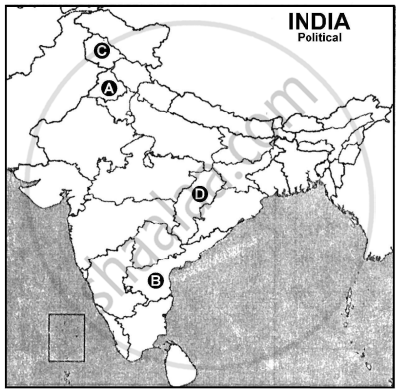
Chapter:
Study the given cartoon and answer the questions that follow:
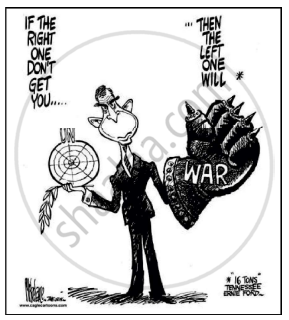
- What does the cartoon depict?
- Influence of UNO on the World
- Influence of USA on UNO
- Relevance of UNO
- Influence of USA on the World
- What message is given by the cartoon?
- If UN fails then the US can control the world by its military power.
- Economic superiority of US
- Veto power of permanent members of UN
- US is the largest contributor to UN
- Why this cartoon is not relevant today?
- UN has become more powerful.
- Many new powerful international organisations have emerged.
- Countries are not having faith in UN.
- Now many new centres of power have emerged.
- What is the primary objective of UNO?
- To foster economic ties of the developed nations.
- To promote international peace and co-operation.
- To eradicate terrorism.
- To promote health care.
Chapter:
Read the passage given below and answer the questions that follow:
| India adopted a democratic approach to the question of diversity. Democracy allows the political expressions of regional aspirations and does not look upon them as anti-national. Besides, democratic politics allows parties and groups to address the people on the basis of their regional identity, aspiration and specific regional problems. Thus, in the course of democratic politics, regional aspirations get strengthened. At the same time, democratic politics also means that regional issues and problems will receive adequate attention and accommodation in the policy making process. |
- Which period in India is seen as a period of grooming regional aspirations for autonomy?
- 1960s
- 1970s
- 1980s
- 1990s
- Which type of diversity is dominant in India?
- Social diversity
- Political diversity
- Cultural diversity
- Regional diversity
- How does democracy deal with the regional problems?
- Through regular negotiations
- Through strong steps
- Through elections
- Through economic measures
- Which one of the following joined Indian Union in 1975?
- Goa
- Sikkim
- Puducherry
- An lsland
Chapter:
Explain any three factors responsible for the European Union to be a highly influential regional organization.
Chapter:
Explain with suitable arguments that Japan is emerging as a new alternate centre of power.
Chapter:
Describe any three major developments that took place in Indian politics in the last decade of the 20th century.
Chapter:
Describe any three recommendations of the Mandal Commission to solve the problems of the other backward classes.
Chapter:
Describe the security challenges faced by the newly independent countries of Asia and Africa after the Second World War.
Chapter: [5] Security in Contemporary World
Explain any three differences between the Non-traditional and Traditional notion of security.
Chapter:
“The foreign policy of independent India has pursued the dream of a peaceful world.” Support the statement with any three suitable arguments.
Chapter:
“India played an important role in maintaining Afro-Asian Unity.” Support the statement with three suitable examples.
Chapter:
Other Solutions
Submit Question Paper
Help us maintain new question papers on Shaalaa.com, so we can continue to help studentsonly jpg, png and pdf files
CBSE previous year question papers Class 12 Political Science with solutions 2024 - 2025
Previous year Question paper for CBSE Class 12 Political Science-2025 is solved by experts. Solved question papers gives you the chance to check yourself after your mock test.
By referring the question paper Solutions for Political Science, you can scale your preparation level and work on your weak areas. It will also help the candidates in developing the time-management skills. Practice makes perfect, and there is no better way to practice than to attempt previous year question paper solutions of CBSE Class 12.
How CBSE Class 12 Question Paper solutions Help Students ?
• Question paper solutions for Political Science will helps students to prepare for exam.
• Question paper with answer will boost students confidence in exam time and also give you an idea About the important questions and topics to be prepared for the board exam.
• For finding solution of question papers no need to refer so multiple sources like textbook or guides.
