Advertisements
Advertisements
प्रश्न
Write two factors that affect the rate of reaction.
List the factors affecting the rate of reaction.
Explain briefly the various factors which affect the rate of a reaction.
On what factors does the rate of a reaction depend?
List any two factors that influence the rate of chemical reaction. Indicate whether the rate constant of the reaction is dependent on or independent of these factors.
Mention any two factors that influence the rate of a chemical reaction.
Mention the factors that affect the rate of a chemical reaction.
Advertisements
उत्तर
- Nature of reactants: The makeup of the reactants affects how quickly a chemical reaction proceeds. For instance, reactions involving polar and ionic chemicals proceed fairly quickly, while those involving covalent compounds proceed considerably more slowly. Because the electrostatic interactions in their molecules are readily disrupted in aqueous solutions, reactions involving polar or ionic compounds proceed relatively quickly. Old bonds are broken and new bonds are formed, or the bonds are rearranged, in a chemical reaction involving covalent reactants. As a result, the rate of a reaction involving the rearrangement of bonds is determined by how easily the particular bonds are made or broken. For example, nitric oxide oxidises to nitrogen peroxide far more quickly than carbon monoxide oxidises to carbon dioxide. The two responses seem to be comparable.
\[\ce{2NO_{(g)} + O2_{(g)} -> 2NO2_{(g)} (fast)}\]
\[\ce{2CO_{(g)} + O2 -> 2CO2_{(g)} (slow)}\]
Because of variations in the energies required for the reactants' bond rearrangement, these two reactions have different speeds. - Concentration of reactants: In general, a reaction's rate rises as the reactant concentration does. Molecular collisions are more likely to occur when a reactant's concentration rises. As a result, the reaction rate rises.
- Temperature: Reaction rates typically rise with temperature. For most homogeneous reactions, increasing the temperature by 10° doubles or triples the rate. Temperature significantly affects reaction rates.
- Surface area: Solid reactants have a higher rate of reaction as their surface area increases. Finely split solid reactants have a higher surface area than huge reactants and react faster. For instance, powdered coal burns faster than lump coal.
Increasing the surface area of a solid reactant improves the contact area between two reactants. This increases the pace of molecular interactions, leading to faster reactions. - Presence of a catalyst: A catalyst is a material that speeds up a reaction while maintaining its amount and chemical makeup.
A catalyst accelerates the rate of a reaction. This is because it offers a less energy-intensive alternate path. Lowering the energy barrier allows more molecules of reactants to cross it. As a result, the rate of reaction rises.
The rate constant depends on the nature of the reactants, temperature, and catalyst, and it is independent of concentration and surface area.
Notes
Students should refer to the answer according to their question.
APPEARS IN
संबंधित प्रश्न
For a reaction: 
Rate = k
(i) Write the order and molecularity of this reaction.
(ii) Write the unit of k.
For the first order thermal decomposition reaction, the following data were obtained:

Time / sec Totalpressure / atm
0 0.30
300 0.50
Calculate the rate constant
(Given: log 2 = 0.301, log3 = 0.4771, log 4 = 0.6021)
For a reaction A + B ⟶ P, the rate is given by
Rate = k [A] [B]2
How is the rate of reaction affected if the concentration of B is doubled?
The conversion of molecules X to Y follows second order kinetics. If concentration of X is increased to three times how will it affect the rate of formation of Y?
For the reaction:
\[\ce{2A + B → A2B}\]
the rate = k[A][B]2 with k = 2.0 × 10⁻⁶ mol−2 L2 s−1. Calculate the initial rate of the reaction when [A] = 0.1 mol L−1, [B] = 0.2 mol L−1. Calculate the rate of reaction after [A] is reduced to 0.06 mol L−1.
Match the graph given in Column I with the order of reaction given in Column II. More than one item in Column I may link to the same item of Column II.
| Column I | Column II | |
| (i) | 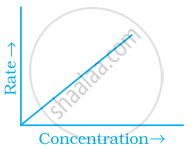 |
|
| (ii) | 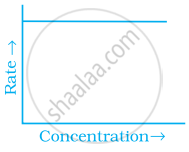 |
(a) 1st order |
| (iii) | 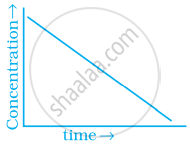 |
(b) Zero-order |
| (iv) | 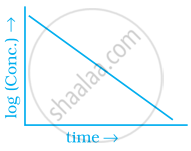 |
Assertion: The enthalpy of reaction remains constant in the presence of a catalyst.
Reason: A catalyst participating in the reaction, forms different activated complex and lowers down the activation energy but the difference in energy of reactant and product remains the same.
For the reaction, \[\ce{A +2B → AB2}\], the order w.r.t. reactant A is 2 and w.r.t. reactant B. What will be change in rate of reaction if the concentration of A is doubled and B is halved?
Read the following passage and answer the questions that follow:
|
The rate of reaction is concerned with decrease in the concentration of reactants or increase in the concentration of products per unit of time. It can be expressed as instantaneous rate at a particular instant of time and average rate over a large interval of time. A number of factors such as temperature, concentration of reactants, catalyst affect the rate of reaction. Mathematical representation of rate of a reaction is given by rate law: Rate = k[A]x [B]y x and y indicate how sensitive the rate is to change in concentration of A and B. Sum of x + y gives the overall order of a reaction. |
- What is the effect of temperature on the rate constant of a reason? [1]
- For a reaction \[\ce{A + B → Product}\], the rate law is given by, Rate = k[A]2 [B]1/2. What is the order of the reaction? [1]
- How order and molecularity are different for complex reactions? [1]
- A first-order reaction has a rate constant 2 × 10⁻³ s–1. How long will 6 g of this reactant take to reduce to 2 g? [2]
OR
The half-life for radioactive decay of 14C is 6930 years. An archaeological artifact containing wood had only 75% of the 14C found in a living tree. Find the age of the sample.
[log 4 = 0.6021, log 3 = 0.4771, log 2 = 0.3010, log 10 = 1] [2]
A flask contains a mixture of compounds A and B. Both compounds decompose by first-order kinetics. The half-lives for A and B are 300 s and 180 s, respectively. If the concentrations of A and B are equal initially, the time required for the concentration of A to be four times that of B (in s) is ______. (Use ln 2 = 0.693)
