Advertisements
Advertisements
प्रश्न
While going from top to bottom in a group the atomic radius ______.
पर्याय
increases
decreases
remains same
No change occurs
Advertisements
उत्तर
While going from top to bottom in a group the atomic radius increases.
Explanation:
When moving from top to bottom in a group, the atomic radius increases. This occurs because each subsequent element down the group has an additional electron shell, which increases the distance between the nucleus and the outermost electrons.
APPEARS IN
संबंधित प्रश्न
Arrange the following as per the instruction given in the brackets:
Na, K, Li (Increasing atomic size)
Answer the following in respect of element `31/15 P `
Give its formula with chlorine?
Arrange the elements of second and third periods in increasing order of their atomic size (excluding noble gases).
Write the name and symbol of the element from the description.
The atom having the smallest atomic mass.
Write the name and symbol of the element from the description.
The noble gas with the smallest atomic radius.
What happens to the atomic size of elements on moving from left to right in a period?
With reference to the variation of properties in the Periodic Table, which of the following is generally true?
Atomic size increases from left to right across a period.
Supply the missing word from those in the brackets:
If an element has seven electrons in its outermost shell then it is likely to have the ______ (largest/ smallest) atomic size among all the elements in the same period.
The electronic configuration of metal A is 2, 8, 18, 1.
The metal A when exposed to air and moisture forms B a green layered compound. A with con. H2 SO4 forms C and D along with water. D is a gaseous compound. Find A, B, C, and D.
Which of the following is the correct order of atomic size?
Which of the following is the correct order of size?
Which among the following elements has the largest atomic radii?
Elements have been arranged in the following sequence on the basis of their increasing atomic masses.
| F, | Na, | Mg, | Al, | Si, | P, | S, | Cl, | Ar, | K |
- Pick two sets of elements which have similar properties.
- The given sequence represents which law of classification of elements?
Atomic number of a few elements are given below
10, 20, 7, 14
- Identify the elements
- Identify the Group number of these elements in the Periodic Table
- Identify the Periods of these elements in the Periodic Table
- What would be the electronic configuration for each of these elements?
- Determine the valency of these elements
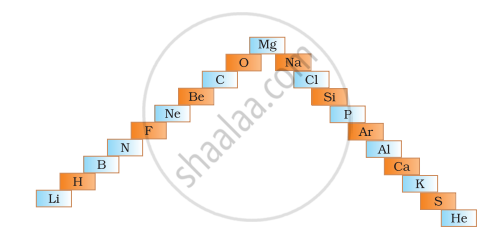
- In below ladder symbols of elements are jumbled up. Rearrange these symbols of elements in the increasing order of their atomic number in the Periodic Table.
- Arrange them in the order of their group also.
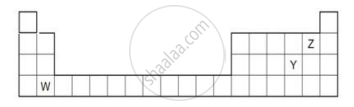
The diagram below shows part of the periodic table.
- Which elements would react together to form covalent compounds?
- Between the two elements W and Z, which will have a bigger atomic radius? Why?
Arrange the following as per instruction given in the bracket.
Mg, Cl, Na, S, Si (decreasing order of atomic size)
Which one of the following has the largest atomic radius?
