Advertisements
Advertisements
प्रश्न
Which of the following arrangements shows schematic alignment of magnetic moments of antiferromagnetic substances?
पर्याय



Advertisements
उत्तर

Explanation:
| Antiferro- magnetic |
This arises when net dipole is zero. This arises due to alignment of dipoles in equal and opposite direction. |
↑ ↓ ↑ ↓ ↑ ↓ Here dipoles |
MnO, MnO2, |
– |
APPEARS IN
संबंधित प्रश्न
Iron (z=26) is highly ferromagnetic. Explain.
Define the following term:
Ferromagnetism
Give reasons:Ferrimagnetic substances show better magnetism than antiferromagnetic substances.
The complexion [Ni(CN)4]2- is:
Pyrolusite ore is _______.
Out of [CoF6]3- and [Co(en)3]3+, which one complex is
(i) paramagnetic
(ii) more stable
(iii) inner orbital complex and
(iv) high spin complex
(Atomic no. of Co = 27)
The BH curve for a ferromagnetic material is shown in the figure. The material is placed inside a long solenoid which contains 1000 turns/cm. The current that should be passed in the solenonid to demagnetize the ferromagnet completely is
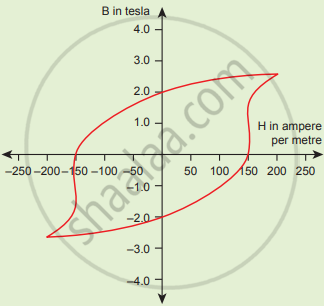
Compare the properties of soft and hard ferromagnetic materials.
Example of ferromagnetic substance is ____________.
When heated to high temperature, ferromagnetic substance changes to ____________.
Fe3O4 is ____________.
Which type of substances would make better permanent magnets?
The heat of combustion of a substance is:
The value of aluminium susceptibility is 2.2 × 10⁻⁵. The percentage increase in the magnetic field if space within a current carrying toroid is filled with aluminium is `"x"/10^4`. Then the value of x is ______.
Which one of the following compounds is diamagnetic and colourless?
Give a reason for the following:
Cu+2 salts are paramagnetic, while Cu+ salts are diamagnetic.
The calculated spin only magnetic moment of Cr2+ ion is ______.
