Advertisements
Advertisements
प्रश्न
Explain why:
(i) Transition elements form coloured compounds.
(ii) Interhalogen compounds are more reactive than their constituent elements.
(iii) Cu+ is diamagnetic but Cu2+ is paramagnetic. (Z = 29)
Advertisements
उत्तर
(i) Transition metal ions generally possess one or more unpaired electrons. By absorbing a requisite amount of energy from visible light, the unpaired electrons present in the lower energy d-orbital get promoted to high energy d-orbitals. This is called a d-d transition. The energy involved in the d-d transition is very small and such radiations are present within the visible region of light. Transition metal ions absorb such radiations from visible light and remaining wavelengths present in the visible region get transmitted and this imparts colour.
(ii) Interhalogen compounds are more reactive than their constituent elements because X-Y bonds present between two different halogens in them are weaker than X-X or Y-Y bonds.
(iii) Cu+ is diamagnetic because it has no impaired electrons in its core.

APPEARS IN
संबंधित प्रश्न
Write the type of magnetism observed when the magnetic moments are oppositely aligned and cancel out each other.
Explain the following with suitable examples:
Paramagnetism
Explain the following with suitable examples:
Ferrimagnetism
The BH curve for a ferromagnetic material is shown in the figure. The material is placed inside a long solenoid which contains 1000 turns/cm. The current that should be passed in the solenonid to demagnetize the ferromagnet completely is
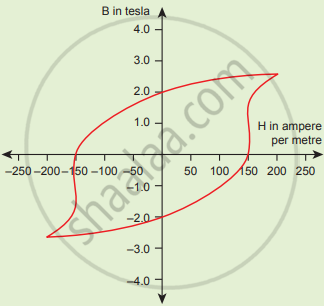
Substances that are strongly attracted by the applied magnetic field and can be permanently magnetized are ____________.
Assertion: On heating ferromagnetic or ferrimagnetic substances, they become paramagnetic.
Reason: The electrons change their spin on heating.
Which of the following arrangements shows schematic alignment of magnetic moments of antiferromagnetic substances?
Which one of the following pairs has only paramagnetic species?
Which of the following is not paramagnetic?
Which one of the following compounds is diamagnetic and colourless?
