Advertisements
Advertisements
प्रश्न
What was the quarrel about between the brother and his sister? How did they become friends again?
Advertisements
उत्तर
It is common for brothers and sisters to quarrel. Many a time they don’t know the point of dispute. But their quarrel does not last long. One day, the narrator quarrelled with her brother for no valid reason. Both stuck firmly to their claim of being right. They began to hate each other. But that very afternoon the brother took the initiative and admitted his mistake. Thus they patched up and forgot their bitterness.
संबंधित प्रश्न
Explain and analyse the use of hyperbole in the poem.
Discuss the art of Ruskin Bond as depicted in the story ‘A face in the Dark.’
What are the techniques used by Ruskin Bond to create an atmosphere of strangeness, mystery and super naturalism in the story? Can Ruskin Bond be called a visual writer? Why?
Join the following sentence to make one complete sentence without using and, but or so.
She was so excited about her performance. She could not sleep at night.
Re-write the following sentence according to the instructions are given. Make other changes that may be necessary, but do not change the meaning of the sentence.
The monsoon is the best season in our country.
(Rewrite using ‘good’)
What difference did you notice between the reaction of the adults and the children when faced with danger?
The phrase 'inter alia' meaning 'among other things' is one of the many Latin expressions commonly used in English.
Find out what these Latin phrases mean.
1.Prima face
2. ad hoc
3. in camera
4.ad infinitum
5.mutatis multanis
6.tabula rasa
Go through the text once again and note down Devu Handa’s fond memories of Kasbai in your exercise book. One is done for you.
Devu Handa has fond memories of Kasbai. They are as follows!
(a) It needs ______________ rain.
(b) _________________
(c) _________________
'Organic farming is the need of the time'. Write your views in favour of and against the statement.
| Views | Counterviews |
| 1. | |
| 2. | |
| 3. | |
| 4. |
Choose the correct alternative for the given line. Focus on the inference of the poet.
‘Dull would he be of soul who could pass by’
The line means - __________________.
There are ample career opportunities in film making and producing films.
The following professions which require different professional skills, and write them accordingly.
| Professions | Professional skills |
| 1. Actor-Male or Female | Acting, voice modulation, Body language, facial expressions, etc. |
| 2. Director | |
| 3. Producer | |
| 4. Music-director | |
| 5. Script-writer | |
| 6. Lyrist | |
| 7. Cameramen | |
| 8. Cinematographer | |
| 9. Set-designer | |
| 10. Costume-designer |
‘..... and that’s how I realized that courage and hope can help me overcome any major mishap/problem in life.’ Write an episode/experience from your own life that leads to the above conclusion.
Let's write a poem.
I have a kite but need a friend to fly it with,
I know a song but need someone to hear it,
I have a ball but need someone to catch it,
I ______
I ______
I ______
I ______
Here are some answers about the given picture.
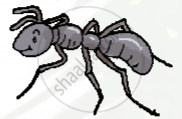
- The colour of the ant is black.
- It lives on land.
- It has two long antennae.
- It crawls on the ground.
- It eats sugar.
Now frame questions for the above answers.
Do you want to try to write your own paragraph now?
Write a paragraph on Cow.

- ______
- ______
- ______
- ______
- ______
What do you expect your close friends to do for you? Beautify the petals with your thoughts.

Complete the summary of the play, choosing the appropriate words from the list given below the passage.
A number of patients wait at the (1) ______of a dentist’s clinic. Everybody is tensed at the thought of a painful (2) ______being extracted. One of the women is bent on showing everyone her (3) ______. After the arrival of the dentist, Joe, the first (4) ______is called in. Sometime later, the nurse comes out and goes in with a (5) ______. Everyone is (6) ______at this, imagining Joe being subjected to a lot of hammering in the process of his tooth being pulled out. Once again the nurse comes out to fetch a large pair of (7) ______and later on she takes in a (8) ______. A little boy confesses that he pretended to have (9) ______, because he did not wish to go to school. The loud (10) ______and screeching from within the room makes everyone leave the (11) ______, one by one. Finally there are only two women in the waiting room, one of them being Joe’s wife. She weeps (12) ______about her husband. But Joe comes out and explains that he had shifted his (13) ______to the evening and had been given some pills for the pain. After they leave, the dentist comes out and locates the key of his tool (14) ______. He had been trying to open it using the hammer, the pliers and the hacksaw only in vain. The woman with the photographs is surprised to see that the (15) ______had moved quickly and she was the next patient to go in.
| hammer | patient |
| hacksaw | cabinet |
| frightened | queue |
| worried | waiting room |
| pliers | tooth |
| photographs | clinic |
| toothache | sawing |
| appointment |
Study the pie-chart carefully and answer the questions that follow.
Percentage of people who speak each language as their first language.

- Which language is spoken by most people?
- What are the Indian languages that rank among the top five spoken languages?
- Which are the languages that are spoken by less than three percent of people?
- With the help of the questions and answers, draw your own conclusions from the pie chart. Then, write a paragraph on the popular spoken languages.
Write conversation on the following situation.
Between two friends about the importance of reading newspapers
These two passages are examples of a short introduction to works of art - a short review. They cover the following points:
- The name of the creator
- The theme or subject matter
- Type of art
- Individual style
- Presentation techniques
- Its effect on viewers
- Message or interpretation
What points will you include if you had to review a book or film or a play? List the points.
