Advertisements
Advertisements
प्रश्न
What is the unit of electric current?
Advertisements
उत्तर
The SI unit of electric current is ampere and is denoted by the letter, A.
APPEARS IN
संबंधित प्रश्न
In the circuit diagram given below five resistances of 10 Ω, 40 Ω, 30 Ω, 20 Ω, and 60 Ω are connected as shown to a 12 V battery.
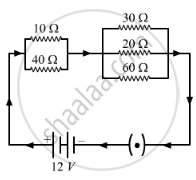
Calculate:
(a) total resistance in the circuit.
(b) total current flowing in the circuit.
In the circuit diagram given below, three resistors R1, R2, and R3 of 5 Ω, 10 Ω and 30 Ω, respectively are connected as shown
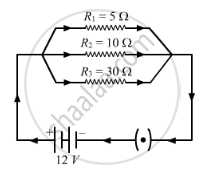
Calculate:
- current through each resistor.
- total current in the circuit.
- total resistance in the circuit.
What happens to the other bulbs in a parallel circuit if one bulb blows off?
Draw a circuit diagram to show how two 4 V electric lamps can be lit brightly from two 2 V cells.
Consider the circuit given below:
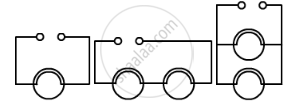
(a) In which circuit are the lamps dimmest?
(b) In which circuit or circuits are the lamps of equal brightness to the lamps in circuit (i)?
(c) Which circuit gives out the maximum light?
State two differences between the e.m.f. and terminal voltage of a cell.
A 720 W heater operates from a 220 V line voltage. Calculate:
(a) The electrical energy consumed by the heater in 3 h.
(b) The cost of electrical energy consumption at the rate of 60 paise per kWh.
A charge of 80 C flows in a conductor for 2 minutes.
(a) Calculate the current flowing through the conductor.
(b) If the current through a heater is 4 A what charge must be passing in 8 seconds?
An electric kettle has a heating element which is rated at 2 kW when connected to a 250 V electric supply. Calculate the
(a) Current which flows in the element when it is connected to a 250 V supply,
(b) Resistance of the filament,
(c) Heat produced in 1 minute by the element,
(d) Cost of running the kettle for 10 minutes a day for 30 days of the month, at the rate of Rs. 3.00 per unit.
Tick (✓) the correct choice among the following :
Which of the following changes would enable a millimeter to be used as a
direct current ammeter reading upto 1 A?
Three heaters each rated 250 W, 100 V are connected in parallel to a 100 V supply. Calculate :
The total current taken from the supply
Three heaters each rated 250 W, 100 V are connected in parallel to a 100 V supply. The resistance of each heater
The SI unit for electric current is the coulomb.
Problems for practice:
If 5A current flows through a circuit, then convert the current in terms of microampere?
What is the rate at which charges flow past a point on a circuit?
Common sources of Alternating Current (AC) are:
Electric current flows through a circuit only when:
