Advertisements
Advertisements
प्रश्न
What is meant by the 'angle of incidence' and the 'angle of refraction' for a ray of light?
Advertisements
उत्तर
Angle of incidence:
The angle between the incident ray and the normal is called angle of incidence.
Angle of refraction:
The angle between the refracted ray and the normal is called angle of refraction.
APPEARS IN
संबंधित प्रश्न
| Column I | Column II | Column III | |
| 1 | Dispersion | Long-sightedness | Twinkling of stars |
| 2 | Refraction | Splitting of white light into component colours | Convex lens |
| 3 | Hypermetropia | Change in the direction of the ray of light due to change in medium | Spectrum of seven colours |
A wall reflects light and a mirror also reflects light. What difference is three in the way they reflect light?
The image formed by a plane mirror is :
(a) virtual, behind the mirror and enlarged.
(b) virtual, behind the mirror and of the same size as the object.
(c) real, at the surface of the mirror and enlarged.
(d) real, behind the mirror and of the same size as the object.
The figure given alongside shows the image of a clock as seen a plane mirror. The correct time is:
Figure
(a) 2.25
(b) 2.35
(c) 6.45
(d) 9.25
A man sits in an optician's chair looking into plane mirror which is 2 m away from him and views the image of a chart which faces the mirror and is 50 cm behind his head. How far away from his eyes does the chart appear to be?
A ray of light strikes a plane mirror PQ at an angle of incidence of 30°, is reflected from the plane mirror and then strikes a second plane mirror QR placed at right angles to the first mirror. The angle of reflection at the second mirror is ______.
When a light ray passes from air into glass, what happens to its speed? Draw a diagram to show which way the ray of light bends.
With the help of a diagram, show how when light falls obliquely on the side of a rectangular glass slab, the emergent ray is parallel to the incident ray.
Light travelling from a denser medium to a rarer medium along a normal to the boundary:
(a) is refracted towards the normal
(b) is refracted away from the normal
(c) goes along the boundary
(d) is not refracted
When a ray of light travels from water to air, it bends ............. the normal.
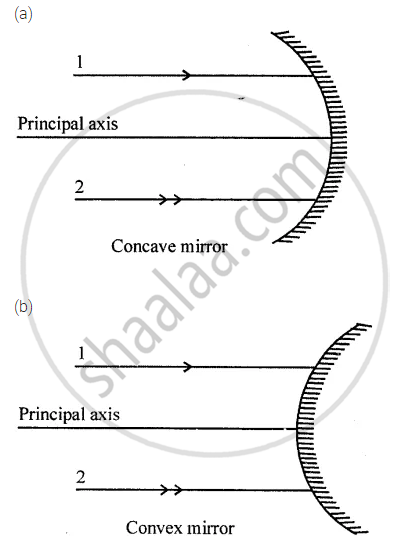
The diagram (figure) given below shows two parallel rays 1 and 2 incident on (a) a concave mirror, (b) a convex mirror. Draw the reflected rays and mark the focus by the symbol F.
What is the cause of refraction of light when it passes from one medium to another?
Fill in the blank and Explain the completed sentences.
The change in ______ of light rays while going from one medium to another is called refraction.
Light enters from air to glass having refractive index 1.50. What is the speed of light in the glass? The speed of light in vacuum is 3 × 10⁸ m s−1.
Explain how the formation of a rainbow occurs.
Numerical problems.
The speed of light in water is 2.25 × 10⁸ ms–1. If the speed of light in vacuum is 3 × 10⁸ ms–1, calculate the refractive index of water.
What is refractive index?
How do twinkling stars occur? (or) what is the cause of the twinkling of stars?
Match the following:
| Column I | Column II | ||
| 1. | r > 90 | a. | Light gazes at the surface of separation between the two modes. |
| 2. | r = 90 | b. | No refraction. |
| 3. | r < 90 | c. | Refracted ray away from the normal |
