Advertisements
Advertisements
प्रश्न
What happens to the rate constant k and activation energy Ea as the temperature of a chemical reaction is increased? Justify.
Advertisements
उत्तर
As the temperature of a chemical reaction rises, the rate constant k rises and the activation energy Ea falls.
According to Arrhenius equation
k = `"Ae"^(-"E"_"a"//"RT")`
As a result, the rate constant k rises exponentially as the temperature rises.
APPEARS IN
संबंधित प्रश्न
Calculate activation energy for a reaction of which rate constant becomes four times when temperature changes from 30 °C to 50 °C. (Given R = 8.314 JK−1 mol−1).
A first-order reaction is 50% completed in 40 minutes at 300 K and in 20 minutes at 320 K. Calculate the activation energy of the reaction. (Given : log 2 = 0·3010, log 4 = 0·6021, R = 8·314 JK–1 mol–1)
Predict the main product of the following reactions: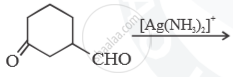
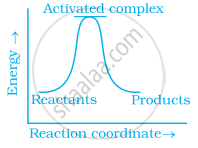
Which of the following graphs represents exothermic reaction?
(a)

(b)
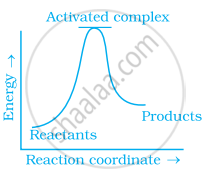
(c)
The reaction between \[\ce{H2(g)}\] and \[\ce{O2(g)}\] is highly feasible yet allowing the gases to stand at room temperature in the same vessel does not lead to the formation of water. Explain.
Thermodynamic feasibility of the reaction alone cannot decide the rate of the reaction. Explain with the help of one example.
What happens to most probable kinetic energy and the energy of activation with increase in temperature?
Total number of vibrational degrees of freedom present in CO2 molecule is
For an endothermic reaction energy of activation is Ea and enthalpy of reaction ΔH (both of there in KJ moI–1) minimum value of Ea will be ______.
The rate of a reaction quadruples when temperature changes from 27°C to 57°C calculate the energy of activation.
(Given: R = 8. 314 J K−1 mol−1, log 4 = 0.6021)
