Advertisements
Advertisements
प्रश्न
What does the speaker usually do while lying in the bed?
Advertisements
उत्तर
The speaker generally contemplated the idea of going inside the shed.
संबंधित प्रश्न
Answer of these question in a short paragraph (about 30 words).
How does he describe the old kind of teachers?
This story about a frightening incident is narrated in a humorous way. What makes it
humorous? (Think of the contrasts it presents between dreams and reality. Some of them
are listed below.)
1. (i) The kind of person the doctor is (money, possessions)
(ii) The kind of person he wants to be (appearance, ambition)
2.(i) The person he wants to marry
(ii) The person he actually marries
3.(i) His thoughts when he looks into the mirror
(ii) His thoughts when the snake is coiled around his arm
Write short paragraphs on each of these to get your answer.
Answer the following question in 30 to 40 words.
Was Bruno a loving and playful pet? Why, then, did he have to be sent away?
Thinking about Poem
What is the meaning of “bleeding bark”? What makes it bleed?
From the day, perhaps a hundred years ago when he sun had hatched him in a sandbank, and he had broken his shell, and got his head out and looked around, ready to snap at anything, before he was even fully hatched-from that day, when he had at once made for the water, ready to fend for himself immediately, he had lived by his brainless craft and ferocity. Escaping the birds of prey and the great carnivorous fishes that eat baby crocodiles, he has prospered, catching all the food he needed, and storing it till putrid in holes in the bank. Tepid water to live in and plenty of rotted food grew him to his great length. Now nothing could pierce the inch-?thick armoured hide. Not even rifle bullets,
which would bounce off. Only the eyes and the soft underarms offered a place. He lived well in the river, sunning himself sometimes with other crocodiles-muggers, as well as the long-? snouted fish-?eating gharials-on warm rocks and sandbanks where the sun dried the clay on them quite white, and where they could plop off into the water in a moment if alarmed. The big crocodile fed mostly on fish, but also on deer and monkeys come to drink, perhaps a duck or two.
Read the extract given below and answer the question that follow.
How did he survive as a baby crocodile from the day he was hatched.
Then, trying to hide my nervousness, I added, “How are you?”
“I’m fine. The question is: How are you?“
“What do you mean?” 1 asked “Something must be eating you,” he said—proud the way foreigners are when they’ve mastered a bit of American slang. “You should be able to qualify with your eyes closed.”
“Believe me, I know it,” I told him—and it felt good to say that to someone.
For the next few minutes we talked together. I didn’t tell Long what was “eating” me, but he seemed to understand my anger, and he took pains to reassure me. Although he’d been schooled in the Nazi youth movement, he didn’t believe in the Aryan-supremacy business any more than I did. We laughed over the fact that he really looked the part, though. An inch taller than I, he had a lean, muscular frame, clear blue eyes, blond hair and a strikingly handsome, chiseled face. Finally, seeing that I had calmed down somewhat, he pointed to the take-off board.
“Look,” he said. “Why don’t you draw a line a few inches in back of the board and aim at making your take-off from there? You’ll be sure not to foul, and you certainly ought to jump far enough to qualify. What does it matter if you’re not first in the trials? Tomorrow is what counts.”
Read the extract given below and answer the question that follow.
Did Owens tell Long what was eating him? If not, why?
Read the extract given below and answer the questions that follow:
Lady Adela: Oh! Charlie, he did look so exactly as if he’d sold me a carpet when I was paying him.
Winsor: [changing into slippers] His father did sell carpets, wholesale, in the City.
Lady Adela: Really? And you say I haven’t intuition! [With a finger on her lips] Morison’s in there.
Winsor: [Motioning towards the door, which she shuts] Ronny Dancy took a tenner off him, anyway, before dinner.
(i) How did Dancy take a ‘tenner’ from De Levis?
How does De Levis later connect this trick with the theft?
(ii) Why, according to Lady Adela, did Dancy leave the army? Why does she call him reckless?
(iii) Where had De Levis kept the money which was stolen? Where had he gone after keeping the money? How much did he lose?
(iv) Why is Winsor outraged when De Levis says he had locked his door? What was the height of the room from the ground? How do they know that the thief did not use a ladder to climb up to De Levis’ room?
(v) How does General Canynge react when De Levis first accuses Dancy of committing the theft? What is your opinion of De Levis?
Give one reason to justify your answer.
Read the extract given below and answer the questions that follow :
An angry athlete is an athlete who will make mistakes, as any coach will tell you I was no exception. On the first of my three qualifying jumps, I leaped from several inches beyond the · take-off board for a foul.
(i) When and where is this story set? What reason does the narrator Jesse Owens give for the heightened nationalistic feelings at this time?
(ii) In which event had Owens been confident of winning a gold medal? Why?
(iii) What had, made Owens angry enough to make mistakes?
(iv) Name Owens' rival who approached him at this point. What advice did this athlete give Owens?
(v) How did the two athletes perform in the finals? What does Jesse Owens consider his 'Greatest Olympic Prize'? Why?
Comment on the aptness of the title of the story, ‘A Pact with the Sun’. What message or idea does the story bring home to you?
Describe the tone in which the narrator’s father dismissed his wife’s warnings every single time.
Write two pairs of rhyming words from the poem.
Which word in the extract means, ‘holes’?
Use the clues given below to complete this crossword puzzle.
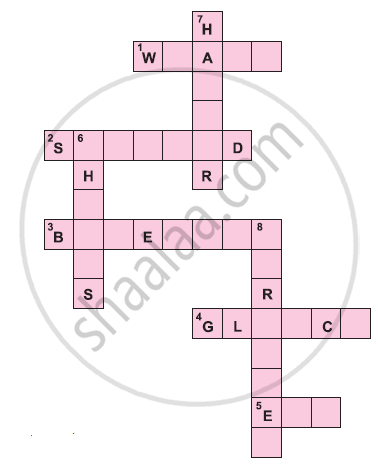
Across
1. very tired
2. had an angry look on the face
3. short trousers
4. a fault in a machine that prevents it from working properly
5. a small and naughty boy-fairy
Down
6. work that must be done every day, often boring
7. a basket with a lid
8. gave a short, high-pitched cry
Why did the dog prefer a strong master to live in the jungle?
Teasing is the poet’s way of ______ with the squirrel.
What does a rebel do when nobody talks during the class?
What was announced on the loudspeakers before the start of the race in the poem, ‘Nine Gold Medals’?
How does Prospero ask to be to be released from his “bands” in the Epilogue of the play, The Tempest?
When Antony says, ‘This is a slight unmeritable man/Meet to be sent on errands’, he refers to ______.
