Advertisements
Advertisements
प्रश्न
What does PCR stand for? Describe the different steps of PCR
Advertisements
उत्तर
PCR stands for Polymerase Chain Reaction:
Basic requirements for PCR technique are :
1) A DNA segment (100-35, 000 bp in length) be amplified.
2) Primers (forward and reverse) which are synthetic oligonucleotides of 17-30 nucleotide. They
are complementary to the sequence present on the desired DNA segment.
3) Four types of deoxyribonucleotides (dATP, dCTP, dGTP, dTTP). They are collectively called
dNTPs
4)A thermostable DNA polymerase, that can withstand up to 94°C. Usually, Taq polymerase isolated from bacterium Thermus aquaticus is used.

The three essential steps for PCR technique are :
1) Heat denaturation: This step involves heating of DNA at about 91°C. The heating breaks the hydrogen bonds to make ssDNA. The DNA molecule with more G-C pairs needs the higher
temperature.
2)Annealing: It is pairing of primers to the ssDNA segment. The primer has to be designed as per the requirement. this step requires temperature at about 55°C.
3) Polymerisation: The temperature is raised to 72°C. The Taq polymerase adds dNTPs behind
the primer on the ssDNA
These three steps constitute one cycle of the reaction. The process is carried out for about 28-30 cycles beyond which its reliability decreases.
APPEARS IN
संबंधित प्रश्न
Give one significant difference between:
Electroporation and Gene Gun.
Vectors are ____________ molecules that carry a foreign gene and replicate inside the host cell.
Which of the following device is required for PCR?
Which of the following DNA sequence is recognised and cut by EcoR I?
____________ cuts the DNA within the specific positions.
Which of the following is not required in the preparation of a recombinant DNA molecule?
Observe the given sequence of nitrogenous bases on a DNA fragments and answer the following questions:
5' - CAGAATTCTTA - 3'
3' - GTCTTAAGAAT - 5'
- Name a restriction enzyme which can recognise this DNA sequence.
- Write the sequence after digestion.
- Why are the ends generated after digestion called sticky ends?
Name two restriction enzymes used in PCR.
What are the different types of electrophoresis?
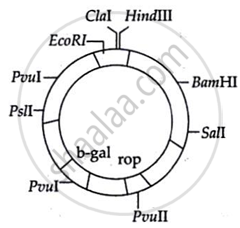
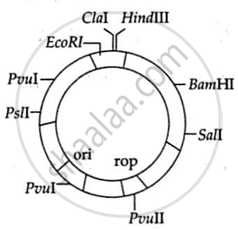
Suneeta is planning an experiment to clone a gene in a vector. So, she has to choose a good cloning vector.
Which one of the vectors shown below should she choose? Justify your answer by giving two reasons.
 |
 |
 |
| Vector A | Vector B | Vector C |
